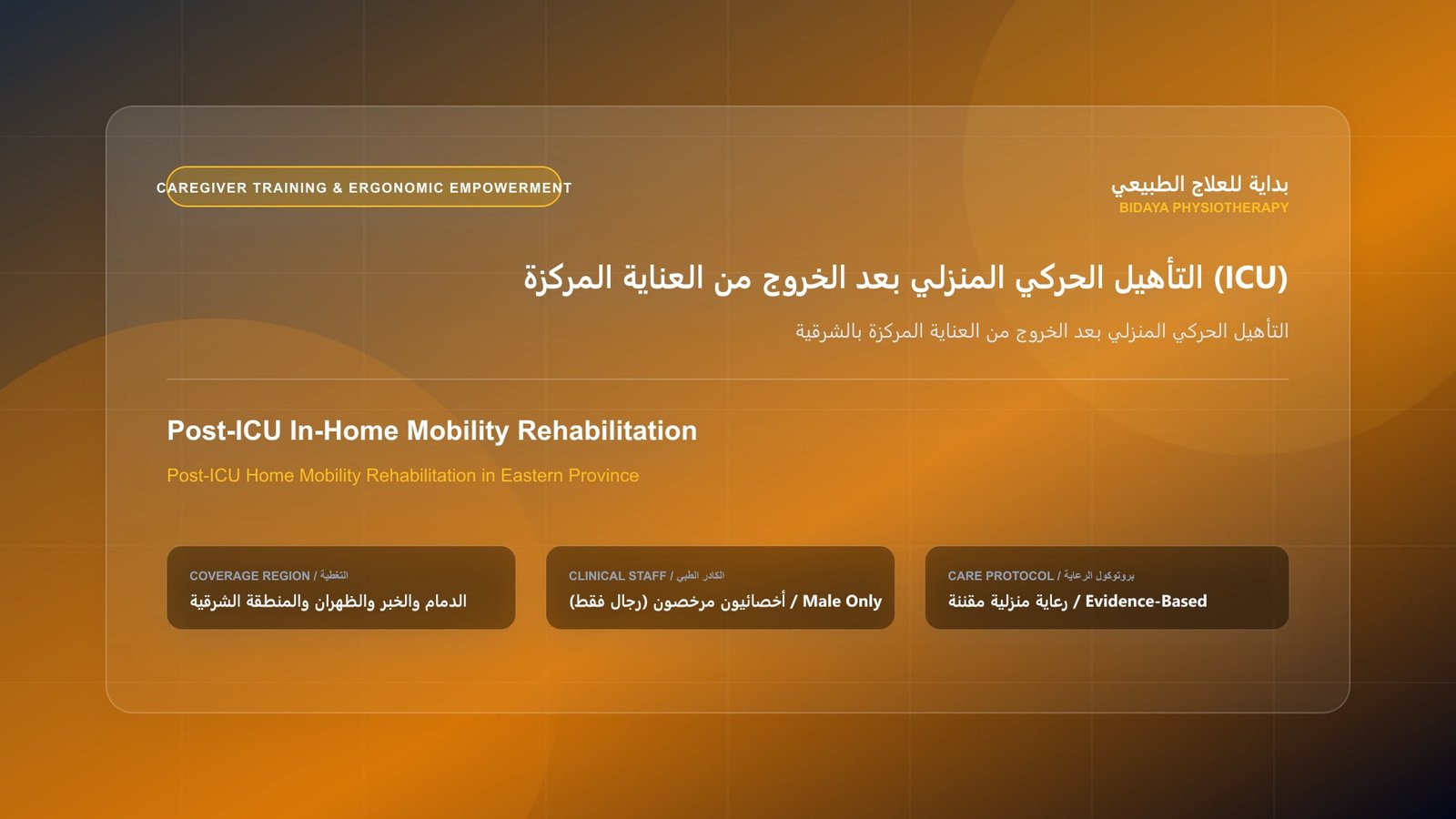
Post-ICU In-Home Mobility Rehabilitation in Dammam & Khobar
Precision pulmonary and physical conditioning reversing ICU-acquired weakness and restoring functional autonomy
Comprehensive In-Home Clinical Evaluation (60-75 Mins)
Detailed functional & neuro examination, home safety audit, and custom protocol with portable equipment — no upfront package commitments.
Flexible appointments 7 days a week (8 AM - 10 PM) • Payment upon visit completion
1,500+ Successful Home Recoveries
Certified Clinical Physiotherapists
Assessment-First Protocol
Thorough physical evaluation before any treatment plan starts
Specialized Male Therapists
Professional licensed therapists visiting your residence
100% In-Home Rehabilitation
No clinic travel friction or waiting room discomfort
Targeted Functional Goals
Focused on daily stairs, walking endurance, and independence
Emergency Medical Red-Flags & Home Care Boundaries
Urgent Medical Notice: In acute emergencies such as sudden chest pain, severe shortness of breath, or loss of consciousness, immediately call the Saudi Red Crescent (997) or the Unified Emergency Number (911). In-home physiotherapy is strictly for medically stable patients.
Driven by clinical excellence across the Eastern Province, Bidaya Physiotherapy provides specialized domiciliary programs for Post-ICU Home Mobility Rehabilitation in Eastern Province serving patients in Dammam, Khobar & Dhahran, directed exclusively by licensed male physical therapists accredited by SCFHS. Our focus centers on restoring muscular strength, optimizing neuromuscular balance, and implementing evidence-guided rehabilitation pathways. Visiting clinicians monitor systemic vitals, educate caregivers on ergonomic support, and formulate graduated exercise protocols that rebuild motor confidence and preserve long-term functional well-being in the comfort of home.
Reversing ICU-Acquired Weakness (ICU-AW) & Post-Intensive Care Syndrome
Physiological Mobilization Pacing and Orthostatic Recalibration
Prolonged critical care admission and mechanical ventilation frequently culminate in ICU-Acquired Weakness (ICU-AW) and Post-Intensive Care Syndrome (PICS), marked by profound myofibrillar catabolism and autonomic vascular dysfunction.
Our visiting male physical therapist initiates a cardiopulmonary-guided rehabilitation protocol. Continuous telemetry monitoring (SpO2, pulse, blood pressure) ensures exertion stays safely within physiological reserve margins. Initial interventions focus on bed-level passive-active kinematics, progressing incrementally to edge-of-bed upright tolerance to retrain baroreceptor reflexes and abolish orthostatic syncope.
Subsequently, standing tolerance is systematically restored utilizing transfer belts, re-engaging antigravity extensor synergies across the pelvic girdle and quadriceps.
PICS Mitigation Window
Structured domiciliary physical mobilization within 72 hours of ICU discharge cuts secondary hospital readmissions by over 40%.
- Maintain continuous pulse oximetry and pulse telemetry throughout all physical exertion
- Progress posture systematically: supine to 45°, 90°, and edge sitting before standing
- Integrate diaphragmatic re-expansion drills to enhance alveolar recruitment and clear secretions
- Structure generous rest intervals between sets to respect compromised metabolic reserves
Cardiopulmonary Reconditioning & Domestic Ambulation Progression
Weaning Supplemental Oxygen Reliance Through Ventilatory Pacing
Restoring muscular strength must proceed in lockstep with diaphragmatic and intercostal reconditioning. Patients are coached in pursed-lip breathing and ventilatory-motor pacing to eliminate exertional desaturation.
The structured protocol charts progression from bed-bound deconditioning to confident indoor walker ambulation across residential hallways:
| Rehabilitation Stage | Primary Clinical Target | Physiological Metric | Prescribed Interventions |
|---|---|---|---|
| Stage 1: Bedside Conditioning | Joint mobility & lung re-expansion | SpO2 maintained > 92% | Active-assistive ROM, diaphragmatic drills |
| Stage 2: Seated Tolerance | Trunk postural equilibrium & transfers | Hemodynamic stability without drop | Edge sitting, seated core stabilization |
| Stage 3: Supported Stance | Antigravity weight-bearing activation | Sustained standing for 3-5 min | Walker-supported standing, partial squats |
| Stage 4: Corridor Ambulation | Short-distance domestic walking | 30-meter walk with minimal rests | Assisted corridor walking, single step drill |
Biomechanical Principles of Safe Patient Handling in Post-ICU Home Mobility Rehabilitation in Eastern Province
Preserving Caregiver Spinal Integrity and Mitigating Lumbar Shear Forces
In delivering evidence-based clinical rehabilitation for Post-ICU Home Mobility Rehabilitation in Eastern Province across Dammam, Khobar & Dhahran, Clinical data reveals that over 60% of domestic caregivers suffer from lumbar spine injuries caused by biomechanically flawed lifting. Our program instills the "compact biological lever" principle: hinging through hips and knees, engaging gluteal power, and deploying gait belts to reduce L4-S1 compression by over 70%.
Our licensed male physical therapist performs a thorough clinical evaluation focusing on Ergonomic management principles for transferring bariatric domestic patients, tailoring movement protocols directly to individual needs in Dammam, Khobar & Dhahran.
Clinical Care Principle
Continuous clinical monitoring and biomechanical safety adherence for Post-ICU Home Mobility Rehabilitation in Eastern Province ensure maximal functional recovery.
- Conduct a thorough baseline mobility screening prior to beginning Post-ICU Home Mobility Rehabilitation in Eastern Province drills
- Document comprehensive medical history and review physician recommendations in Dammam, Khobar & Dhahran
- Establish measurable, realistic functional recovery targets with the physical therapist
- Audit resting vital signs to confirm physiological stability prior to active exercise
Caregiver Competency Matrix & Clinical Mastery in Post-ICU Home Mobility Rehabilitation in Eastern Province
Structured Competency Framework Transitioning Families to Safe Mastery
In delivering evidence-based clinical rehabilitation for Post-ICU Home Mobility Rehabilitation in Eastern Province across Dammam, Khobar & Dhahran, We empower family members through four structured competency tiers: supine repositioning via segmental log-rolling, edge-of-bed sitting transitions, wheelchair pivot transfers with brake engagement, and dynamic trailing ambulation guarding across domestic hallways and multi-tier stairwells.
Our clinician utilizes a phased training matrix centered around Establishing perfect clinical harmony between therapist guidelines and daily habits, facilitating clear weekly benchmarking of mobility gains across Dammam, Khobar & Dhahran.
| Competency Stage | Target Domestic Skill | Clinical Mastery Standard | Functional Impact on Patient |
|---|---|---|---|
| Level 1: Supine Repositioning | Segmental log-rolling & elevation for Post-ICU Home Mobility Rehabilitation in Eastern Province | Maintaining straight spinal axis as a rigid unit | Complete prevention of pressure ulcers & wound dehiscence |
| Level 2: Edge-of-Bed Sitting | Synchronized leg drop and trunk pivot | Stable seated pelvis without forward slipping | Cardiovascular priming and postural hypotension prevention |
| Level 3: Wheelchair Transfer | Gait belt pivot with knee bracing | Locked wheel brakes and non-shearing swing | Smooth, zero-fall transition to mobile seating |
| Level 4: Ambulation Guarding | Dynamic trailing guard on weak side | Immediate balanced deceleration during trips | Safe, confident walking throughout the residence |
In-Bed Mobilization Protocol & Ulcer Prophylaxis in Post-ICU Home Mobility Rehabilitation in Eastern Province
Segmental Log-Rolling, Passive Motion, and Pressure Injury Prevention
In delivering evidence-based clinical rehabilitation for Post-ICU Home Mobility Rehabilitation in Eastern Province across Dammam, Khobar & Dhahran, Bedbound patients require dedicated prophylactic motion to prevent progressive contractures. Our therapist instructs caregivers in gentle passive ROM for ankles, knees, and wrists (10 repetitions twice daily), alongside contoured foam positioning to facilitate venous return and eliminate pressure injury risks.
Our clinical team reinforces safe motor practice through Prescribing caregiver stretching routines shielding cervical and lumbar musculature, fostering self-efficacy and functional independence within home environments in Dammam, Khobar & Dhahran.
Daily Adherence
Daily consistency with prescribed gentle drills for Post-ICU Home Mobility Rehabilitation in Eastern Province reinforces tissue adaptation and preserves joint compliance.
- Adhere consistently to prescribed daily movement repetitions for Post-ICU Home Mobility Rehabilitation in Eastern Province without over-exertion
- Maintain continuous diaphragmatic breathing and avoid breath-holding during Prescribing caregiver stretching routines shielding cervical and lumbar musculature
- Take adequate structured rest intervals between movement sets to prevent cumulative muscle fatigue
- Record functional observations or movement resistance to review with the therapist during next visit
Domestic Architectural Ergonomics for Safe Care in Post-ICU Home Mobility Rehabilitation in Eastern Province
Optimizing Bed Heights, Seating Profiles, and Corridor Access
In delivering evidence-based clinical rehabilitation for Post-ICU Home Mobility Rehabilitation in Eastern Province across Dammam, Khobar & Dhahran, Expansive villa architecture presents unique challenges; our clinician guides families in reconfiguring bedrooms so transport chairs remain directly accessible, eliminating raised doorway thresholds, and installing modular 1:12 exterior ramps for effortless garden and appointment access.
Our therapist delivers actionable architectural recommendations focusing on Adapting domestic living spaces with anchored biomechanical support aids, establishing robust physical safety throughout residences in Dammam, Khobar & Dhahran.
Domestic Spatial Optimization
Optimizing domestic walking corridors and elevating seating across Dammam, Khobar & Dhahran residences eliminates mechanical joint shear.
- Remove loose scatter rugs and maintain clutter-free walkways across Dammam, Khobar & Dhahran residences
- Ensure bright, glare-free lighting across corridors and transition zones to bathrooms
- Verify mechanical stability of grab rails and optimal seating elevation tailored for Post-ICU Home Mobility Rehabilitation in Eastern Province
- Designate a secure bedside drill zone allowing unhindered mobility for patient and clinician
Caregiver Red Flags & Emergency Medical Triage in Post-ICU Home Mobility Rehabilitation in Eastern Province
Acute Clinical Decline Mandating Immediate 997 Emergency Dispatch
In delivering evidence-based clinical rehabilitation for Post-ICU Home Mobility Rehabilitation in Eastern Province across Dammam, Khobar & Dhahran, Caregivers are trained in acute clinical vigilance; activity must stop and emergency services summoned (Saudi Red Crescent 997 or Unified 911) upon detecting unilateral calf warmth and swelling (suspected DVT), abrupt dyspnea, profound lethargy, or peripheral cyanosis. Never massage a suspected thrombotic calf.
Domestic care incorporates thorough caregiver education regarding vital sign monitoring and clinical vigilance against First-response stabilization and dialing 997/911 upon cardiopulmonary arrest, adhering strictly to 997 triage.
Emergency Safety Directive
At the earliest indication of acute cardiovascular or respiratory compromise, halt exercise and dial 997 or 911.
- Monitor pulse rate and oxygen saturation levels during intensive Post-ICU Home Mobility Rehabilitation in Eastern Province sessions
- Halt exercise immediately and sit securely upon acute dizziness, dyspnea, or chest tightness
- Contact emergency services without hesitation via Saudi Red Crescent (997) or Unified 911
- Position the individual comfortably in recumbency avoiding oral fluids during syncopal episodes
Scheduling In-Home Caregiver Ergonomic Coaching in Post-ICU Home Mobility Rehabilitation in Eastern Province
Certified Male Physical Therapists Instructing Families at Home
In delivering evidence-based clinical rehabilitation for Post-ICU Home Mobility Rehabilitation in Eastern Province across Dammam, Khobar & Dhahran, If your family cares for a recovering patient and seeks expert in-home coaching in ergonomic transfer mechanics, Bidaya is here to support you. All visits are conducted exclusively by licensed male physical therapists certified by SCFHS. Contact our coordination desk to arrange training.
We provide discreet, professional in-home rehabilitation delivered exclusively by licensed male clinicians monitoring Comprehensive in-home clinical instruction conducted by licensed male clinicians to secure enduring recovery across Dammam, Khobar & Dhahran.
Direct Clinical Intake
Our clinical intake team is ready to review medical records and arrange scheduled in-home visits for Post-ICU Home Mobility Rehabilitation in Eastern Province.
- Connect directly with Bidaya medical coordination to schedule in-home visits in Dammam, Khobar & Dhahran
- Prepare recent clinical reports and current medication lists for the visiting physical therapist
- Leverage ongoing functional auditing and weekly program progression for Post-ICU Home Mobility Rehabilitation in Eastern Province
- Clarify all aspects of the rehabilitative trajectory ensuring seamless alignment with family routines
Frequently Asked Questions about In-Home Physiotherapy
Therapy typically commences within 48 to 72 hours of arriving home, following verification of hemodynamic stability and clearance from critical care physicians.
Related Clinical & Regional Pathways
Post-Cardiac Surgery Sternal-Safe Home Physiotherapy in Eastern Province Rehabilitation Protocol→
Precision cardiopulmonary rehabilitation protecting sternal bone healing and progressively restoring daily stamina
Managing Freezing of Gait in Parkinson's at Home: Caregiver Guide Eastern Province Rehabilitation Protocol→
External visual, auditory, and cognitive cueing mechanisms overcoming episodic motor blocks and preventing dom...
Post-Spine Surgery Home Safety & Log-Rolling Technique in Eastern Province Rehabilitation Protocol→
Rigorous biomechanical protocol protecting spinal hardware fixation and preventing axial twist during domestic mobility
Geriatric Physiotherapy & Fall Prevention Rehabilitation Protocol→
Evidence-based clinical rehabilitation tailored specifically to preserve functional independence
Post-Operative Physiotherapy Rehabilitation Protocol→
Evidence-based surgical rehabilitation protocols engineered to restore joint range of motion
Neurological Physiotherapy Rehabilitation Protocol→
Evidence-based neurological physical therapy harnessing neuroplasticity
Musculoskeletal Physiotherapy Rehabilitation Protocol→
Evidence-based clinical rehabilitation for spinal disorders
Post-Stroke First 30 Days In-Home Recovery Guide in Eastern Province Rehabilitation Protocol→
Maximizing the golden neuroplasticity window to retrain hemiparetic limbs and restore domestic mobility