Advanced In-Home Post-Operative Physiotherapy & Rehabilitation
Evidence-based surgical rehabilitation protocols engineered to restore joint range of motion, prevent adhesions, rebuild muscular strength, and eliminate complications following orthopedic and spinal surgery within your Eastern Province home.
Comprehensive In-Home Clinical Evaluation (60-75 Mins)
Detailed functional & neuro examination, home safety audit, and custom protocol with portable equipment — no upfront package commitments.
Flexible appointments 7 days a week (8 AM - 10 PM) • Payment upon visit completion
1,500+ Successful Home Recoveries
Certified Clinical Physiotherapists
Assessment-First Protocol
Thorough physical evaluation before any treatment plan starts
Specialized Male Therapists
Professional licensed therapists visiting your residence
100% In-Home Rehabilitation
No clinic travel friction or waiting room discomfort
Targeted Functional Goals
Focused on daily stairs, walking endurance, and independence
Emergency Medical Red-Flags & Home Care Boundaries
Emergency Notice: If you experience sudden calf swelling, chest pain, acute shortness of breath, or purulent wound drainage, immediately dial 997 for emergency assistance.
The immediate period following major orthopedic, joint replacement, or spinal surgery represents a critical, time-sensitive window that largely dictates long-term functional recovery. Regardless of surgical precision inside the operating theater, international orthopedic literature demonstrates that over 70% of long-term joint function, ambulatory stability, and patient independence depend directly on the timing, rigor, and compliance of post-operative physical rehabilitation. During the first twelve weeks following hospital discharge, patients navigate acute physiological hurdles: managing severe post-surgical inflammation, mitigating massive intra-articular effusion, combating arthrogenic quadriceps muscle inhibition, and breaking down fibrotic scar adhesions before permanent joint contractures solidify.
At Bidaya In-Home Physiotherapy & Medical Rehabilitation, we deliver a hospital-grade surgical recovery pathway directly to the patient's bedside across Dammam, Al Khobar, Dhahran, and Qatif. We understand that transporting a freshly discharged surgical patient to outpatient clinics exposes them to significant physical agony, dangerous joint shear forces during vehicle transfers, and jarring road vibrations across Eastern Province highways that exacerbate swelling and pain.
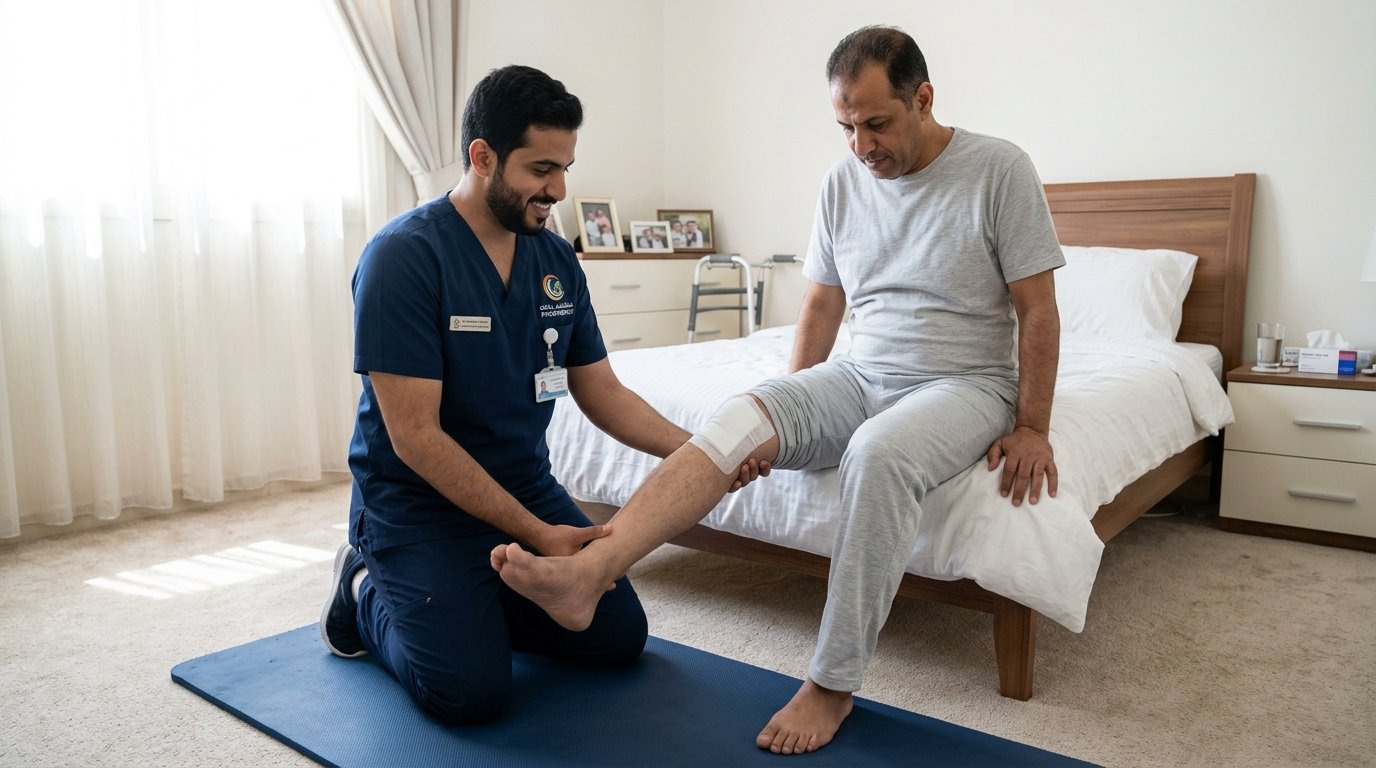
Our licensed physical therapy specialists eliminate these logistical hazards by arriving directly at your residence equipped with specialized post-surgical modalities. Working in strict adherence to your orthopedic surgeon's operative report and weight-bearing parameters, we deliver structured early mobilization, manual lymphatic drainage, gentle passive and active-assisted range of motion protocols, neuro-muscular electrical stimulation (NMES), progressive gait re-education, and stair negotiation training. Our hands-on domestic care protects surgical integrity while guiding patients systematically from bed rest back to autonomous, pain-free daily living.
Clinical Scope of Post-Surgical Orthopedic Care at Home
Specialized Protocols Aligned with Common Surgical Procedures in the Eastern Province
Our clinical team delivers individualized rehabilitation protocols across a wide array of surgical procedures: 1. Total and Partial Joint Arthroplasty: Total Knee Arthroplasty (TKA), Unicompartmental Knee Replacement, Total Hip Arthroplasty (THA via direct anterior, anterolateral, or posterior surgical approaches), and Reverse/Anatomical Shoulder Arthroplasty. 2. Open Reduction and Internal Fixation (ORIF) for Fractures: Surgical stabilization of proximal femur and femoral neck fractures (cephalomedullary nails, dynamic hip screws), tibial plateau and pilon fractures, bimalleolar ankle fractures, and complex pelvic trauma. 3. Arthroscopic Ligamentous and Meniscal Reconstruction: Anterior Cruciate Ligament (ACL) reconstruction using autografts or allografts, meniscal repair and root tear fixation, and arthroscopic rotator cuff tear repair with subacromial decompression. 4. Spinal Decompression and Stabilization Procedures: Lumbar microdiscectomy for sequestered disc herniations, spinal laminectomy for central canal stenosis, and multi-level posterior lumbar interbody fusion (PLIF/TLIF) with pedicle screw fixation.
Phased Clinical Rehabilitation: From Day One to Functional Autonomy
A Criterion-Based Continuum Balancing Tissue Protection with Progressive Loading
Our home rehabilitation follows a structured, criterion-based timeline adapted to patient healing physiology: - Phase 1: Immediate Protection and Effusion Management (Weeks 1 to 2): Primary goals include pain control, aggressive swelling reduction via retrograde lymphatic massage and cryotherapy, restoration of passive knee extension to 0 degrees, activation of the quadriceps muscle without lag, and safe domestic bed/chair transfers using mobility aids. - Phase 2: Range of Motion Progression and Neuromuscular Re-Education (Weeks 3 to 6): Breaking down fibrous adhesions to achieve 90 to 110 degrees of knee flexion, introducing closed-chain kinematic strengthening (mini-squats, heel raises), advancing static balance, and transitioning from a two-wheeled walker to single elbow crutch ambulation. - Phase 3: Functional Strength, Gait Symmetry, and Stair Training (Weeks 7 to 12): Restoring quadriceps and hamstring strength to at least 80% of the contralateral limb, mastering reciprocal stair climbing (step-over-step), refining single-leg dynamic balance, and simulating domestic prayer transitions and car entry/exit mechanics. - Phase 4: Advanced Community Integration and Return-to-Activity (Week 12 and Beyond): Functional capacity testing, sustained brisk walking over uneven surfaces, progressive resistance training, and long-term joint preservation education.
Post-Surgical Edema Management and Critical DVT Prophylaxis
Physiological Defense Against Venous Stasis, Thromboembolism, and Wound Complications
Lower extremity venous stasis and dependent edema represent the most perilous post-surgical complications. Bidaya enforces a multi-tiered venous protection protocol during every home visit: - Active Ankle Pump Regimens: Prescribing 20 to 30 vigorous dorsiflexion-plantarflexion cycles hourly while awake to engage the gastrocnemius-soleus calf muscle pump, accelerating venous return to the heart. - Manual Lymphatic Retrograde Drainage: Gentle, specialized manual strokes directed proximally toward the inguinal and popliteal lymph nodes, dispersing intra-articular and subcutaneous fluid without disturbing healing surgical incisions. - Controlled Cryotherapy Integration: Application of medical-grade gel cryo-packs for 15 to 20-minute cycles post-exercise to blunt inflammatory hyperemia, minimize swelling spikes, and suppress peripheral pain receptor firing. - Systematic Deep Vein Thrombosis (DVT) Screening: Daily objective palpation of calf musculature, inspecting for unilateral pitting edema, localized tenderness, elevated dermal temperature, or a positive Homan's sign requiring immediate diagnostic Doppler referral.
Surgical Precautions and Joint Protection Guidelines at Home
Rigorous Patient and Caregiver Education Preventing Prosthetic Dislocation and Fixation Failure
Biomechanical restrictions must be strictly maintained during early tissue remodeling to prevent catastrophic structural failures: - Posterior Total Hip Precautions: Strictly forbidding hip flexion beyond 90 degrees (such as sitting on low soft couches), eliminating adduction past midline (crossing legs), and avoiding internal hip rotation. Patients are trained to utilize abduction wedges during supine sleep and elevated toilet seats. - Rotator Cuff Repair Protection: Enforcing continuous abduction sling wear for the first 4 to 6 weeks, eliminating all active unassisted arm elevation, and restricting movements exclusively to passive range of motion within prescribed safe angular planes. - Prevention of Knee Flexion Contractures: Absolutely prohibiting the placement of pillows directly beneath the knee joint while resting in bed, which insidiously promotes hamstring contractures and permanently robs the patient of terminal knee extension.
Domestic Transfer Mechanics, Gait Training, and Assistive Device Weaning
Step-by-Step Transition from Bed-Bound Vulnerability to Confident Household Ambulation
Our physical therapist coaches the patient and domestic caregivers through daily movement mechanics within their actual living spaces: - Bed and Seating Transfers: Teaching safe log-roll techniques for spinal surgery patients and extended-leg lead transitions for joint replacement recipients, preventing sudden shear torque across surgical sites. - Progressive Assistive Device De-escalation: Transitioning patients methodically from a sturdy two-wheeled front walker to bilateral elbow crutches, down to a single cane positioned in the hand contralateral to the operated limb to promote natural pelvic levelness during stance phase. - Biomechanical Stair Negotiation: Instilling the foundational orthopedic rule: "Up with the Good, Down with the Bad." Patients lead with the unoperated leg when ascending steps, and lead with the crutch and operated limb when descending, guaranteeing maximal joint stability.
Overcoming Arthrogenic Muscle Inhibition (AMI) via Neuromuscular Stimulation
Restoring Volitional Corticomotor Drive to the Vastus Medialis Oblique Muscle
Following acute joint trauma or surgery, reflex articular swelling triggers Arthrogenic Muscle Inhibition (AMI) — an involuntary neural blockade wherein the central nervous system shuts down quadriceps motor unit recruitment: - Neuromuscular Electrical Stimulation (NMES): Applying biphasic pulsed electrical currents over the motor points of the vastus medialis oblique (VMO) and rectus femoris to evoke tetanic muscle contractions, overriding inhibitory spinal reflexes and restoring neural firing patterns. - High-Frequency Isometric Quad Sets: Coaching maximal voluntary isometric contractions in terminal knee extension, depressing the popliteal fossa against a firm foam roller to rebuild resting muscle tone without joint displacement. - Eliminating Extensor Lag: Systematically progressing terminal knee extensions until the patient can execute an unassisted straight leg raise with a completely locked, rigid knee joint.
Clinical Red Flags and Urgent Post-Surgical Emergency Protocols
Critical Indicators Demanding Immediate Hospital Emergency Department Escalation
Patients and household members must maintain constant vigilance for emergent medical complications requiring immediate emergency escalation: - Suspected Deep Vein Thrombosis (DVT): Rapid onset of intense, cramp-like calf tenderness, pronounced unilateral swelling exceeding 3 cm compared to the unoperated limb, skin discoloration, and localized heat. - Acute Surgical Site Infection (SSI): Active purulent or malodorous wound drainage, expanding erythema radiating more than 2 inches beyond surgical margins, wound dehiscence, or systemic fever above 38.5°C accompanied by rigors. - Suspected Pulmonary Embolism (PE): Sudden onset of unexplained dyspnea, sharp pleuritic chest pain exacerbated by deep inhalation, tachycardia, cyanosis, or coughing up blood-streaked sputum. In the event of any suspected PE, extensive DVT, or acute cardiovascular collapse, immediately contact the Saudi Red Crescent Authority at 997 and arrange urgent transport to the nearest emergency hospital.
Frequently Asked Questions about In-Home Physiotherapy
Rehabilitation should ideally initiate within 24 to 48 hours following discharge. Early structured mobilization mitigates venous thromboembolism risks, curtails inflammatory edema, and prevents debilitating fibrous tissue contractures.
Related Clinical & Regional Pathways
Specialized Sports Physiotherapy & Injury Rehabilitation→
Evidence-based clinical rehabilitation engineered to accelerate soft-tissue repair
Specialized Geriatric Physiotherapy & Fall Prevention→
Evidence-based clinical rehabilitation tailored specifically to preserve functional independence
Specialized Musculoskeletal Physiotherapy→
Evidence-based clinical rehabilitation for spinal disorders
Specialized Post-Operative Acute Home Care (Days 1-14)→
Evidence-based post-operative rehabilitation delivered directly to your doorstep in Dammam
Specialized Post-Operative DVT Prevention Mobility→
Evidence-based post-operative rehabilitation delivered directly to your doorstep in Dammam
Specialized Post-Operative Edema & Swelling Management→
Evidence-based post-operative rehabilitation delivered directly to your doorstep in Dammam
Specialized Post-Op Walking Aid Transition & Progression→
Evidence-based post-operative rehabilitation delivered directly to your doorstep in Dammam
Specialized Post-Operative Home Stair Climbing Safety→
Evidence-based post-operative rehabilitation delivered directly to your doorstep in Dammam
Complete Decongestive Therapy & MLD for Post-Surgical Swelling→
Clinical manual lymphatic drainage and compression bandaging protocols for surgical edema
Remedial Movement & Muscle-Pump Exercise for Lymphatic Drainage→
Therapeutic active muscle pump exercises designed to facilitate post-operative fluid clearance