Advanced In-Home Neurological & Stroke Rehabilitation
Evidence-based neurological physical therapy harnessing neuroplasticity, task-oriented motor relearning, and balance retraining for stroke and neuro-trauma survivors across Dammam, Khobar, and Eastern Province.
Comprehensive In-Home Clinical Evaluation (60-75 Mins)
Detailed functional & neuro examination, home safety audit, and custom protocol with portable equipment — no upfront package commitments.
Flexible appointments 7 days a week (8 AM - 10 PM) • Payment upon visit completion
1,500+ Successful Home Recoveries
Certified Clinical Physiotherapists
Assessment-First Protocol
Thorough physical evaluation before any treatment plan starts
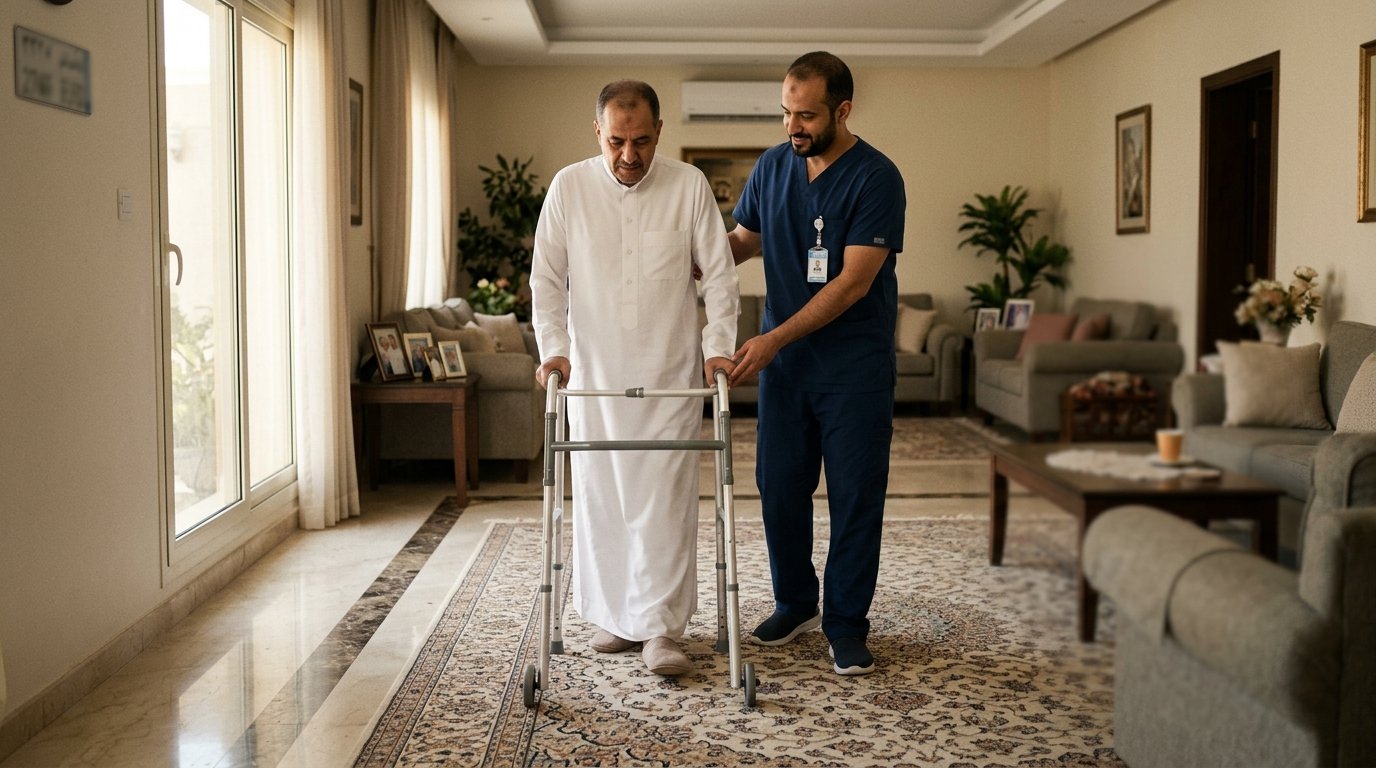
Specialized Male Therapists
Professional licensed therapists visiting your residence
100% In-Home Rehabilitation
No clinic travel friction or waiting room discomfort
Targeted Functional Goals
Focused on daily stairs, walking endurance, and independence
Emergency Medical Red-Flags & Home Care Boundaries
Emergency Notice: If acute recurrent stroke signs (FAST) appear, immediately contact 997 for emergency hospital transfer.
Central nervous system lesions—including cerebrovascular accidents (ischemic and hemorrhagic stroke), incomplete spinal cord injuries, and progressive neurodegenerative disorders such as Parkinson's disease and Multiple Sclerosis (MS)—induce profound physical, cognitive, and emotional disruption for patients and their families. Survivors frequently experience sudden unilateral hemiparesis, muscle spasticity, loss of selective motor control, balance degradation, and an inability to perform basic bed mobility or ambulation. In Saudi households across the Eastern Province, transporting a hemiplegic or neurologically impaired family member to outpatient rehabilitation centers represents a formidable physical obstacle fraught with fall hazards and logistical friction.
At Bidaya In-Home Physiotherapy & Medical Rehabilitation, we deliver specialized, hospital-grade neurological physical therapy directly to your residence across Dammam, Al Khobar, Dhahran, and Qatif. Our clinical philosophy is anchored in modern neurobiology: the injured adult human brain retains significant adaptive capacity termed neuroplasticity. Healthy uninjured cerebral cortical networks can reorganize, generate novel synaptic connections, and assume control of paretic motor functions when stimulated through high-repetition, meaningful, task-oriented functional training.
Our licensed physical therapists deploy internationally established therapeutic concepts—including the Bobath Concept (Neuro-Developmental Treatment), Proprioceptive Neuromuscular Facilitation (PNF), and Task-Oriented Motor Relearning. We reject passive, non-functional exercises; instead, we systematically integrate the paretic limbs into real-world domestic demands: bed transfers, sit-to-stand transitions, dynamic postural balance, and independent community ambulation, preserving patient dignity in their domestic setting.
Clinical Scope of In-Home Neurological Rehabilitation
Specialized Physical Therapy Protocols Across Central and Peripheral Neuropathologies
Our clinical team delivers targeted interventions across diverse neurological presentations: 1. Cerebrovascular Accidents (Stroke): Acute, subacute, and chronic management of ischemic infarcts and hemorrhagic strokes presenting with hemiplegia, hemiparesis, hypertonicity/spasticity, ataxia, and unilateral spatial neglect. 2. Parkinson's Disease: Staged interventions incorporating high-amplitude movement training (LSVT principles), axial spinal flexibility, overcoming freezing of gait (FOG) with auditory/visual cues, and progressive fall prevention. 3. Multiple Sclerosis (MS): Energy conservation protocols, managing fatigue, mitigating spasticity, preserving joint range of motion, and sensory re-education during remission phases. 4. Peripheral Neuropathies & Guillain-Barré Syndrome: Progressive motor re-education, orthotic fitting, sensory stimulation, and functional strengthening during subacute recovery.
Objective Neurological Evaluation Framework
A Structured 60-to-75-Minute Intake Establishing Baseline Functional Benchmarks
Prior to treatment implementation, our clinician conducts an exhaustive baseline examination: - Hypertonia and Spasticity Quantification: Utilizing the Modified Ashworth Scale (MAS 0-4) to grade velocity-dependent resistance across elbow flexors, wrist flexors, quadriceps, and plantarflexors. - Voluntary Motor Control & Synergy Fractionation: Evaluating whether the patient can isolate multi-joint movements or remains trapped in stereotypical primitive flexion/extension synergy patterns (Brunnstrom Stages 1-7). - Static and Dynamic Postural Balance Benchmarks: Administering the Berg Balance Scale (BBS) and Timed Up and Go (TUG) test to establish quantitative fall risk profiles. - Somatosensory & Proprioceptive Mapping: Assessing conscious joint position sense, tactile localization, and two-point discrimination to determine sensory afferent feedback integrity. - Activities of Daily Living (ADL) Autonomy: Utilizing the Barthel Index to document baseline transfer, hygiene, and mobility competencies.
Neuroplasticity and Task-Oriented Motor Relearning in Practice
Driving Cortical Remodeling Through High-Repetition Functional Movements
Cortical reorganization requires structured, salient practice embedded within daily living environments: - Repetitive Task Practice: Engaging the patient in hundreds of goal-directed movement repetitions—such as grasping a cup on the dining table, opening doors, or stepping over domestic thresholds—stimulating synaptogenesis within motor cortices. - Constraint-Induced Movement Therapy (CIMT) Adaptation: Mitigating learned non-use by gently restricting compensatory movement patterns of the sound limb, requiring active neuromuscular activation of the paretic arm. - Proprioceptive Neuromuscular Facilitation (PNF): Deploying multi-planar diagonal and spiral movement patterns with tactile facilitatory contact to recruit dormant motor units across paretic muscle groups.
Spasticity Modulation and Prevention of Joint Contractures
Mitigating Muscle Hypertonia and Safeguarding Soft Tissue Extensibility
Uncontrolled hypertonicity leads to arthrofibrosis, tendon shortening, and permanent joint deformities. Our therapists implement comprehensive spasticity management protocols: - Prolonged Inhibitory Stretching: Applying sustained low-load mechanical tension across hypertonic muscle groups for several minutes, dampening excessive muscle spindle excitability and preserving sarcomere length. - Neuromuscular Electrical Stimulation (NMES): Stimulating antagonist muscle groups (e.g., wrist extensors) to induce reciprocal Ia inhibitory interneuron reflexes that automatically relax spastic agonist flexors. - Anti-Spastic Positioning & Orthotic Guidance: Instructing family caregivers on positioning paretic limbs in neutral, extended postures using specialized pillows, bed wedges, and resting splints to prevent debilitating contractures.
Domestic Gait Retraining and Assistive Mobility Fitting
Correcting Circumduction Gait, Eliminating Foot Drop, and Rebuilding Ambulation
Hemiparetic gait frequently features compensatory hip hiking and external circumduction due to impaired knee flexion and ankle dorsiflexion weakness (foot drop).
Our clinicians systematically retrain locomotion through progressive biomechanical stages: 1. Dynamic Pelvic Weight Shifting: Training symmetric stance tolerance and lateral weight transfers onto the paretic lower limb, establishing pelvic stability essential for safe swing-phase initiation. 2. Functional Ankle-Foot Orthosis (AFO) Prescription: Selecting and fitting appropriate posterior leaf-spring or carbon-fiber AFOs to ensure toe clearance and prevent tripping over carpets. 3. Indoor Pathway Obstacle Retraining: Transitioning the patient from reciprocal four-point canes to single-point canes, practicing safe navigation through hallways, doorway thresholds, and domestic staircases.
Family and Caregiver Coaching on Ergonomic Transfers
Zero-Lift Biomechanics and Preventing Glenohumeral Subluxation
In Saudi domestic environments, family members and domestic aides provide extensive daily physical assistance. We train caregivers in safe, injury-free transfer protocols: - Utilizing Transfer Gait Belts: Ensuring caregivers grasp supportive waist belts rather than pulling on paretic upper limbs, preventing traction-induced glenohumeral subluxation and brachial plexus trauma. - Stand-Pivot Transfer Mechanics: Demonstrating coordinated pivot transfers between bed, wheelchair, and commode chairs, minimizing lumbar compressive forces on caregivers. - Pressure Ulcer Prevention Protocols: Teaching systematic 2-hour rotational positioning schedules and pressure-relieving mattress utilization for non-ambulatory patients.
Fine Motor Retraining and Hand Function Recovery in Stroke
Cylindrical Grasp, Pincer Precision, and Mirror Therapy Protocols
Restoring functional upper extremity and hand dexterity represents one of the most intricate challenges in neurological rehabilitation due to the massive disproportionate cortical representation of the human hand: - Finger Fractionation and Release Drills: Deploying textured silicone therapeutic putty and graduated pegs to counteract involuntary flexor spasticity, encouraging isolated finger extension and voluntary release. - Functional Grasp Pattern Retraining: Systematically practicing everyday grasp topologies: cylindrical grasp (holding water bottles), spherical grasp (retrieving round fruit), and tip-to-tip pincer grasps (holding cutlery and pens). - Mirror Therapy and Sensory Imagery: Utilizing an inter-limb mirror box where visual feedback of the moving sound hand creates the cortical illusion of normal bilateral movement, activating dormant mirror neurons within the premotor cortex and accelerating motor relearning.
Neurological Fatigue Management and Energy Conservation in Parkinson's and MS
Interval Pacing, Thermoregulation, and Sensory Cueing Protocols at Home
Patients living with progressive neurodegenerative conditions such as Multiple Sclerosis (MS) and Parkinson's disease frequently battle central neurological fatigue, where continuous exertion degrades motor conductivity.
Bidaya clinicians implement specialized domestic fatigue management protocols: - Interval-Paced Exercise Structuring: Structuring therapeutic tasks into brief 5-to-8-minute high-quality exercise bouts separated by complete physiological rest periods, preventing central neurotransmitter depletion. - Thermoregulation and Uhthoff's Phenomenon Mitigation: For MS patients, maintaining indoor ambient temperatures between 20°C and 22°C prevents temperature-induced conduction blocks across demyelinated axons. - Rhythmic Auditory and Visual Cueing for Parkinson's: Deploying high-contrast floor tape markers and metronomic auditory rhythms to provide external sensory pacing, enabling patients to bypass impaired basal ganglia pathways and execute long, symmetric steps without freezing.
Clinical Red Flags and Urgent Neurological Emergency Protocol
Immediate Action Guidelines for Acute Recurrent Stroke or Deterioration
Family members must maintain vigilance for clinical warning signs requiring immediate emergency medical intervention: - Acute Recurrent Stroke Signs (FAST Protocol): New facial asymmetry, sudden slurring of speech, or acute loss of power on the previously sound side. - Unexplained sudden onset of focal or generalized seizures, acute alteration of mental status, or severe uncal herniation signs. - Severe swallowing dysfunction (dysphagia) causing acute aspiration coughing during oral intake. In such events, in-home therapy is aborted immediately, and emergency transport is summoned via the Saudi Red Crescent Authority at 997.
Frequently Asked Questions about In-Home Physiotherapy
Therapy should commence immediately upon medical stabilization and hospital discharge, typically within the first 1 to 2 weeks, capitalizing on the critical early neuroplastic recovery window.
Related Clinical & Regional Pathways
Specialized Geriatric Physiotherapy & Fall Prevention→
Evidence-based clinical rehabilitation tailored specifically to preserve functional independence
Specialized Musculoskeletal Physiotherapy→
Evidence-based clinical rehabilitation for spinal disorders
Specialized Post-Operative Physiotherapy→
Evidence-based surgical rehabilitation protocols engineered to restore joint range of motion
Specialized Comprehensive In-Home Neurological Physical Therapy Assessment→
Advanced in-home neuro-rehabilitation harnessing neuroplasticity and functional independence by licensed male therapists
Specialized Rehabilitation for Neurogenic Muscle Weakness & Paretic Deficits→
Advanced in-home neuro-rehabilitation harnessing neuroplasticity and functional independence by licensed male therapists
Specialized Neurological Spasticity Management & Prolonged Stretch→
Advanced in-home neuro-rehabilitation harnessing neuroplasticity and functional independence by licensed male therapists
Specialized Neurological Sensory Re-Education & Proprioceptive Retraining→
Advanced in-home neuro-rehabilitation harnessing neuroplasticity and functional independence by licensed male therapists
Specialized Rehabilitation for Neurological Gait Ataxia & Incoordination→
Advanced in-home neuro-rehabilitation harnessing neuroplasticity and functional independence by licensed male therapists