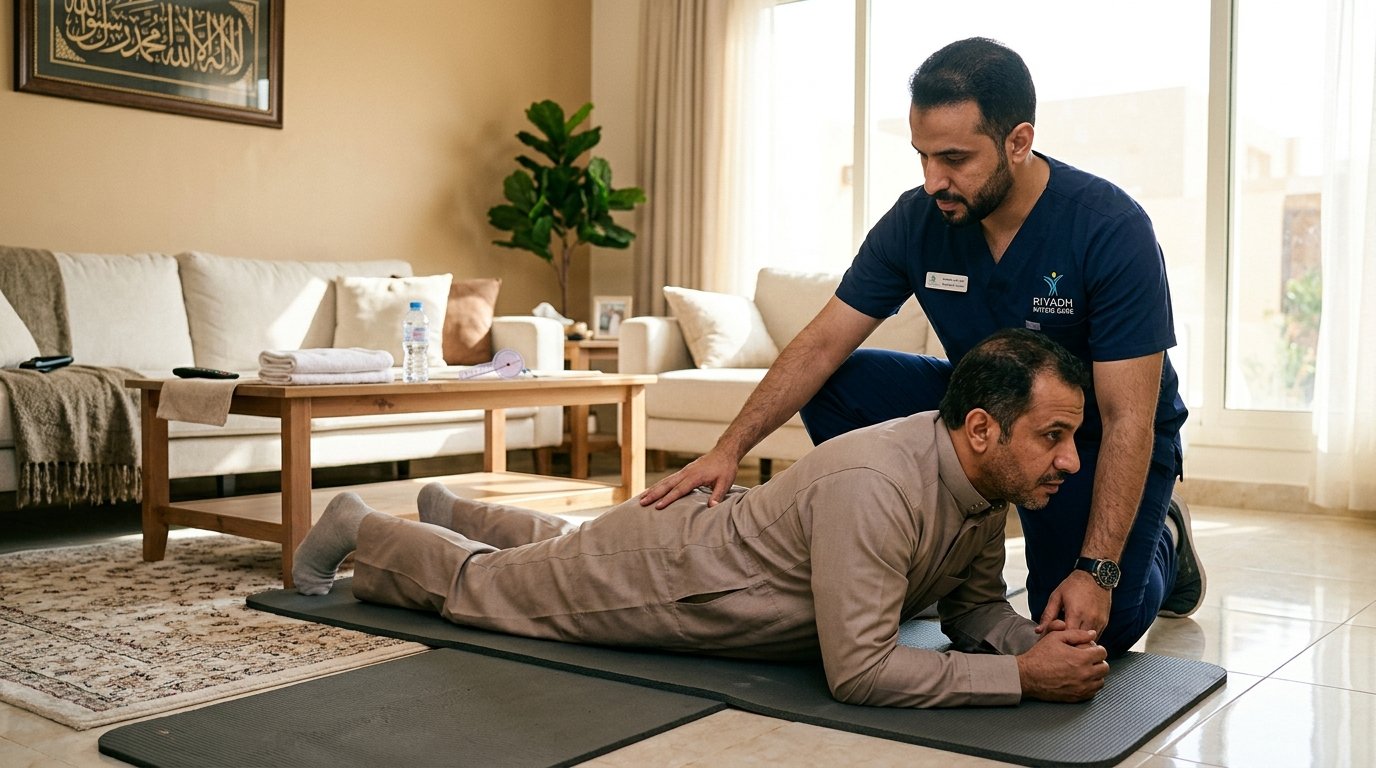
Advanced In-Home Physiotherapy for Low Back Pain & Sciatica
Evidence-based clinical rehabilitation engineered to resolve lumbar disc herniations, relieve sciatic nerve impingement, and rebuild dynamic core stability within your home across Dammam, Khobar, and Eastern Province.
Comprehensive In-Home Clinical Evaluation (60-75 Mins)
Detailed functional & neuro examination, home safety audit, and custom protocol with portable equipment — no upfront package commitments.
Flexible appointments 7 days a week (8 AM - 10 PM) • Payment upon visit completion
1,500+ Successful Home Recoveries
Certified Clinical Physiotherapists
Assessment-First Protocol
Thorough physical evaluation before any treatment plan starts
Specialized Male Therapists
Professional licensed therapists visiting your residence
100% In-Home Rehabilitation
No clinic travel friction or waiting room discomfort
Targeted Functional Goals
Focused on daily stairs, walking endurance, and independence
Emergency Medical Red-Flags & Home Care Boundaries
Emergency Notice: If you experience sudden bladder/bowel incontinence, saddle numbness around the groin, or acute foot drop, immediately call 997 or proceed to the nearest emergency room.
Low back pain (LBP) and lumbar radiculopathy, universally recognized as sciatica, represent the leading cause of global physical disability, occupational absenteeism, and chronic suffering. Across the Eastern Province of Saudi Arabia, lifestyle factors dramatically magnify mechanical spinal loading. Demanding corporate desk postures in industrial hubs, extended daily vehicular commutes traversing the highways between Dammam, Al Khobar, Dhahran, and Jubail, and frequent domestic floor sitting on low majlis cushions impose unrelenting asymmetric shear and compressive stresses upon the lumbar intervertebral discs.
At Bidaya In-Home Physiotherapy & Medical Rehabilitation, we deliver an advanced clinical spine care pathway directly to your home. We reject passive bed rest and transient symptomatic masking through pain medications, which clinical guidelines universally condemn. When an individual suffers from severe acute lumbar locking or agonizing, burning radicular pain radiating down the posterior lower extremity, travelling by car to outpatient clinics exacerbates nerve compression, provokes severe muscular spasm, and inflicts intolerable agony.
Our mobile clinical physical therapists arrive directly at your private residence, equipped with standardized mechanical diagnostic tools. We employ the gold-standard McKenzie Method of Mechanical Diagnosis and Therapy (MDT) to identify directional preference and drive rapid pain centralization. Combining precision neurodynamic sciatic nerve mobilization, targeted re-education of deep spinal stabilizers (lumbar multifidus and transversus abdominis), and comprehensive domestic ergonomic restructuring, we guide you safely from debilitating pain back to functional freedom, comfortable prayer postures, and lasting spinal resilience.
Mechanical and Pathoanatomical Classification of Low Back Pain
Differentiating Primary Spinal Drivers to Deliver Precision Clinical Interventions
Bidaya rejects generic back pain treatment. We rigorously categorize lumbar conditions into four distinct clinical syndromes: 1. Lumbar Disc Herniation and Discogenic Pain: Annular tear and nuclear displacement (commonly L4-L5 and L5-S1) imposing chemical and mechanical pressure on the posterior longitudinal ligament; characterized by midline deep aching exacerbated by lumbar flexion, prolonged sitting, and coughing. 2. Lumbar Radiculopathy (Sciatica): Mechanical impingement or inflammatory irritation of the L4, L5, or S1 nerve roots; manifesting as electric-shock sensations, dysesthesia, numbness, and burning pain tracking from the buttock along the sciatic nerve distribution into the calf and foot. 3. Lumbar Facet Joint Arthropathy: Degenerative osteoarthritis or acute capsular entrapment within posterior zygapophyseal joints; pain spikes during spinal extension and rotational twisting, accompanied by prominent morning stiffness that eases with gentle ambulation. 4. Sacroiliac (SI) Joint Dysfunction: Mechanical shearing or ligamentous sprain of the sacroiliac articulation; provoking unilateral buttock and groin pain exacerbated by single-leg standing, stair climbing, and supine rolling.
The McKenzie Method (MDT) and the Centralization Phenomenon
The Clinical Benchmark for Disc Nuclear Decompression and Radicular Relief
Our physical therapy specialists deploy the internationally acclaimed McKenzie framework during every home intake: - Repeated Mechanical Movement Testing: Methodically testing repeated end-range lumbar flexion and extension in standing and lying postures to assess symptomatic and mechanical responses. - Identifying Directional Preference: Determining the specific movement trajectory (most frequently extension in posterior derangements) that progressively reduces pain intensity and restores lost spinal range of motion. - Centralization Phenomenon: The critical prognostic milestone wherein peripheral radicular symptoms retreat proximally from the foot and calf back toward the midline lumbar spine, signifying reduced neural tension and disc nuclear relocation. - Patient Empowerment and Self-Treatment: Training the patient in high-frequency, specific directional exercises performed independently throughout the day, eliminating therapeutic dependency on external modalities.
Sciatic Neurodynamics and Nerve Mobilization Techniques
Restoring Pain-Free Neural Excursion and Relieving Intraneural Ischemia
When the sciatic nerve trunk becomes entrapped or chemically sensitized, it loses its normal mechanical compliance, provoking severe pain upon stretch: - Neurodynamic Sliders: Synchronizing movement across adjacent joints (e.g., knee extension coupled with cervical extension) to translate the sciatic nerve along its anatomical sheath without creating longitudinal tensile strain, facilitating intraneural fluid evacuation. - Graduated Neurodynamic Tensioners: Introducing controlled elongation across both ends of the neural bed during subacute phases to restore full physiological tensile threshold and eliminate kinesiophobia. - Peripheral Desensitization: Employing gentle manual mobilization and ischemic pressure to alleviate deep gluteal trigger points and piriformis contractures that mechanically tether the sciatic nerve.
Motor Control and Deep Lumbopelvic Stabilization Retraining
Activating the Deep Muscular Core Cylinder to Protect Lumbar Spinal Segments
Clinical research conclusively demonstrates that the onset of lumbar pain reflexively shuts down deep segment-stabilizing musculature: - Transversus Abdominis Isolation: Retraining the deep abdominal drawing-in maneuver paired with diaphragmatic breathing, establishing active intra-abdominal pressure that unloads the lumbar disc rings. - Lumbar Multifidus Re-Conditioning: Restoring volitional firing across segmental multifidus fascicles through precise quadruped bird-dog and bridging progressions, providing segmental intervertebral shear stability. - Gluteal Strengthening and Hip Dissociation: Conditioning the gluteus maximus and medius to produce explosive hip extension and lateral pelvic leveling, eliminating compensatory hyperextension and rotation in the lumbar spine.
Domestic Ergonomics, Prayer Mechanics, and Eastern Province Lifestyle Adaptations
Engineering 24-Hour Spinal Protection in Saudi Household and Vehicular Environments
Our therapist directly addresses lifestyle drivers specific to Eastern Province residents: - Biomechanics of Daily Prayer: Managing acute disc injuries by transitioning patients to seated chair prayer during inflammatory phases to eliminate aggressive spinal flexion, subsequently retraining progressive ground kneeling and Sujood with a neutral lordotic curve. - Commuter Lumbar Support: Prescribing and fitting firm lumbar support rolls for long vehicular commutes between Dammam, Khobar, and Jubail, maintaining lordosis and counteracting road vibration forces. - Floor Sitting and Majlis Optimization: Coaching safe transitional mechanics for rising from floor gatherings, utilizing firm cushions to elevate hips above knee level and relieve excessive posterior pelvic tilt. - Domestic Lifting Mechanics: Coaching hip-hinge mechanics and keeping heavy objects close to the center of gravity, engaging quadriceps and gluteal force rather than bending through the lumbar spine.
Phased Recovery Timeline and Milestone Benchmarks
A Structured Progression from Severe Pain to Lasting Musculoskeletal Immunity
Our comprehensive in-home spinal pathway follows predictable, milestone-driven healing phases: - Phase 1: Acute Pain Decompression (Days 1 to 10): Extinguishing acute muscle spasm, achieving directional centralization, restoring basic domestic walking capacity, and eliminating symptom exacerbators. - Phase 2: Range of Motion and Neurodynamic Restoration (Weeks 2 to 4): Achieving full pain-free spinal extension and flexion, progressive sciatic nerve flossing, and initial transversus abdominis activation. - Phase 3: Dynamic Core Strengthening and Load Tolerance (Weeks 4 to 8): Advancing functional closed-chain core exercises, carrying loads, climbing stairs unassisted, and returning to occupational duties. - Phase 4: Long-Term Relapse Prevention (Week 8 and Beyond): Embedding a 10-minute daily spinal hygiene routine, periodic self-assessment, and sustaining high-level physical recreation.
Clinical Red Flags and Emergent Spinal Pathology Screening
Immediate Diagnostic Triage for Cauda Equina Syndrome and Spinal Cord Compression
Bidaya enforces strict clinical vigilance during initial assessments to detect rare surgical emergencies: - Cauda Equina Syndrome: Acute bowel or bladder dysfunction (urinary retention, overflow incontinence), loss of anal sphincter tone, saddle anesthesia (numbness over perineum, buttocks, and inner thighs), and bilateral progressive lower limb motor paralysis. - Progressive Motor Paresis: Sudden emergence of foot drop (inability to dorsiflex the ankle, tripping over toes during gait). - Spinal Infection or Malignancy: Unrelenting non-mechanical nocturnal back pain unresponsive to position changes, unexplained systemic weight loss, elevated ESR/CRP, or persistent high fever. In any suspected Cauda Equina Syndrome or severe neurological compromise, immediately contact 997 or transfer the patient to the nearest hospital emergency department.
Frequently Asked Questions about In-Home Physiotherapy
Yes, international spine society data reveals that over 90% of lumbar disc herniations and radicular sciatica cases fully recover with structured conservative physical therapy, mechanical directional therapy, and active movement rehabilitation within 6 to 12 weeks.
Related Clinical & Regional Pathways
Mechanical Low Back Pain→
Evidence-based clinical rehabilitation delivered directly to your doorstep in Dammam
Post-Laminectomy Decompression Recovery→
Evidence-based clinical rehabilitation delivered directly to your doorstep in Dammam
Lumbar Disc Herniation→
Evidence-based clinical rehabilitation delivered directly to your doorstep in Dammam
Back & Spine Rehabilitation→
Evidence-based clinical rehabilitation delivered directly to your doorstep in Dammam
In-Home Physiotherapy in Dammam→
Evidence-based clinical rehabilitation delivered directly to your doorstep across Dammam metropolitan districts
In-Home Physiotherapy in Al Khobar→
Evidence-based clinical rehabilitation delivered directly to your villa
Musculoskeletal Physiotherapy→
Evidence-based clinical rehabilitation for spinal disorders
Lumbar Facet Joint Syndrome→
Evidence-based clinical rehabilitation delivered directly to your doorstep in Dammam