Clinical Directory of Conditions Treated at Home
A comprehensive medical guide outlining the musculoskeletal disorders, post-surgical recoveries, and neurological conditions we rehabilitate directly within your home across Dammam, Khobar, and Eastern Province.
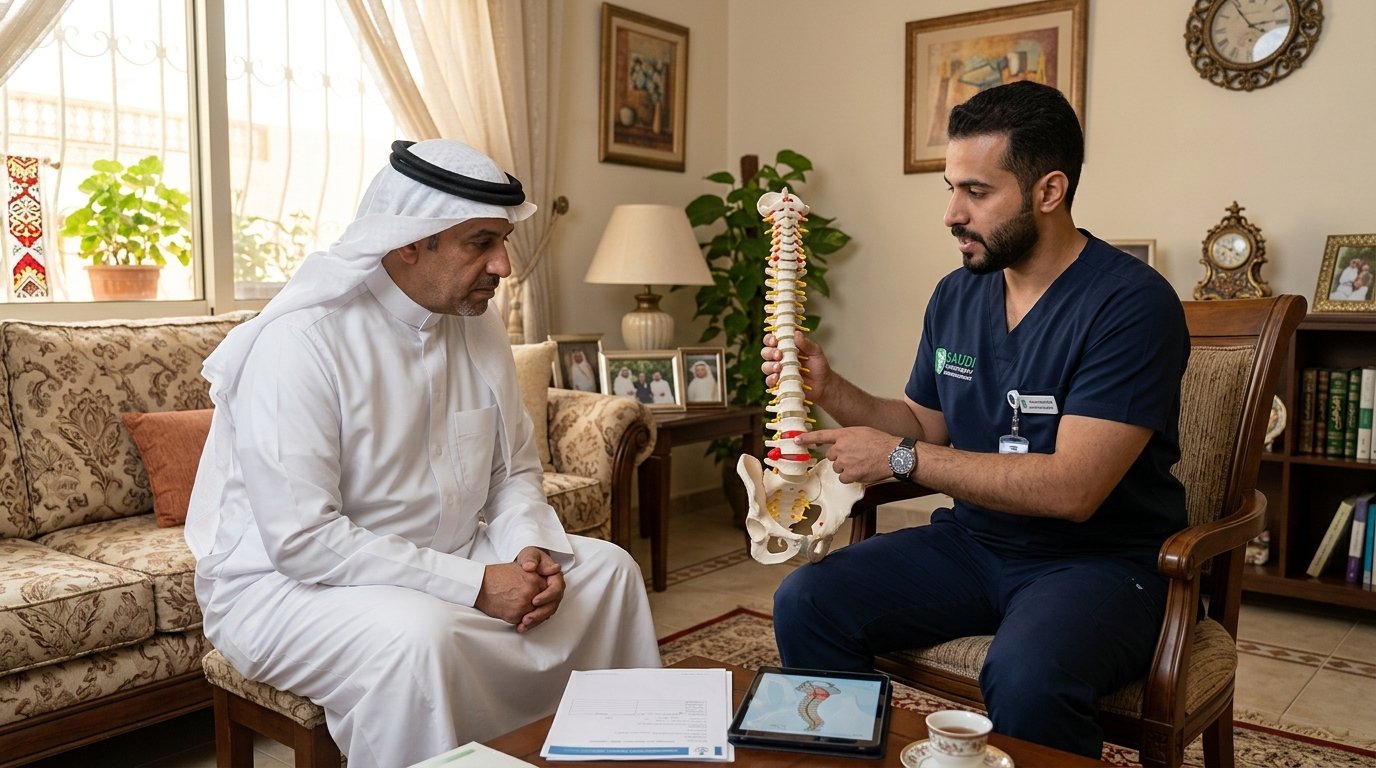
Comprehensive In-Home Clinical Evaluation (60-75 Mins)
Detailed functional & neuro examination, home safety audit, and custom protocol with portable equipment — no upfront package commitments.
Flexible appointments 7 days a week (8 AM - 10 PM) • Payment upon visit completion
1,500+ Successful Home Recoveries
Certified Clinical Physiotherapists
Assessment-First Protocol
Thorough physical evaluation before any treatment plan starts
Specialized Male Therapists
Professional licensed therapists visiting your residence
100% In-Home Rehabilitation
No clinic travel friction or waiting room discomfort
Targeted Functional Goals
Focused on daily stairs, walking endurance, and independence
Emergency Medical Red-Flags & Home Care Boundaries
Emergency Medical Notice: Symptoms involving sudden loss of bowel/bladder control or acute progressive weakness require immediate surgical evaluation. Dial 997 immediately.
Bidaya In-Home Physiotherapy & Medical Rehabilitation provides evidence-based rehabilitation protocols across a wide spectrum of orthopaedic, post-operative, and neurological pathologies throughout the Eastern Province. Our clinical practice is established on the principle that effective rehabilitation does not merely suppress transient symptoms; rather, it isolates and corrects the underlying biomechanical, neurological, and neuromuscular deficits driving pain and functional impairment, enabling patients to recover true functional independence.
Our clinical scope addresses acute, subacute, and chronic conditions: from highly prevalent spinal complaints such as lumbar disc herniations, sciatica, and cervical radiculopathy induced by prolonged sedentary routines, to complex presentations including post-stroke hemiparesis, recovery following total joint arthroplasty, and progressive balance degradation in aging adults.
This comprehensive clinical directory informs patients and families in Dammam, Al Khobar, and Dhahran about the clinical conditions we accept, our diagnostic evaluation protocols, expected functional milestones, and the rigorous red-flag triage criteria deployed to exclude emergency medical emergencies from domestic rehabilitation.
Classification of Clinical Conditions Managed at Home
Four Primary Clinical Domains Spanning Modern Physical Rehabilitation
Our clinical intake categorizes patient conditions across four established domains:
1. Spinal Impairments & Radicular Nerve Syndromes: - Lumbar Disc Herniation and Sciatic Neuropathy (Sciatica). - Cervical Disc Pathologies and Cervicobrachial Radiculopathy. - Sacroiliac Joint Dysfunction (SIJ) and Chronic Lumbar Muscle Strain. - Lumbar Spinal Stenosis with Neurogenic Claudication limiting standing and ambulation.
2. Peripheral Joint Disorders & Musculoskeletal Pain Syndromes: - Advanced Knee Osteoarthritis (Degenerative Joint Disease) with flexion contractures. - Adhesive Capsulitis (Frozen Shoulder) across freezing, frozen, and thawing phases. - Rotator Cuff Tendinopathy, Impingement, and Partial Tears. - Patellofemoral Pain Syndrome (PFPS) and Chondromalacia Patellae. - Hip Osteoarthritis, Greater Trochanteric Pain Syndrome (GTPS), and Hip Bursitis.
3. Post-Surgical Orthopaedic Rehabilitation: - Post-Total Knee Arthroplasty (TKR) early mobility and gait training. - Post-Total Hip Arthroplasty (THA) dislocation precautions and ambulation restoration. - Post-Anterior Cruciate Ligament (ACL) Reconstruction and Meniscal Repairs. - Post-Open Reduction Internal Fixation (ORIF) of complex fractures.
4. Neurological Conditions & Balance Impairments: - Post-Stroke Hemiparesis, Spasticity, and Gait Retraining. - Parkinson's Disease functional mobility and fall hazard mitigation. - Multiple Sclerosis (MS) fatigue management and functional conditioning. - Geriatric Balance Instability, Vestibular Imbalance, and High Fall Risk.
Differential Diagnosis Methodology: Pinpointing the Biomechanical Root
Ruling Out Serious Medical Pathology and Establishing Safe Clinical Indications
Our licensed physical therapists deploy a systematic differential diagnosis model during the initial evaluation to confirm that patient symptoms stem from mechanical neuromuscular disorders suitable for exercise and manual therapy, rather than occult systemic pathologies:
- Neurological Tension & Provocation Tests: Executing the Straight Leg Raise (SLR), Slump test, and Femoral Nerve Traction test to quantify radicular dural irritation. - Joint-Above and Joint-Below Screening: Examining adjacent joints (e.g., screening the lumbar spine and hip joint when evaluating anterior knee pain) to eliminate referred pain patterns. - Sensory Dermatomal and Deep Tendon Reflex Examination: Verifying the integrity of sensory-motor reflex pathways and distinguishing lower vs. upper motor neuron deficits. - Correlating Diagnostic Imaging with Functional Presentation: Comparing MRI, CT, and radiographic reports directly against active movement findings, ensuring we treat the functional human presentation rather than isolated radiological imaging.
The Four-Stage Clinical Milestone Progression Model
A Structured Pathway Progressing Patients from Acute Pain to Autonomy
Every clinical case advances through four deliberate therapeutic phases:
Stage 1: Symptom Modulation & Acute Inflammation Control: Deploying gentle manual therapy, analgesic electrotherapy, cryotherapy/thermotherapy, and protective positioning to deactivate irritated neural and soft tissues while preserving circulation.
Stage 2: Joint Mobility & Soft-Tissue Remodeling: Implementing passive and active-assisted joint mobilizations, therapeutic stretching, and myofascial release to reverse capsular stiffness and regain anatomical range of motion.
Stage 3: Progressive Strength & Neuromuscular Stabilization: Introducing calibrated progressive resistance training to correct muscle imbalances and enhance dynamic joint stability during loaded daily tasks.
Stage 4: Functional Task Integration & Long-Term Prevention: Transitioning the patient to real-world domestic demands: ascending and descending stairs, ground prayer postures (Sujood), lifting household items safely, and independent walking confidence.
Assistive Device Fitting and Domestic Gait Retraining
Precise Ergonomic Sizing and Safe Motor Control with Walkers and Canes
Effective ambulation rehabilitation requires rigorous attention to assistive mobility devices within the residential environment: - Ergonomic Sizing and Handle Height Alignment: The clinician measures walker or cane handle height precisely to the patient's greater trochanter with elbow flexion maintained between 20° and 30°, eliminating shoulder elevation and compensatory lumbar leaning. - Step-Pattern Sequencing: Coaching the patient in step-to and step-through gait sequences aligned with surgical weight-bearing protocols, ensuring stability on polished tile floors. - Weaning Milestones: Establishing objective clinical criteria (quadriceps strength >= 4/5, unassisted single-leg balance > 5 seconds) to safely transition patients from reciprocal walkers to single-point canes and independent walking.
Sensory-Motor Balance Retraining and Vestibular Adaptation at Home
Restoring Neuromuscular Equilibrium and Reflexive Postural Control in Older Adults
Balance impairment represents one of the most critical precipitants of functional decline and catastrophic fall injuries among older residents across Eastern Province homes. Human postural stability relies upon the real-time integration of three distinct physiological sensory systems: visual inputs, the inner-ear vestibular system, and proprioceptive mechanoreceptors embedded in muscles, tendons, and joint capsules.
Bidaya implements progressive sensory-motor balance conditioning within the familiar residential environment: - Graded Romberg and Semi-Tandem Postural Stances: Training patients to maintain static stability with progressively narrowed bases of support, subsequently eliminating visual compensation by eyes-closed drills to stimulate somatosensory mechanoreceptors. - Dynamic Head-Turn Locomotor Drills: Retraining gaze stability and vestibular ocular reflexes (VOR) while the patient walks along indoor corridors, preventing dizziness during head movements in daily life. - Multi-Surface Proprioceptive Perturbation: Utilizing graded-density medical foam pads to challenge ankle joint mechanoreceptors, cultivating rapid reactive muscle synergies necessary to recover balance following a stumble.
Cardiovascular Vitals Monitoring and Safe Exertion Titration
Hemodynamic Monitoring, Oxygen Saturation Audits, and Borg RPE Scaling
Executing evidence-based physical rehabilitation requires continuous vigilance regarding cardiovascular and respiratory safety, particularly among elderly individuals presenting with comorbid hypertension, diabetes mellitus, or stable ischemic heart disease.
Our visiting clinicians record vital parameters (blood pressure, radial pulse rate, and pulse oximetry SpO2) across three distinct clinical milestones: at baseline rest, at peak exercise exertion, and following post-session recovery. We systematically employ the validated Borg Rating of Perceived Exertion (RPE 6-20 Scale) to pace therapeutic resistance exercises, keeping intensity strictly within the safe, aerobic 'moderate' zone (scores 11 to 13) and avoiding cardiopulmonary overload or hypertensive spikes.
Red-Flag Symptoms Mandating Immediate Emergency Escalation
Unyielding Clinical Boundaries Protecting Patient Well-Being
Bidaya enforces strict clinical exclusion criteria for symptoms requiring emergency surgical or medical intervention: 1. Cauda Equina Syndrome: Acute onset of urinary retention or faecal incontinence, saddle paresthesia (numbness in perineal/groin region), and progressive bilateral lower-limb motor paresis; demands immediate neurosurgical decompression within hours. 2. Unstable Skeletal Fractures: Severe acute pain following significant trauma in osteoporotic seniors with complete inability to bear any weight. 3. Septic Arthritis or Spinal Infection: Unexplained high fever, chills, localized erythema, and severe agonizing joint pain at rest. 4. Non-Mechanical Malignancy Signs: Unremitting nocturnal pain that is entirely unaffected by position or rest, accompanied by rapid unexplained weight loss.
Upon detecting any of these signs, therapy is halted immediately and emergency transfer (997) is initiated.
The Vital Role of Home Exercise Adherence
Caregiver and Patient Partnership Driving Long-Term Clinical Recovery
Evidence-based clinical studies demonstrate that over 60% of physical rehabilitation success depends upon the patient's consistent adherence to independent therapeutic exercises prescribed between clinical visits.
Our clinicians provide each patient with an individualized, concise home exercise program taking 15 to 20 minutes daily, clearly illustrating movement repetitions, safe postures, and specific movement precautions. This structured compliance ensures continuous tissue remodeling and prevents regression between formal treatment appointments.
Frequently Asked Questions about In-Home Physiotherapy
In more than 85% of lumbar disc herniations presenting without acute red-flag neurological deficits, evidence-based in-home physical therapy successfully reduces nerve inflammation, restores mobility, and avoids surgical intervention.
Related Clinical & Regional Pathways
Specialized Service Locations Coverage→
A responsive clinical mobile network connecting residences across the Eastern Province with licensed physical ...
Specialized Physiotherapy Services→
An integrated clinical care system delivering evidence-based physical therapy disciplines directly to your res...
Specialized Physiotherapy Eastern Province→
Comprehensive clinical rehabilitation delivered directly to your residence across Dammam
Specialized What Happens During Your First In-Home Physiotherapy Session in Eastern Province→
Detailed family guide to clinical evaluation
Specialized How to Prepare for an In-Home Physiotherapy Visit in Eastern Province→
Essential steps to prepare your home environment
Specialized Physiotherapy Reassessment and Objective Progress Tracking in Eastern Province→
Standardized clinical scales and objective functional testing charting your recovery every step of the way
Specialized Hospital Discharge to Home Rehabilitation Timeline in Eastern Province→
A clinical day-by-day roadmap guiding patients and families from hospital discharge to complete functional autonomy
Specialized When to Wean or Discharge from In-Home Physiotherapy in Eastern Province→
Transparent clinical criteria defining successful graduation to full independent self-management
In-Home Lipedema Physiotherapy & Conservative Rehabilitation→
Comprehensive clinical authority guide on non-surgical lipedema management in Eastern Province
Lipedema vs Lymphedema vs Obesity Clinical Differentiation→
Diagnostic comparison detailing Stemmer sign, allodynia, and clinical characteristics