Advanced In-Home Physiotherapy for Shoulder Pain & Frozen Shoulder
Evidence-based clinical rehabilitation engineered to release glenohumeral capsular contractures, resolve subacromial impingement, and restore rotator cuff strength within your home across Dammam, Khobar, and Eastern Province.
Comprehensive In-Home Clinical Evaluation (60-75 Mins)
Detailed functional & neuro examination, home safety audit, and custom protocol with portable equipment — no upfront package commitments.
Flexible appointments 7 days a week (8 AM - 10 PM) • Payment upon visit completion
1,500+ Successful Home Recoveries
Certified Clinical Physiotherapists
Assessment-First Protocol
Thorough physical evaluation before any treatment plan starts
Specialized Male Therapists
Professional licensed therapists visiting your residence
100% In-Home Rehabilitation
No clinic travel friction or waiting room discomfort
Targeted Functional Goals
Focused on daily stairs, walking endurance, and independence
Emergency Medical Red-Flags & Home Care Boundaries
Emergency Notice: If you experience crushing chest pain radiating to your left shoulder, shortness of breath, or cold sweats, immediately dial 997; these are critical signs of a cardiac emergency.
The shoulder complex represents the most mobile and versatile articulation in the human body, affording the upper extremity an expansive spherical workspace to execute daily self-care, occupational tasks, and recreational pursuits. However, this extraordinary mobility sacrifices inherent bony stability; the shallow glenoid fossa covers less than one-third of the humeral head, rendering joint integrity entirely dependent upon a dynamic equilibrium between the rotator cuff musculotendinous envelope, the labrum, and periscapular stabilizers. Across the Eastern Province of Saudi Arabia, shoulder pain, chronic adhesive capsulitis (frozen shoulder), and rotator cuff tears demonstrate high clinical incidence, especially among patients with diabetes mellitus, desk-bound professionals, and racquet-sport enthusiasts. When neglected, minor impingements rapidly progress into rigid, debilitating capsular contractures that prohibit simple daily movements such as donning a thobe or abaya, grooming hair, or resting peacefully at night.
At Bidaya In-Home Physiotherapy & Medical Rehabilitation, we deliver a specialized in-home clinical pathway for shoulder dysfunctions directly to your living space across Dammam, Al Khobar, Dhahran, and Qatif. We understand that a patient suffering from agonizing nocturnal shoulder pain and severe capsular restriction faces tremendous physical and psychological exhaustion. Navigating vehicular transit to outpatient hospital centers places jarring rotational torque on sensitized shoulder structures, worsening painful muscle guarding and elevating stress levels.
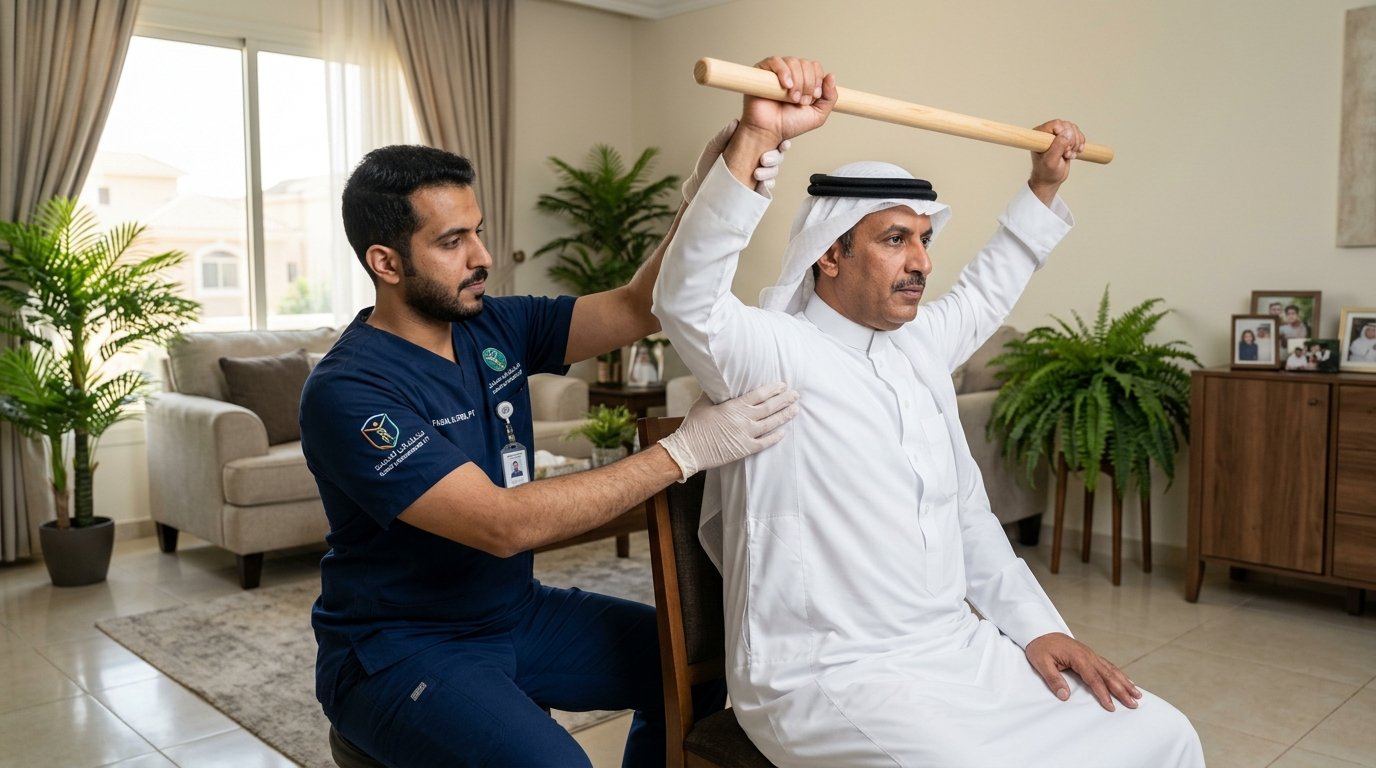
Our mobile clinical specialists eliminate these barriers by delivering hospital-grade diagnostics and specialized manual therapy directly to your home. We reject passive, unmonitored modalities, implementing comprehensive evidence-based treatments: Maitland glenohumeral joint mobilizations, targeted stretches for contracted capsular pouches, periscapular neuromuscular re-education, and phased rotator cuff strengthening. Our clinical care restores pain-free functional reach while preventing irreversible joint contractures.
Differential Diagnosis of Prevalent Shoulder Complex Pathologies
Differentiating Capsular, Tendinous, and Biomechanical Drivers to Target Treatment
Bidaya's clinical specialists rigorously differentiate shoulder symptoms across four major clinical syndromes: 1. Adhesive Capsulitis (Frozen Shoulder): Progressive inflammation and fibrotic contracture of the glenohumeral capsule and coracohumeral ligament, traversing three classic clinical phases: the painful freezing phase, the stiff frozen phase, and the gradual thawing recovery phase; characterized by equal active and passive loss of range of motion, predominantly in external rotation and abduction. 2. Subacromial Impingement Syndrome (SAIS): Mechanical compression and inflammatory irritation of the supraspinatus tendon and subacromial bursa beneath the rigid coracoacromial arch; classically eliciting a painful arc between 60 and 120 degrees of active arm abduction. 3. Rotator Cuff Tendinopathy and Tears: Degenerative or acute structural disruption of the rotator cuff tendons (supraspinatus, infraspinatus, subscapularis, teres minor); characterized by weakness during abduction or external rotation, night pain, and a positive drop-arm sign in full-thickness tears. 4. Scapular Dyskinesis (SICK Scapula Syndrome): Altered resting posture and dynamic motion of the scapula over the thoracic cage, driven by inhibition of the serratus anterior and lower trapezius coupled with upper trapezius overactivity, narrowing the subacromial space.
Standardized 60-Minute Clinical Intake and Scapulohumeral Biomechanical Screening
Quantitative Goniometric and Provocation Testing Isolating Pathomechanical Drivers
Our physical therapist conducts a standardized clinical evaluation during the initial home visit: - Digital Goniometric Active and Passive Range of Motion (ROM): Measuring active and passive glenohumeral angles across external rotation, internal rotation, forward flexion, and abduction; identifying the pathognomonic capsular pattern (external rotation most limited, followed by abduction and internal rotation). - Orthopedic Special Tests for Rotator Cuff Competence: Administering the Empty Can (Jobe's) and Full Can tests for supraspinatus pathology, resisted external rotation at neutral for infraspinatus integrity, and the Lift-Off / Belly-Press test for subscapularis tears. - Provocative Subacromial Impingement Tests: Performing Neer's impingement maneuver and the Hawkins-Kennedy forward flexion internal rotation test to provoke mechanical bursa compression. - Dynamic Scapulohumeral Rhythm Analysis: Evaluating the 2:1 kinetic ratio between glenohumeral elevation and upward scapular rotation, identifying abnormal compensatory shoulder shrugging.
Maitland Glenohumeral Joint Mobilization and Capsular Decompression
Restoring Obligate Arthrokinematic Glides and Expanding the Axillary Recess
Manual therapy serves as the critical intervention to break down fibrotic capsular adhesions: - Inferior Glenohumeral Glides: Applying rhythmic manual oscillatory forces directed inferiorly in varying abduction angles; this specifically stretches the contracted inferior axillary pouch, facilitating overhead arm elevation without mechanical impingement. - Posterior Humeral Head Glides: Translating the humeral head posteriorly within the glenoid cavity, restoring lost forward flexion and internal rotation necessary to reach behind the back. - Long-Axis and Lateral Glenohumeral Traction: Delivering gentle mechanical separation across the articulating joint surfaces, bathing the ischemic hyaline surfaces with synovial fluid and dampening nociceptive pain firing.
Progressive Exercise Prescription: From Codman's Pendulum to Elastic Resistance
A Structured Motor Continuum Rebuilding Strength Without Provoking Inflammation
Our exercise pathway advances through carefully controlled physiological phases: - Passive Codman's Pendulum Drills: Utilizing gravity and trunk oscillation to gently distract the glenohumeral joint, circulating synovial fluid and relaxing hypertonic periarticular muscles without active contraction. - Active-Assisted Range of Motion (AAROM): Implementing lightweight therapy canes and door-mounted pulley systems, enabling the uninjured limb to guide the affected arm through progressive overhead elevation and external rotation. - Submaximal Isometric Rotator Cuff Activation: Introducing gentle contractions against walls or pillows at neutral joint angles, stimulating tenocyte repair without causing tendon friction. - Scapular Stabilization and Kinetic Retraining: Side-lying external rotations, prone horizontal abduction, and wall slide exercises to condition the serratus anterior and lower trapezius.
Domestic Ergonomics, Dressing Techniques, and Eastern Province Lifestyle Adaptations
Practical Biomechanical Strategies Restoring Daily Independence in Saudi Households
Our therapist implements customized modifications tailored to daily life in the Eastern Province: - Dressing Mechanics for Traditional Garments: Instructing patients to thread the affected arm first when donning thobes, abayas, or shirts, and undressing the unaffected arm first, avoiding extreme painful rotational reaching. - Nocturnal Sleep Ergonomics: Strictly forbidding direct compression on the affected shoulder; coaching patients to sleep side-lying on the uninjured side while hugging a supportive pillow to support the affected arm, or sleeping supine with a folded towel beneath the elbow to prevent posterior capsular tension. - Prayer Posture Modifications: Coaching patients to execute Takbirat al-Ihram within safe, pain-free angular limits without shrugging, adapting hand placement over the chest, and transitioning to seated prayer if prostration creates intolerable compressive shoulder loading.
Nocturnal Pain Management and Sleep Preservation Strategies
Evidence-Based Non-Pharmacological Protocols Halting Nighttime Pain Cycles
Nocturnal pain is the single most debilitating symptom reported by shoulder patients: - Pre-Bed Targeted Cryotherapy: Applying contoured gel ice wraps for 15 minutes prior to sleep to suppress inflammatory mediators within the subacromial bursa and numb sensory afferents. - Axillary Support Positioning: Positioning a firm folded towel roll between the upper arm and lateral chest wall, preventing the "wringing out" effect wherein the humeral head compresses the anterior circumflex artery, preserving essential microvascular tendon perfusion throughout the night. - Self-Administered Myofascial Release: Guiding the patient in utilizing a tennis ball against a bedroom wall to release ischemic trigger points in the levator scapulae and posterior deltoid prior to retiring.
Clinical Red Flags and Emergent Shoulder Pathology Screening
Immediate Diagnostic Triage Ruling Out Cardiovascular, Malignant, and Septic Emergencies
Bidaya enforces rigorous red-flag triage during every initial assessment: - Acute Myocardial Infarction / Coronary Ischemia: Sudden onset of crushing chest pressure radiating into the left shoulder, jaw, or inner arm, accompanied by acute diaphoresis, dyspnea, and lightheadedness; an immediate medical emergency requiring urgent 997 activation. - Septic Glenohumeral Arthritis: Marked local heat, expanding erythema, intense joint effusion, complete inability to tolerate any passive touch or motion, accompanied by systemic pyrexia. - Pancoast Apical Lung Neoplasm: Unrelenting, non-mechanical posterior shoulder and scapular pain in chronic tobacco smokers, associated with Horner's syndrome (ptosis, miosis, anhidrosis) and progressive ulnar nerve weakness. In any suspected cardiovascular emergency or serious systemic pathology, immediately contact 997.
Frequently Asked Questions about In-Home Physiotherapy
While untreated frozen shoulder can linger for 1 to 2 years, structured in-home physical therapy with gentle joint mobilizations dramatically accelerates the thawing process, restoring functional mobility and eliminating night pain within 6 to 12 weeks.
Related Clinical & Regional Pathways
Frozen Shoulder (Adhesive Capsulitis)→
Evidence-based shoulder complex rehabilitation delivered directly to your doorstep in Dammam
Post-Shoulder Dislocation & Bankart Repair→
Evidence-based shoulder complex rehabilitation delivered directly to your doorstep in Dammam
Rotator Cuff Tendinopathy→
Evidence-based shoulder complex rehabilitation delivered directly to your doorstep in Dammam
Shoulder Rehabilitation→
Evidence-based clinical rehabilitation delivered directly to your doorstep in Dammam
In-Home Physiotherapy in Dammam→
Evidence-based clinical rehabilitation delivered directly to your doorstep across Dammam metropolitan districts
In-Home Physiotherapy in Al Khobar→
Evidence-based clinical rehabilitation delivered directly to your villa
Musculoskeletal Physiotherapy→
Evidence-based clinical rehabilitation for spinal disorders
Proximal Biceps Tendonitis→
Evidence-based shoulder complex rehabilitation delivered directly to your doorstep in Dammam