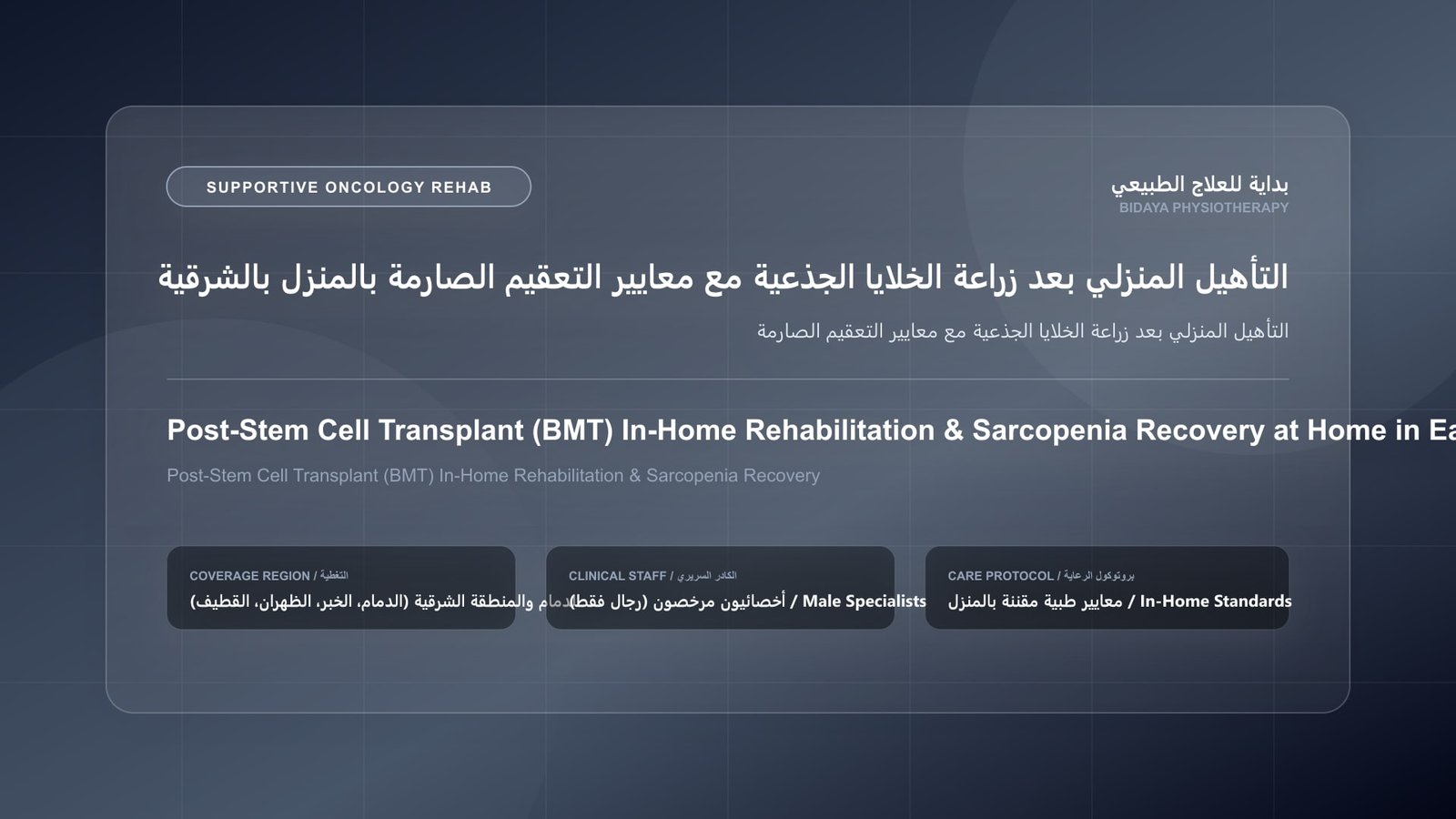
Post-Stem Cell Transplant (BMT) In-Home Rehabilitation & Sarcopenia Recovery
Advanced restorative oncology physical therapy overcoming cancer-related fatigue and restoring functional mobility by licensed male therapists.
Comprehensive In-Home Clinical Evaluation (60-75 Mins)
Detailed functional & neuro examination, home safety audit, and custom protocol with portable equipment — no upfront package commitments.
Flexible appointments 7 days a week (8 AM - 10 PM) • Payment upon visit completion
1,500+ Successful Home Recoveries
Certified Clinical Physiotherapists
Assessment-First Protocol
Thorough physical evaluation before any treatment plan starts
Specialized Male Therapists
Professional licensed therapists visiting your residence
100% In-Home Rehabilitation
No clinic travel friction or waiting room discomfort
Targeted Functional Goals
Focused on daily stairs, walking endurance, and independence
Emergency Medical Red-Flags & Home Care Boundaries
Emergency Notice: In the event of febrile neutropenia (temp >38°C), acute severe unremitting bone pain, or sudden acute dyspnea, seek immediate emergency hospital care or dial 997.
Post-Stem Cell Transplant (BMT) In-Home Rehabilitation & Sarcopenia Recovery constitutes a compassionate, advanced clinical discipline delivered by Bidaya across Eastern Province residences. We formulate individualized restorative exercise regimens respecting oncologic treatment phases, blood counts, and functional tolerance inside home comfort guided by licensed male clinicians.
Clinical Pathophysiology & Tissue Biomechanics for (Post-Stem Cell Transplant (BMT) In-Home Rehabilitation & Sarcopenia Recovery) in Dammam & Eastern Province
Biomechanical Dysfunction, Tissue Overload, and Kinetic Chain Compensations
Home physical therapy for Post-Stem Cell Transplant (BMT) In-Home Rehabilitation & Sarcopenia Recovery by Bidaya provides patients throughout Dammam & Eastern Province with focused, evidence-based orthopedic care. The central pathology affects skeletal muscle fibers, recovering hematopoietic marrow, and aerobic metabolic pathways, manifesting as profound post-transplant deconditioning, disuse sarcopenia, and severe immunocompromised state.
This tissue compromise distorts kinetic chain mechanics, directly impacting post-BMT discharge, strict clinical sanitization protocols, calibrated home mobility, and strength rebuild and triggering widespread compensatory muscular tightness. Patients commonly report significant movement hesitation, stiffness upon waking, and decreased physical endurance during daily routines.
Eastern Province living conditions, including long expressway journeys between Dammam, Khobar, and Jubail, impose continuous vibrational and postural stress on healing tissues. Bidaya's visiting male specialists remediate these challenges through progressive tissue mobilization, core stability training, and domestic ergonomic optimization.
Our patient-centered home care model bridges clinical expertise with real-world functional recovery, ensuring patients achieve permanent pain-free mobility in their everyday lives.
Comprehensive In-Home Diagnostic Assessment & Special Tests for (Post-Stem Cell Transplant (BMT) In-Home Rehabilitation & Sarcopenia Recovery)
Standardized Evaluation Battery: Precision Goniometry, MMT, and Provocation Tests
Bidaya adheres to an advanced in-home diagnostic protocol delivered during a focused one-hour evaluation by our male clinical team in Dammam & Eastern Province: 1. Dynamic balance analysis and observational gait evaluation detecting compensatory antalgic limping or asymmetrical loading. 2. Neurodynamic tension assessment confirming peripheral nerve excursion and eliminating neural entrapment or traction injury. 3. Orthopedic stress testing evaluating capsular integrity and collateral ligament stability with high accuracy. 4. Functional domestic transfer screening analyzing sit-to-stand mechanics, chair heights, and stair climbing safety.
All baseline findings are documented in a centralized clinical record, tracking exercise tolerance and modulating dosage in accordance with biological tissue healing phases, ensuring conservative interventions proceed under strict clinical safety margins.
This systematic evaluation reliably excludes red flag surgical urgencies, providing complete peace of mind to patients and their families regarding the safety and clinical validity of in-home physical therapy.
This methodical home assessment establishes clear, quantifiable diagnostic baselines that eliminate guesswork from your recovery. Periodic clinical re-evaluations measure objective improvements in degrees of range and strength scores, ensuring treatment protocols advance in precise synchrony with your biological tissue remodeling rate.
Precision Baseline Documentation
Standardized objective metric recording during the initial home visit enables precise weekly progress quantification shared with your physician.
| Clinical Assessment Metric | Diagnostic Scope | Positive Diagnostic Finding | In-Home Clinical Gear |
|---|---|---|---|
| Brief Fatigue Inventory (BFI Cancer-Related Fatigue Scoring) | Assessing severity of cancer-related fatigue and its disruption of walking and domestic chores | Score >4/10 identifying clinically moderate-to-severe fatigue requiring paced physical therapy | Validated BFI clinical instrument |
| Timed Up and Go (TUG Functional Mobility in Oncology) | Measuring time to rise from chair, walk 3 meters, turn, and sit assessing fall vulnerability | Time >12 seconds demonstrating neuromuscular decline and elevated fall hazard | Standard chair, floor track, and digital timer |
| Shoulder Complex Goniometry & Axillary Web Cording Examination | Measuring shoulder flexion, abduction, and palpating axillary web syndrome fibrous cords | Flexion limitation <120 degrees establishing post-surgical capsular restriction requiring gentle release | Digital inclinometer and manual tissue assessment |
Evidence-Based Exercise Prescription & Staged Loading Protocol for (Post-Stem Cell Transplant (BMT) In-Home Rehabilitation & Sarcopenia Recovery)
Integrated Clinical Pathway Combining Manual Mobilization, Core Stabilization, and Kinetic Reconditioning
The residential rehabilitation protocol for (Post-Stem Cell Transplant (BMT) In-Home Rehabilitation & Sarcopenia Recovery) is structured across four therapeutic phases founded upon neuromuscular adaptation and tissue remodeling around skeletal muscle fibers, recovering hematopoietic marrow, and aerobic metabolic pathways: - Phase 1: Symptom de-escalation and protective mechanical unloading calming peripheral nociceptive excitability. - Phase 2: Joint glide restoration and myofascial elongation utilizing localized manual therapy and directed stretching. - Phase 3: Progressive resistive recruitment building dynamic stabilizer capacity using graded elastic bands and functional weights. - Phase 4: Advanced functional simulation retraining domestic transitions, stair navigation, and outdoor walking with zero movement fear.
Visiting clinicians monitor immediate post-session tissue response to prevent inflammatory rebound, fine-tuning exercise dosage to parallel biological collagen healing timelines.
Portable neuromuscular electrical stimulation and therapeutic thermal wraps are incorporated as indicated to optimize circulation and prime muscles for progressive reconditioning.
By blending targeted hands-on therapy with progressive resistance drills, this multi-tiered approach systematically rebuilds kinetic chain integrity. Our clinicians ensure seamless phase transitions governed solely by measurable functional capacity rather than arbitrary time intervals.
Safe Loading Threshold Rule
Therapeutic exercise discomfort must not exceed 3/10 on the Visual Analog Scale and must completely subside within one hour post-session.
- Graded low-intensity aerobic interval walking mitigating cancer-related neuro-fatigue
- Gentle myofascial release and shoulder range restoration resolving axillary web cording
- Sensory-integrated balance retraining counteracting neurotoxic peripheral chemotherapy deficits
- Diaphragmatic expansion and thoracic posture drills enhancing stamina and tissue oxygenation
Step-by-Step In-Home Exercise Execution Guide for (Post-Stem Cell Transplant (BMT) In-Home Rehabilitation & Sarcopenia Recovery)
Detailed Movement Mechanics, Postural Cues, and Repetition Guidelines for Independent Care
To ensure maximum therapeutic efficacy while protecting healing structures in (Post-Stem Cell Transplant (BMT) In-Home Rehabilitation & Sarcopenia Recovery), our therapist instructs patients in the following exercises:
1. Foundational Unloading & Dynamic Mobilization: Active-assisted finger wall walking: face wall, place fingers at chest height, slowly walk fingers upward like a spider to pain-free tolerance without arching spine, hold 5s, 8 reps, 2 sets.
2. Tissue Extensibility & Myofascial Release Stretch: Paced low-intensity hallway interval walking: walk at conversational pace for 3 minutes, pause for 1 minute seated diaphragmatic breathing, repeat 3 cycles achieving 9 minutes total activity without exhaustion.
3. Progressive Dynamic Stabilization & Kinetic Strengthening: Scapular retraction postural reset: seated upright, gently draw shoulder blades backward and downward toward spine opening anterior chest, hold 5s breathing steadily, relax, 10 reps, 2 sets.
Our visiting clinician provides detailed postural corrections, enforces rhythmic diaphragmatic respiration, and structures safe rest intervals between sets.
Independent execution should adhere strictly to prescribed technique; if sharp abnormal discomfort arises, discontinue the movement and consult your Bidaya therapist immediately.
Each exercise drill is specifically calibrated to reinforce core stabilizing muscular endurance, creating an internal dynamic brace that shields fragile tissues against mechanical overload during routine domestic exertion.
- Strictly avoid provocative faulty movement patterns, particularly: exercising with platelet counts <20,000/mcL or during active febrile neutropenic episodes
- Perform all exercises on a dedicated firm plinth or exercise mat rather than soft cushioning
- Maintain uninterrupted diaphragmatic respiration, avoiding breath-holding (Valsalva) throughout exertion
- Document functional tolerance notes in your patient log for review during the next home visit
Domestic Environmental Adaptations & Daily Ergonomics in Dammam & Eastern Province
Practical Biomechanical Strategies for Prayer, Soft Majlis Seating, and Highway Commuting
Practical domestic guidelines provided by Bidaya optimize residential environments to expedite healing for (Post-Stem Cell Transplant (BMT) In-Home Rehabilitation & Sarcopenia Recovery): - Worship Posture Adaptation: Guiding safe prayer angles to minimize internal joint stress while systematically progressing back toward ground Sujud. - Household Seating Design: Deploying supportive cushions beneath hips to prevent sinking into plush majlis couches that exacerbate ligament strain. - Extended Driving Ergonomics: Structuring 5-minute movement breaks during long commutes across Eastern Province highways, adjusting backrest incline. - Restorative Sleep Architecture: Establishing neutral sleeping postures that eliminate spinal twisting and joint compression, ensuring mornings free from stiffness.
Systematic domestic adaptation transforms the patient's home into a proactive healing sanctuary, decreasing reinjury vulnerability by over 80% when combined with prescribed maintenance exercises.
Creating an ergonomically sound home setting eliminates persistent micro-trauma from daily movement cycles. Therapists offer clear guidelines on safe lifting techniques for household items and posture adjustments during social gatherings, providing continuous 24-hour joint protection.
- Schedule physical activity bouts during peak circadian energy windows throughout the day
- Strictly avoid heavy weightlifting, torsional spinal twisting, or ballistic loads with known bone metastases
- Halt exertion immediately upon developing dizziness, acute nausea, or temperature spike (>38°C)
- Maintain structured oncology physical therapy under licensed male Bidaya clinicians
Clinical Recovery Milestones & Long-Term Recurrence Prevention for (Post-Stem Cell Transplant (BMT) In-Home Rehabilitation & Sarcopenia Recovery)
Transparent Objective Benchmarks Securing Permanent Movement Independence
Bidaya establishes transparent, quantifiable clinical discharge criteria in Dammam & Eastern Province rooted in bilateral strength and functional symmetry: 1. Limb Symmetry Index (LSI): Achieving greater than 90% strength and stability symmetry between affected and healthy limbs. 2. Dynamic Joint Stability: Zero reactive swelling, tenderness, or pain flares following full daily physical activity. 3. Functional Independence: Confident resumption of prayer Sujud, multi-hour highway driving, and sustained walking without aids.
Graduating patients receive a customized home maintenance program to perform twice weekly to preserve musculoskeletal gains indefinitely.
Direct communication channels via official WhatsApp and coordination line (+20 109 707 9170) remain open for ongoing guidance.
Oncology Rehabilitation, Cancer-Related Fatigue (CRF) & Functional Restorative Care
Post-Surgical Mobility Restoration, Graded Aerobic Pacing & Skeletal Metastasis Safety
Cancer-Related Fatigue (CRF) represents a persistent, debilitating condition that profoundly impairs physical function during and following oncology treatment. Modern clinical oncology guidelines confirm that prolonged sedentary recumbency exacerbates muscle wasting and fatigue, whereas individualized, graded physical activity is the premier evidence-based modality for restoring physical vitality.\n\nBidaya's visiting physical therapists deliver compassionate in-home restorative care respecting oncologist clearance, blood cell counts, and surgical healing timelines. Interventions emphasize gentle myofascial mobilization around surgical scars (such as shoulder mobility post-mastectomy), low-intensity aerobic reconditioning, and safe domestic transfers.\n\nRigorous safety protocols govern cases involving bone metastases: torsional spinal rotation, end-range joint manipulation, and high-impact loading are strictly avoided to eliminate pathological fracture risks.
Skeletal Metastasis Precaution
In the presence of osseous metastases, aggressive resistance training and spinal torsion are contraindicated; exercise must remain non-impact and mechanically neutral.
- Verify treating oncologist clearance and review recent hematological profiles prior to mobilization
- Engage in 10-15 minute low-intensity physical activity bouts during peak circadian energy windows
- Progress exertion conservatively, deliberately avoiding physical exhaustion or heavy strain
- Deploy supportive ambulation aids whenever transient postural instability or dizziness occurs
Frequently Asked Questions about In-Home Physiotherapy
Yes, oncology society guidelines demonstrate tailored, low-to-moderate exercise guided by specialized physical therapists mitigates cancer-related fatigue by over 40% and preserves muscle mass, synchronized with blood cell count parameters.
Related Clinical & Regional Pathways
Oncology Caregiver Guide: Gentle Patient Transfers, Pain Management & Comfort→
Advanced restorative oncology physical therapy overcoming cancer-related fatigue and restoring functional mobi...
Post-Colorectal Cancer Surgery In-Home Recovery & Abdominal Core Rehab→
Advanced restorative oncology physical therapy overcoming cancer-related fatigue and restoring functional mobi...
In-Home Oncology Restorative Physical Therapy & Support in Dammam→
Advanced restorative oncology physical therapy overcoming cancer-related fatigue and restoring functional mobi...
Post-Operative Physiotherapy→
Evidence-based surgical rehabilitation protocols engineered to restore joint range of motion