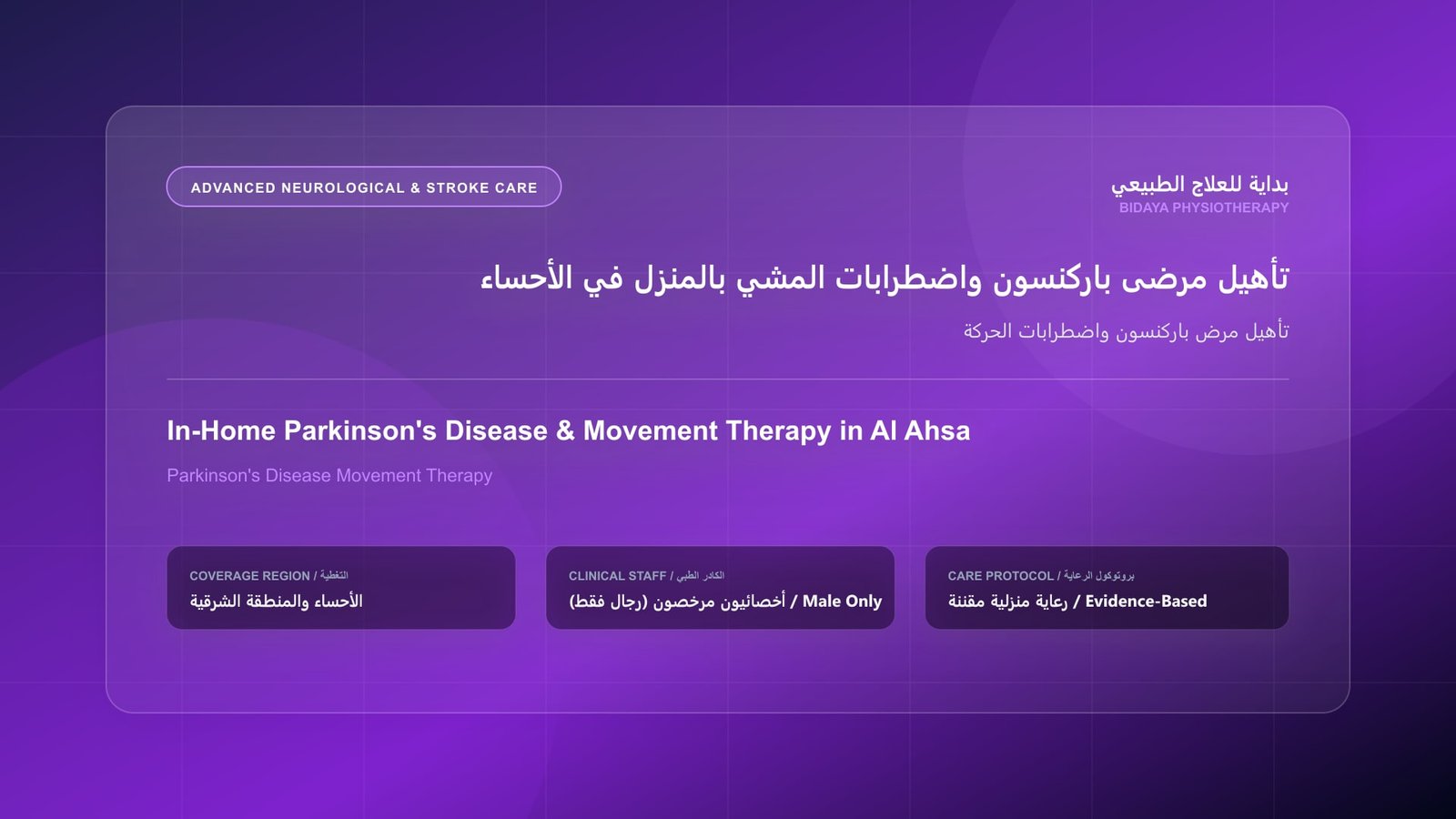
In-Home Parkinson's Disease & Movement Therapy in Al Ahsa
Advanced in-home rehabilitation across Al Ahsa led by licensed male clinicians, restoring mobility and daily functional independence.
Comprehensive In-Home Clinical Evaluation (60-75 Mins)
Detailed functional & neuro examination, home safety audit, and custom protocol with portable equipment — no upfront package commitments.
Flexible appointments 7 days a week (8 AM - 10 PM) • Payment upon visit completion
1,500+ Successful Home Recoveries
Certified Clinical Physiotherapists
Assessment-First Protocol
Thorough physical evaluation before any treatment plan starts
Specialized Male Therapists
Professional licensed therapists visiting your residence
100% In-Home Rehabilitation
No clinic travel friction or waiting room discomfort
Targeted Functional Goals
Focused on daily stairs, walking endurance, and independence
Emergency Medical Red-Flags & Home Care Boundaries
Emergency Medical Boundary: Bidaya provides scheduled in-home therapeutic rehabilitation and is not an emergency medical dispatch service. For acute neurological deficits, unreduced fractures, severe respiratory distress, or sudden chest pain, contact the Saudi Red Crescent immediately at 997 or 911.
Bidaya delivers an advanced in-home clinical rehabilitation pathway for Parkinson's Disease Movement Therapy across Al Ahsa, grounded in biomechanical science and graded neuromuscular loading. Care is directed strictly by a licensed male physical therapist who brings portable diagnostic instrumentation to your residence, aligning closely with protocols established at King Fahd Hospital in Al-Hofuf, Prince Saud bin Jalawi Hospital, and Almoosa Specialist Hospital.
Clinical Assessment of Parkinson's Disease & Bradykinesia in Al Ahsa
Assessing Rigidity, Postural Instability & Freezing of Gait (FOG) at Domestic Doorways
Parkinson's disease presents progressive functional motor challenges: bradykinesia, muscular rigidity, resting tremor, and episodic Freezing of Gait (FOG) when negotiating domestic doorways.
Bidaya's visiting physical therapists evaluate axial and appendicular rigidity, screen postural alignment, and analyze domestic spatial triggers that provoke motor freezing inside the home.
Medication Timing Synergy
Scheduling physical therapy visits during peak pharmacological 'On-Time' ensures optimal motor responsiveness and functional training gains.
- Evaluate bradykinesia and rigidity across major joint arcs
- Map domestic spatial trigger zones (doorways, turns) inducing gait freezing
- Administer pull-tests to assess reactive postural recovery mechanisms
- Coordinate therapy schedules with dopaminergic medication timetables
In-Home Large-Amplitude Movement Training & Sensory Cueing
High-Amplitude Drills, Auditory/Visual Cueing & Axial Extension Exercises
Therapy incorporates high-amplitude movement protocols to recalibrate internal motor amplitude perception, compelling larger steps and expansive arm swing trajectories.
Clinicians introduce visual floor cues (contrasting tape strips across thresholds) and rhythmic auditory pacing to break freezing episodes, paired with thoracic spinal extension calisthenics to correct stooped postures.
Freezing Override Strategy
When encountering a freezing episode, mentally cueing yourself to step over an imaginary laser beam or obstacle promptly reinitiates forward gait.
- Perform daily exaggerated big-amplitude arm and leg movement drills
- Install high-contrast visual floor tape lines across narrow domestic doorways
- Engage in daily pectoral and thoracic spinal extension stretches
- Walk accompanied along uncluttered domestic corridors practicing cadence pacing
Empowering Family Caregivers in Daily Rehabilitation for Parkinson's Disease Movement Therapy in Al Ahsa
Coaching Safe Biomechanics to Protect Caregiver Spine and Ensure Patient Stability
Sustained functional recovery within Al Ahsa households heavily depends on seamless synergy between the visiting physical therapist, family members, and domestic caregivers. Relying solely on clinical sessions without structured between-visit movement pacing significantly retards recovery velocity.
Bidaya's clinicians dedicate targeted intervals during each home visit to coach caregivers in: 1. Biomechanical transfer mechanics: Guiding patient transfers using gait belts and pelvic cues rather than traction on vulnerable joints, safeguarding the caregiver's spine. 2. Protective positioning: Systematic repositioning regimens to alleviate focal tissue pressure and thwart joint contractures, implementing LSVT BIG high-amplitude movement calisthenics, auditory metronome cadence retraining, and axial trunk rotation stretches. 3. Vital monitoring and exertion limits: Recognizing physiological red flags and pacing daily active-assisted drills.
This hands-on education transforms caregivers into competent, confident therapeutic partners across Al Ahsa.
Caregiver Mechanics Rule in Al Ahsa
Never hoist a patient by the axillae or affected arm; utilize a secure transfer belt, keeping the load close to your center of gravity with flexed knees.
- Fasten a specialized transfer belt snugly around patient waist during transfers
- Engage dual wheel locks on wheelchairs and hospital beds prior to shifting weight
- Prompt maximal active patient effort to prevent learned dependency
- Pace activity cycles with controlled diaphragmatic breathing breaks
Kinetic Chain Functional Screening & Dynamic Movement Profiling for Parkinson's Disease Movement Therapy
Analyzing Movement Compensations & Neuromuscular Coordination in Al Ahsa
Bidaya's clinical practice across Al Ahsa applies an advanced functional assessment model examining entire kinetic chain interactions relating to Parkinson's Disease Movement Therapy. Frequently, localized joint pain stems from compensatory strain secondary to hypo-mobility in proximal or distal articulations.
Advanced functional diagnostic pillars: 1. Multi-Planar Task Observation: Evaluating movement strategies during domestic ambulation, forward bending, and axial rotation to expose compensatory asymmetries. 2. Specialized Clinical Examination: Administering Unified Parkinson's Disease Rating Scale (UPDRS), 360-degree turn analysis, and retropulsion pull test to document baseline functional impairment. 3. Deep Core Stability Assessment: Testing anticipatory feed-forward activation of stabilizing muscles during limb perturbation. 4. Closed-Chain Proprioceptive Profiling: Assessing dynamic equilibrium and joint position sense to measure afferent sensory integrity.
This holistic kinematic map empowers our visiting male physical therapist to calibrate interventions aligned with Parkinson's Disease Questionnaire (PDQ-39) and Timed 10-Meter Walk Velocity.
Kinetic Chain Paradigm in Al Ahsa
Treating an isolated symptomatic joint without addressing kinetic chain dysfunction yields transient results; global realignment secures permanent recovery.
- Assess pelvic and core tilt control during single-leg weight-bearing challenges
- Document bilateral asymmetries in functional soft-tissue extensibility batteries
- Map postural alignment under functional load bearing
- Translate clinical biomechanical findings into actionable patient recovery goals
Functional Motor Recovery Roadmap & Progressive Kinetic Milestones for Parkinson's Disease Movement Therapy
Structured Transition from Assisted Movement to Independent Loading and Endurance
Bidaya implements a calibrated clinical roadmap ensuring progressive muscular endurance and full motion restoration for Parkinson's Disease Movement Therapy.
Functional progression trajectory: 1. Phase I (Neuromuscular Activation): Administering LSVT BIG high-amplitude movement calisthenics, auditory metronome cadence retraining, and axial trunk rotation stretches to engage motor units and resolve joint stiffness. 2. Phase II (Active Functional Arcs): Advancing toward full active range of motion reinforced by stabilizing muscle loading. 3. Phase III (Autonomy & Functional Capacity): Achieving eliminating doorway gait freezing episodes, mastering auditory-cued gait initiation, and expanding stride length by over 35%, training independent corridor ambulation and reciprocal stair navigation.
Phase transitions rely on objective testing substantiating tissue load tolerance.
Safe Transition Benchmark
Progressing to higher-demand drills strictly requires executing current protocols across 3 consecutive sessions with zero reactive soreness.
- Log repetitions and completed sets during each clinical session
- Temporarily halt exercise if sharp, unfamiliar pain suddenly manifests
- Perform exercises with slow, deliberate tempo to maximize target muscle recruitment
- Verify balance stability prior to weaning from crutches or walkers
Preventive Home Ergonomics & Recovery Microclimate Design for Parkinson's Disease Movement Therapy
Optimizing Room Clearance, Lighting & Safe Conditioning in Al Ahsa
Long-term rehabilitative success for Parkinson's Disease Movement Therapy depends on engineering an obstacle-free residential environment across Al Ahsa.
Preventive domestic adaptation steps: 1. Transit corridor clearance: Repositioning redundant furniture away from main domestic hallways to accommodate mobility aids without hindrance. 2. Specific motion precautions: Strictly respecting documented clinical instructions: removing throw rugs, applying high-contrast floor visual cues at doorways to break kinesia paradoxa, and providing rigid armrest seating. 3. Daily exercise execution: Diligently performing LSVT BIG high-amplitude movement calisthenics, auditory metronome cadence retraining, and axial trunk rotation stretches interspersed with structured recovery breaks. 4. Restful sleep mechanics: Deploying a contour mattress supporting physiological spinal lordosis and neutral joint alignment.
These structural adjustments enable patients to regain functional independence safely. Direct line: (+20 109 707 9170).
Restful Sleep Alignment in Al Ahsa
Positioning an ergonomic contour pillow between knees in side-lying posture aligns pelvic symmetry, arresting morning stiffness.
- Place a firm supportive pillow between knees when resting in side-lying
- Ensure adequate illumination across primary corridors day and night
- Execute home exercises during periods of peak physiological energy
- Share functional recovery updates via WhatsApp (+20 109 707 9170)
Clinical Triage Protocol & Urgent Medical Escalation for Parkinson's Disease Movement Therapy
Immediate Action Procedures & Rapid Referral to Tertiary Centers in Al Ahsa
Bidaya adheres to rigorous clinical governance standards across Al Ahsa. Our licensed male clinicians possess advanced training in rapid risk stratification and immediate emergency triage.
Indications demanding immediate therapeutic cessation and emergency escalation: 1. Disease-Specific Red Flags: Emergence of severe orthostatic syncopal drop, acute dysphagia aspiration, or unmitigated cranial impact falls. 2. Acute Cerebrovascular Symptoms: Sudden expressive dysphasia, facial asymmetry, or unprovoked unilateral hemiparesis. 3. Hemodynamic Collapse Indicators: Severe acute hypotension accompanied by pallor and diaphoresis, or resting ventricular tachyarrhythmia. 4. Thromboembolic Complications: Severe unilateral lower extremity swelling with localized heat, erythema, and calf tenderness.
Action Protocol: The clinician halts therapy, positions the patient comfortably, and immediately contacts the Saudi Red Crescent (997) for emergency ambulance transport to King Fahd Hospital in Al-Hofuf, Prince Saud bin Jalawi Hospital, and Almoosa Specialist Hospital. Bidaya delivers scheduled rehabilitative therapy, not emergency dispatch. Coordination: (+20 109 707 9170).
Urgent Triage Boundary in Al Ahsa
Patient safety is non-negotiable; any emergent red flag triggers immediate session termination and activation of emergency response (997).
- Halt physical therapy session instantly upon detecting abnormal physiological vitals
- Contact the Saudi Red Crescent (997) without clinical hesitation
- Immobilize the affected extremity if traumatic displacement is suspected
- Maintain continuous bedside observation until formal paramedic transfer
Functional Durability Blueprint & Recurrence Prevention for Parkinson's Disease Movement Therapy
Managing Daily Physical Capacity, Muscular Balance & Continuity Care across ${cityEn}
Bidaya implements an extended rehabilitative strategy across Al Ahsa shielding patients managing Parkinson's Disease Movement Therapy from long-term strength degradation or joint stiffness.
Pillars of functional durability: 1. Domestic Muscular Fortification: Executing LSVT BIG high-amplitude movement calisthenics, auditory metronome cadence retraining, and axial trunk rotation stretches consistently to sustain balanced vector forces surrounding target joints. 2. Avoiding Provocative Overload: Strictly observing movement boundaries: removing throw rugs, applying high-contrast floor visual cues at doorways to break kinesia paradoxa, and providing rigid armrest seating. 3. Standardized Metric Auditing: Periodically reassessing standardized scores via Parkinson's Disease Questionnaire (PDQ-39) and Timed 10-Meter Walk Velocity to detect subtle subclinical deficits. 4. Responsive Clinical Intake Desk: Maintaining direct communication with our licensed male physical therapists (+20 109 707 9170) to address questions.
This integrated approach ensures active, uncompromised daily living across Al Ahsa.
Kinetic Fortification in Al Ahsa
Retaining acquired muscular strength reduces symptom recurrence rates and re-injury potential by over 70%.
- Reserve dedicated daily time slots for restorative therapeutic calisthenics
- Wear supportive orthotic footwear during community strolls
- Engage in progressive low-impact exercise without acute fatigue
- Call Bidaya (+20 109 707 9170) to arrange review consultations when needed
Holistic Community Reintegration & Active Family Engagement across Al Ahsa
Total Motor Autonomy, Fulfilling Social Roles & Enjoying Life in Al Ahsa
Bidaya culminates its comprehensive physical therapy programs in Al Ahsa by restoring the patient's full familial and social contributions with complete vigor.
Pillars of ultimate life reintegration: 1. Enjoying Multi-Generational Family Life: Participating actively in activities with children and grandchildren without limitations from Parkinson's Disease Movement Therapy. 2. Mosque Prayer Fulfillment: Enjoying independent walking to community mosques for congregation prayers with comfort and dignity. 3. Routine Walkway Fitness: Embedding low-impact ambulation along shaded date-palm oasis pathways, Jabal Al-Qarah trails, and Ain Najm public park into permanent weekly routines. 4. Spontaneous Regional Transit: Traveling comfortably across districts like central Hofuf, Al Mubarraz, Eastern and Northern oasis districts to visit cultural and familial landmarks.
This tangible outcome represents our clinical mission for every individual served in Al Ahsa. Scheduling desk: (+20 109 707 9170).
Complete Autonomy in Al Ahsa
Autonomous functional mobility in daily life represents the true milestone of evidence-based, dedicated clinical rehabilitation.
- Celebrate functional mobility milestones and encourage ongoing physical activity
- Maintain outdoor corridor ambulation 2 to 3 times weekly as a lifestyle habit
- Stay connected with your clinical team for annual preventive wellness checks
- Call Bidaya (+20 109 707 9170) to coordinate any future rehabilitative needs
Clinical Governance, Quality Assurance & Standardized Functional Metrics in Al Ahsa
Rigorous Clinical Documentation, Objective Outcome Quantification & Safety Standards
All home physiotherapy interventions delivered by Bidaya across Al Ahsa for Parkinson's Disease Movement Therapy operate under a structured clinical governance framework, guaranteeing quality and clinical efficacy equivalent to premium tertiary institutions.
Pillars of clinical quality assurance and objective monitoring: 1. Standardized Patient-Reported Outcome Measures (PROMs): Deploying internationally validated metrics—including Parkinson's Disease Questionnaire (PDQ-39) and Timed 10-Meter Walk Velocity—at baseline, interim, and graduation intervals to quantify recovery progress objectively. 2. Peer Review and Clinical Case Auditing: Conducting multidisciplinary chart reviews to confirm therapeutic trajectories align with evidence-based rehabilitative milestones and recommendations from King Fahd Hospital in Al-Hofuf, Prince Saud bin Jalawi Hospital, and Almoosa Specialist Hospital. 3. Stringent Mobile Infection Control: Enforcing hospital-grade sanitization protocols for all mobile therapy apparatus prior to domestic deployment and immediately post-session. 4. Patient and Caregiver Experience Governance: Gathering continuous feedback through our clinical coordination desk (+20 109 707 9170) to adapt care pacing and enhance domestic engagement.
This uncompromising standard establishes Bidaya as the dependable in-home physical therapy provider across Al Ahsa.
Clinical Excellence Metric in Al Ahsa
Quantifying rehabilitation milestones with standardized objective scales ensures full transparency and predictable functional restoration.
- Maintain encrypted electronic functional tracking throughout the episode of care
- Adhere to hospital-grade disinfection for all portable assessment instruments
- Conduct periodic functional score re-evaluations to substantiate discharge criteria
- Reach clinical coordination desk (+20 109 707 9170) for medical chart summaries
Frequently Asked Questions about In-Home Physiotherapy
An MRI is rarely a prerequisite; our clinician's rigorous biomechanical examination includes Unified Parkinson's Disease Rating Scale (UPDRS), 360-degree turn analysis, and retropulsion pull test to accurately identify structural drivers and movement limitations.
Related Clinical & Regional Pathways
Diabetic Neuropathy & Balance Physiotherapy→
Advanced in-home rehabilitation across Al Ahsa led by licensed male clinicians
Stroke & Hemiplegia Neurological Rehab→
Advanced in-home rehabilitation across Al Ahsa led by licensed male clinicians
Cardiopulmonary & Chest Physiotherapy→
Advanced in-home rehabilitation across Al Ahsa led by licensed male clinicians
In-Home Physiotherapy Eastern Province Therapy→
Comprehensive clinical rehabilitation delivered directly to your residence across Dammam
In-Home Low Back Pain & Sciatica Rehabilitation Therapy→
Evidence-based clinical rehabilitation engineered to resolve lumbar disc herniations
In-Home Knee Pain & Osteoarthritis Rehabilitation Therapy→
Evidence-based clinical rehabilitation engineered to arrest articular cartilage degeneration
In-Home Stroke Rehabilitation & Neurological Physiotherapy Therapy→
Evidence-based neurological rehabilitation engineered to stimulate corticomotor neuroplasticity
In-Home Post-Operative Physiotherapy Therapy→
Evidence-based surgical rehabilitation protocols engineered to restore joint range of motion