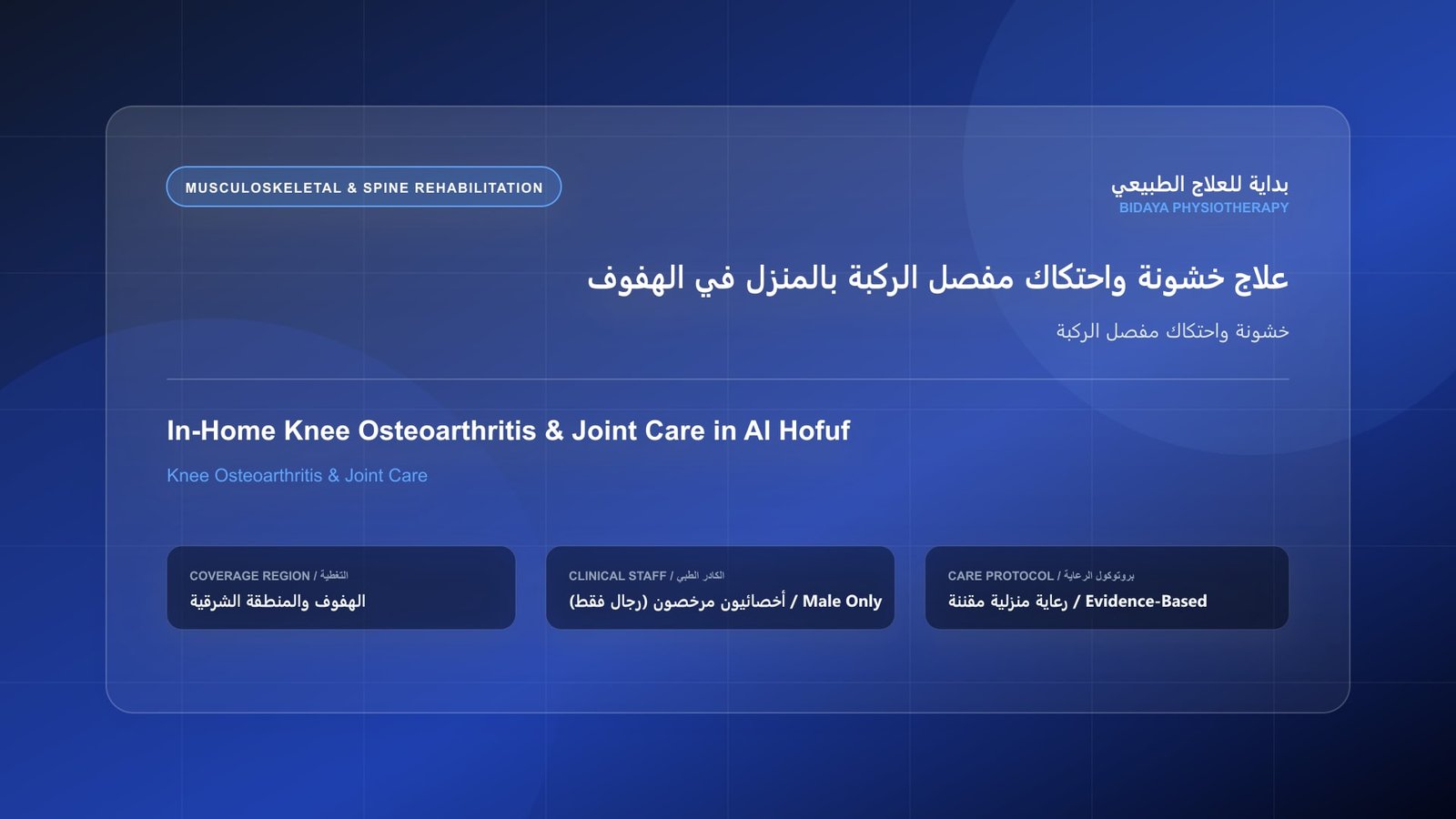
In-Home Knee Osteoarthritis & Joint Care in Al Hofuf
Advanced in-home rehabilitation across Al Hofuf led by licensed male clinicians, restoring mobility and daily functional independence.
Comprehensive In-Home Clinical Evaluation (60-75 Mins)
Detailed functional & neuro examination, home safety audit, and custom protocol with portable equipment — no upfront package commitments.
Flexible appointments 7 days a week (8 AM - 10 PM) • Payment upon visit completion
1,500+ Successful Home Recoveries
Certified Clinical Physiotherapists
Assessment-First Protocol
Thorough physical evaluation before any treatment plan starts
Specialized Male Therapists
Professional licensed therapists visiting your residence
100% In-Home Rehabilitation
No clinic travel friction or waiting room discomfort
Targeted Functional Goals
Focused on daily stairs, walking endurance, and independence
Emergency Medical Red-Flags & Home Care Boundaries
Emergency Medical Boundary: Bidaya provides scheduled in-home therapeutic rehabilitation and is not an emergency medical dispatch service. For acute neurological deficits, unreduced fractures, severe respiratory distress, or sudden chest pain, contact the Saudi Red Crescent immediately at 997 or 911.
Specialized in-home physiotherapy for Knee Osteoarthritis & Joint Care across Al Hofuf provides the gold standard for restoring movement while sparing patients the physical strain of clinic transit. Bidaya's visiting male clinicians execute meticulous diagnostic assessments including goniometric knee flexion/extension arcs, ligamentous/meniscal stress screening (Lachman & McMurray), patellar mobility, and VMO recruitment audit, structuring targeted functional drills.
Clinical Diagnosis of Knee Osteoarthritis in Al Hofuf
Cartilage Degeneration, Crepitus & Seating Transfer Biomechanics
Knee osteoarthritis is exceptionally prevalent among older adults across Al Hofuf, aggravated by repetitive low floor seating and acute knee hyperflexion.
Bidaya's visiting physical therapists assess active and passive knee ranges of motion, palpate patellofemoral crepitus, grade joint effusion, and evaluate quadriceps and hip strength.
Cartilage Nutrition Metric
Articular cartilage relies on mechanical motion for synovial nutrient diffusion; controlled non-impact exercises preserve cartilage integrity.
- Quantify active knee flexion and extension deficits
- Palpate joint line tenderness, crepitus, and assess effusion severity
- Evaluate chair sit-to-stand kinematics and biomechanical compensations
- Prescribe ergonomic seating modifications for domestic living spaces
In-Home Quadriceps Strengthening & Cartilage Offloading
Submaximal Isometrics, Closed-Chain Loading & Ergonomic Sitting/Prayer Advice
Therapy introduces submaximal isometric quad sets that activate musculature without abrasive articular wear, advancing to closed-chain loading and hip abductor strengthening.
Clinicians coach ergonomic prayer mechanics and elevated chair seating, minimizing patellofemoral compressive stresses.
Morning Stiffness Relief Pearl
Performing gentle non-weight-bearing knee extensions in bed prior to rising stimulates synovial fluid, reducing morning stiffness.
- Execute isometric quadriceps contractions in supine or seated postures daily
- Utilize elevated seating maintaining hips and knees at 90 degrees
- Apply moist thermotherapy prior to exercises to relax peri-articular structures
- Maintain brief, paced indoor walks on level flooring
Overcoming Residential Staircase & Entryway Step Barriers in Al Hofuf
Practical Strategies for Internal Multi-Tier Stairs, Thresholds & Family Transit
Patients managing Knee Osteoarthritis & Joint Care across Al Hofuf frequently encounter mobility barriers rooted in residential design, where exterior entrances require ascending concrete steps and living spaces span multiple stories.
Bidaya's structured in-home clinical approach includes: 1. Progressive stair navigation retraining: Utilizing handrail support and coaching bodyweight distribution while strictly respecting avoiding deep unassisted knee hyperflexion squats, and applying post-exertional cold packs to abort reactive joint effusion. 2. Entryway threshold clearance: Training safe swing-phase foot clearance to negotiate raised door thresholds typical of Al Hofuf villas. 3. Interval pacing strategies: Instructing scheduled micro-pauses during domestic transit to prevent cumulative muscular fatigue.
All drills are directed by credentialed male physical therapists who blend clinical rigor with complete respect for domestic privacy.
Stair Navigation Rule in Al Hofuf
Ascending leading with the sound leg recruits healthy musculature to hoist bodyweight, while descending leading with the affected leg protects healing tissues.
- Practice daily staircase negotiation under clinician or trained caregiver supervision
- Confirm rigid anchoring of all domestic staircase handrails
- Avoid staircase navigation under extreme fatigue or subdued illumination
- Deploy a single supportive cane for inter-floor domestic transits when recommended
Neuromuscular & Sensorimotor Profiling for Knee Osteoarthritis & Joint Care Across Al Hofuf
Reflex Integrity, Motor Synergies & Equilibrium Response in Domestic Quarters
Bidaya's credentialed male physical therapists in Al Hofuf deliver systematic neuromuscular screening for patients with Knee Osteoarthritis & Joint Care, ensuring efferent motor output coordinates with afferent sensory feedback.
Diagnostic examination workflow: 1. Dedicated Clinical Screening: Administering goniometric knee flexion/extension arcs, ligamentous/meniscal stress screening (Lachman & McMurray), patellar mobility, and VMO recruitment audit to quantify motor conduction velocity and joint capsular stability. 2. Synergistic Motor Control Testing: Evaluating stabilizing muscle latency during rapid center-of-mass perturbations. 3. Hemodynamic Exertional Tolerance: Recording blood pressure, pulse rate, and exertion ratings to verify cardiovascular fitness for rehabilitation. 4. Ecological Gait Auditing: Analyzing real-world ambulation kinematics over the patient's home flooring, detecting antalgic compensations.
This diagnostic baseline enables personalized therapeutic dosing substantiated by Knee Injury and Osteoarthritis Outcome Score (KOOS) and WOMAC Osteoarthritis Index.
Sensorimotor Synergy in Al Hofuf
Muscular force restoration remains incomplete without retrained proprioceptive reflexes that prevent accidental domestic re-injury.
- Assess protective righting reactions during dynamic balance challenges
- Screen inter-limb coordination during multi-joint movement tasks
- Log baseline hemodynamic vitals prior to initiating active evaluation
- Correlate clinical findings with medical records from King Fahd Hospital in Al-Hofuf and specialized outpatient rehabilitation clinics
Arthrokinematic Loading & Eccentric Deceleration Training for Knee Osteoarthritis & Joint Care
Developing Dynamic Motor Control & Myofascial Remodeling in Domestic Setting
Bidaya's structured protocol emphasizes dynamic motor control and tissue adaptation for patients with Knee Osteoarthritis & Joint Care via progressive mechanical dosing.
Arthrokinematic progression phases: 1. Multi-Angle Isometrics: Initiating progressive Vastus Medialis Obliquus (VMO) band-resisted loading, closed-chain gluteus medius pelvic stabilization, and terminal knee extension isometrics to build force output without provocative articular displacement. 2. Controlled Eccentric Loading: Training muscle-tendon units to decelerate loads during elongation, stimulating tensile remodeling. 3. Functional Multi-Planar Drills: Progressing to domestic chair transfers and ground-level rising mechanics.
The central clinical goal is attaining restoring full 0-degree extension without capsular restriction, reciprocal stair negotiation, and reducing walking pain beneath 2/10 with uncompromising biomechanical safety.
Significance of Eccentric Conditioning
Eccentric training enhances tendon tensile modulus and energy absorption, safeguarding articulations against domestic shear forces.
- Execute the eccentric lowering phase at twice the duration of concentric lifting
- Maintain regular diaphragmatic respiration avoiding the Valsalva maneuver
- Monitor joint alignment throughout multi-joint functional drills
- Document functional milestone progression in domestic clinical logs
Autonomous Domestic Independence & Self-Care Protocols for Knee Osteoarthritis & Joint Care
Daily Energy Conservation, Habitual Joint Protection & Exercise Adherence in Al Hofuf
Bidaya empowers patients across Al Hofuf to direct their daily self-care confidently without fear of symptom resurgence from Knee Osteoarthritis & Joint Care.
Key pillars of domestic functional autonomy: 1. Energy conservation pacing: Performing personal grooming seated rather than standing whenever feasible to offload lower extremity joints. 2. Adherence to safety envelopes: Strictly observing documented movement limits: avoiding deep unassisted knee hyperflexion squats, and applying post-exertional cold packs to abort reactive joint effusion. 3. Daily restorative movement: Sustaining prescribed progressive Vastus Medialis Obliquus (VMO) band-resisted loading, closed-chain gluteus medius pelvic stabilization, and terminal knee extension isometrics to build enduring musculoskeletal resilience. 4. Longitudinal clinical communication: Consulting your designated clinician to advance exercise dosages as milestones are attained.
This structured autonomy allows patients to resume fulfilling domestic lives across Al Hofuf. Contact coordination: (+20 109 707 9170).
Joint Energy Conservation in Al Hofuf
Executing light domestic chores seated diminishes cumulative compressive forces on lower limb joints by 35%.
- Utilize a sturdy high stool in food preparation areas to avoid prolonged stance
- Perform gentle morning extensibility drills to disperse joint stiffness
- Avoid hurried movements, incorporating calculated micro-pauses throughout the day
- Coordinate with your visiting clinician (+20 109 707 9170) for progression
Rigorous Safety Standards & Emergency Triage Pathways for Knee Osteoarthritis & Joint Care
Immediate Session Cessation, Stabilization & Direct Red Crescent (997) Referral
All home physical therapy encounters delivered by Bidaya's licensed male clinicians in Al Hofuf adhere to strict safety protocols prioritizing medical stability above functional exercise.
Situations necessitating immediate therapeutic cessation: 1. Acute Clinical Crisis Indicators: Emergence of severe acute knee effusion with erythema and systemic fever (suspected septic arthritis), or true sudden mechanical joint locking. 2. Hemodynamic Instability: Palpitations coupled with profound dizziness or anginal discomfort. 3. Surgical or Vascular Breakdown: Sudden wound dehiscence or active bleeding refractory to light direct pressure. 4. Acute Cauda Equina or Sudden Paresis: Loss of sensation in the perineum or acute bilateral lower limb weakness.
Emergency Care Workflow: The clinician terminates drills immediately, reassures the family, and coordinates immediate ambulance dispatch via the Saudi Red Crescent at 997 or 911. Bidaya is a scheduled restorative therapy service, not an emergency ambulance service. Clinical desk: (+20 109 707 9170).
Maximal Clinical Safety in Al Hofuf
Strict adherence to medical safety boundaries protects patients, ensuring acute care is administered at the appropriate facility.
- Dial Saudi Red Crescent (997) instantly upon suspecting clinical red flags
- Avoid moving patients following severe domestic falls with suspected pelvic fractures
- Assemble hospital discharge summaries and medication lists for paramedics
- Follow up with patient and clinical desk following hospital stabilization
Longitudinal Kinetic Surveillance & Joint Preservation Protocol for Knee Osteoarthritis & Joint Care
Structured Self-Drills, Mobility Tracking & Periodic Consultations in ${cityEn}
Bidaya's long-term kinetic surveillance protocol cements functional milestones achieved during in-home sessions for Knee Osteoarthritis & Joint Care across Al Hofuf.
Core elements of kinetic surveillance: 1. Daily Restorative Routine: Performing gentle mobility exercises drawn from progressive Vastus Medialis Obliquus (VMO) band-resisted loading, closed-chain gluteus medius pelvic stabilization, and terminal knee extension isometrics to stimulate synovial fluid circulation. 2. Self-Administered Motion Audits: Training patients to self-evaluate functional motion against restoring full 0-degree extension without capsular restriction, reciprocal stair negotiation, and reducing walking pain beneath 2/10. 3. Social Ergonomic Adaptation: Practical strategies for safe sitting and standing during community and family gatherings across Al Hofuf. 4. Longitudinal Support Conduits: Ongoing clinical guidance available via Bidaya's telephone desk (+20 109 707 9170).
This continuous oversight provides long-term peace of mind and sustained functional vitality.
Joint Preservation Practice in Al Hofuf
Cartilage nutrition relies on repetitive cyclic loading; gentle therapeutic movement represents the first defense against joint degeneration.
- Sustain prescribed autonomous exercise calisthenics at home regularly
- Identify early signs of focal joint irritation and modulate intensity
- Engage in structured walking along pleasant promenades like Al-Ahsa Municipality civic walkway and Al-Hofuf central landscaped loops
- Connect with Bidaya (+20 109 707 9170) to advance exercise programs periodically
Community Reintegration & Social Lifestyle Resumption Across Al Hofuf
Safe Return to Mosque Prayers, Public Strolling & Domestic Family Engagements
The ultimate measure of successful in-home rehabilitation delivered by Bidaya across Al Hofuf for Knee Osteoarthritis & Joint Care is restoring the patient's full participation in cultural, familial, and spiritual routines without apprehension.
Key pillars of domestic and social reintegration: 1. Mosque Prayer Functional Mobility: Retraining safe transitions between upright stance, bowing (ruku), and kneeling/prostration (sujud), or mastering ergonomic prayer chair transfers. 2. Community Strolling & Walkway Navigation: Conditioning ambulation over diverse outdoor terrains along Al-Ahsa Municipality civic walkway and Al-Hofuf central landscaped loops with paced breathing cadence. 3. Vehicular Transfers & Family Visits: Practicing automotive ingress/egress and negotiating multi-height domestic thresholds to enjoy family gatherings across Al-Koot, Al-Naathel, Al-Salihiyah, Al-Shehabiyah, and Al-Khalidiyah. 4. Psychological Empowerment & Autonomy: Dispelling fear-avoidance beliefs and overcoming domestic isolation, which dramatically elevates systemic well-being and quality of life.
We accompany each patient step by step until complete functional vitality is restored within their community in Al Hofuf. Clinical intake desk: (+20 109 707 9170).
Community Independence in Al Hofuf
Restoring the capacity to walk to local mosques and attend family gatherings represents the true milestone of functional recovery.
- Rehearse vehicle ingress and egress mechanics under clinician guidance
- Select temperate diurnal windows for outdoor community strolling
- Wear biomechanically supportive footwear suited to variable outdoor terrains
- Contact Bidaya (+20 109 707 9170) to coordinate guided community mobility progression
Clinical Governance, Quality Assurance & Standardized Functional Metrics in Al Hofuf
Rigorous Clinical Documentation, Objective Outcome Quantification & Safety Standards
All home physiotherapy interventions delivered by Bidaya across Al Hofuf for Knee Osteoarthritis & Joint Care operate under a structured clinical governance framework, guaranteeing quality and clinical efficacy equivalent to premium tertiary institutions.
Pillars of clinical quality assurance and objective monitoring: 1. Standardized Patient-Reported Outcome Measures (PROMs): Deploying internationally validated metrics—including Knee Injury and Osteoarthritis Outcome Score (KOOS) and WOMAC Osteoarthritis Index—at baseline, interim, and graduation intervals to quantify recovery progress objectively. 2. Peer Review and Clinical Case Auditing: Conducting multidisciplinary chart reviews to confirm therapeutic trajectories align with evidence-based rehabilitative milestones and recommendations from King Fahd Hospital in Al-Hofuf and specialized outpatient rehabilitation clinics. 3. Stringent Mobile Infection Control: Enforcing hospital-grade sanitization protocols for all mobile therapy apparatus prior to domestic deployment and immediately post-session. 4. Patient and Caregiver Experience Governance: Gathering continuous feedback through our clinical coordination desk (+20 109 707 9170) to adapt care pacing and enhance domestic engagement.
This uncompromising standard establishes Bidaya as the dependable in-home physical therapy provider across Al Hofuf.
Clinical Excellence Metric in Al Hofuf
Quantifying rehabilitation milestones with standardized objective scales ensures full transparency and predictable functional restoration.
- Maintain encrypted electronic functional tracking throughout the episode of care
- Adhere to hospital-grade disinfection for all portable assessment instruments
- Conduct periodic functional score re-evaluations to substantiate discharge criteria
- Reach clinical coordination desk (+20 109 707 9170) for medical chart summaries
Frequently Asked Questions about In-Home Physiotherapy
Home rehabilitation trains real-world functional tasks—such as bed transfers and villa staircase negotiation in Al Hofuf—yielding faster and more sustainable functional autonomy.
Related Clinical & Regional Pathways
In-Home Physiotherapy in Al Mubarraz→
Comprehensive in-home physical therapy delivered across Al Mubarraz by licensed male clinicians for geriatric
Lumbar Disc & Sciatica Physiotherapy→
Advanced in-home rehabilitation across Al Hofuf led by licensed male clinicians
Elderly Mobility & Balance Physiotherapy→
Advanced in-home rehabilitation across Al Mubarraz led by licensed male clinicians
In-Home Physiotherapy Eastern Province Therapy→
Comprehensive clinical rehabilitation delivered directly to your residence across Dammam
In-Home Low Back Pain & Sciatica Rehabilitation Therapy→
Evidence-based clinical rehabilitation engineered to resolve lumbar disc herniations
In-Home Knee Pain & Osteoarthritis Rehabilitation Therapy→
Evidence-based clinical rehabilitation engineered to arrest articular cartilage degeneration
In-Home Stroke Rehabilitation & Neurological Physiotherapy Therapy→
Evidence-based neurological rehabilitation engineered to stimulate corticomotor neuroplasticity
In-Home Post-Operative Physiotherapy Therapy→
Evidence-based surgical rehabilitation protocols engineered to restore joint range of motion