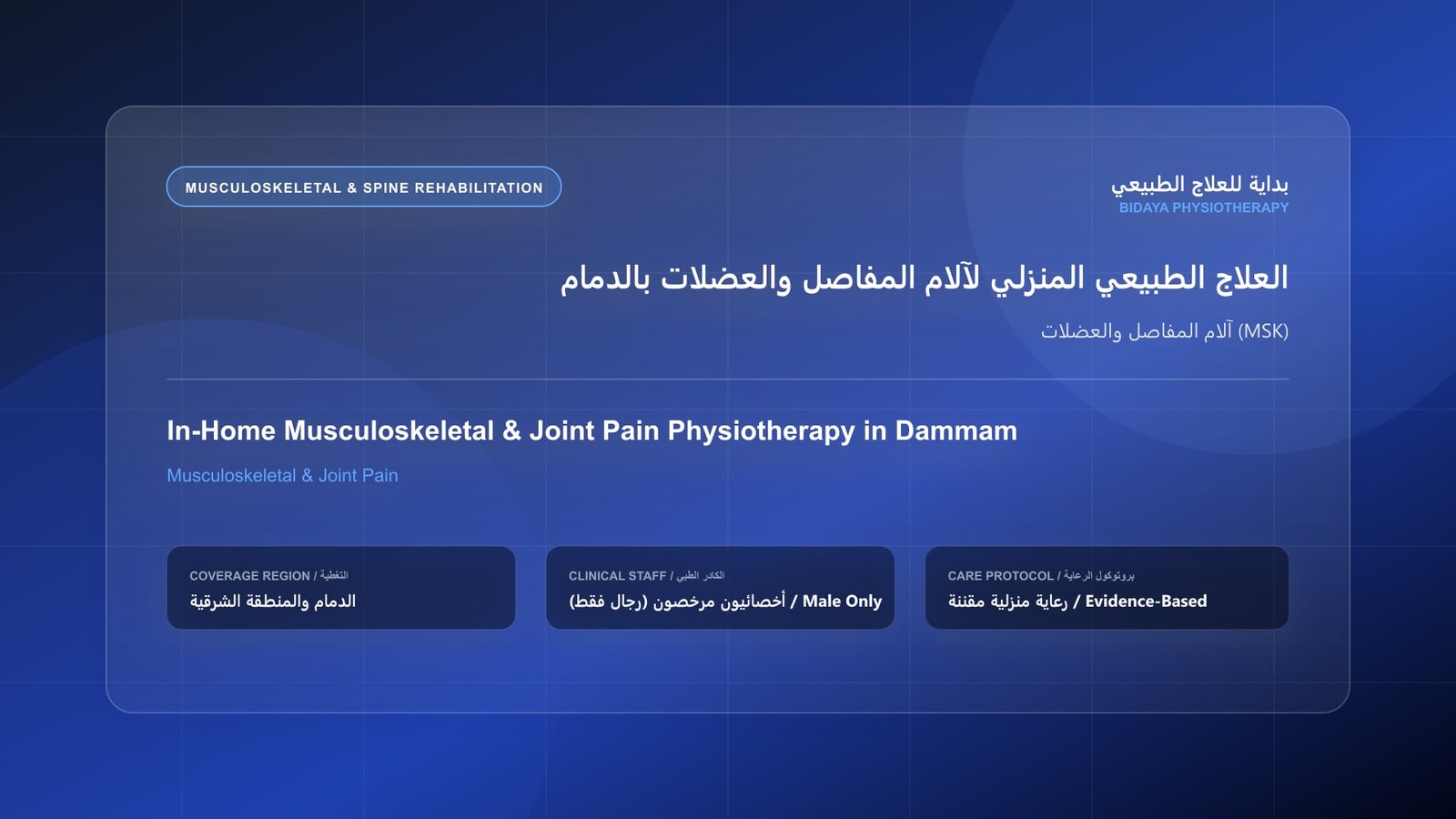
In-Home Musculoskeletal & Joint Pain Physiotherapy in Dammam
Advanced in-home rehabilitation across Dammam led by licensed male clinicians, restoring mobility and daily functional independence.
Comprehensive In-Home Clinical Evaluation (60-75 Mins)
Detailed functional & neuro examination, home safety audit, and custom protocol with portable equipment — no upfront package commitments.
Flexible appointments 7 days a week (8 AM - 10 PM) • Payment upon visit completion
1,500+ Successful Home Recoveries
Certified Clinical Physiotherapists
Assessment-First Protocol
Thorough physical evaluation before any treatment plan starts
Specialized Male Therapists
Professional licensed therapists visiting your residence
100% In-Home Rehabilitation
No clinic travel friction or waiting room discomfort
Targeted Functional Goals
Focused on daily stairs, walking endurance, and independence
Emergency Medical Red-Flags & Home Care Boundaries
Emergency Medical Boundary: Bidaya provides scheduled in-home therapeutic rehabilitation and is not an emergency medical dispatch service. For acute neurological deficits, unreduced fractures, severe respiratory distress, or sudden chest pain, contact the Saudi Red Crescent immediately at 997 or 911.
Specialized in-home physiotherapy for Musculoskeletal & Joint Pain across Dammam provides the gold standard for restoring movement while sparing patients the physical strain of clinic transit. Bidaya's visiting male clinicians execute meticulous diagnostic assessments including objective joint goniometry, selective tissue tension palpation, and bilateral kinetic chain alignment screening, structuring targeted functional drills.
Biomechanical Evaluation of Musculoskeletal Joint Dysfunction in Dammam
Deconstructing Kinetic Chain Imbalances, Joint Restrictions & Trigger Point Pain
Musculoskeletal (MSK) disorders represent a primary cause of physical limitation in Dammam, frequently exacerbated by prolonged vehicular transit and sedentary desk work.
Bidaya's visiting physical therapists (licensed male clinicians) evaluate full closed and open kinetic chains, palpating myofascial trigger points, joint arthrokinematic glide restrictions, and surrounding muscular imbalances.
Therapy evaluates domestic furniture ergonomics: low traditional seating often imposes excessive compressive stress across hip and patellofemoral joints, which our clinicians correct through practical biomechanical adjustments.
Kinetic Chain Clinical Pearl
Articular pain frequently manifests due to insufficient periarticular muscular stabilization rather than isolated cartilage pathology.
- Assess active and passive arthrokinematic joint excursion
- Map hypertonic versus inhibited muscle groups across kinetic chains
- Deliver targeted gentle manual joint mobilizations to resolve stiffness
- Modify living room seating heights to mitigate joint contact pressures
Progressive Domestic Conditioning Protocol for Pain Relief & Joint Stability
Functional Resistance Calisthenics Calibrated to Patient Home Architecture
Bidaya's structured in-home protocol initiates with sub-maximal isometric stabilization to damp nociceptive input without stressing inflamed synovium, progressing toward dynamic band resistance calisthenics.
All exercise prescriptions utilize domestic structures (hallway walls, sturdy chairs, bed frames), automating self-management and securing lasting mobility gains during functional ambulation and stair transitions.
Practical Symptom Modulation
Applying superficial thermotherapy for 15 minutes prior to mobility routines enhances regional tissue compliance and diminishes stiffness.
- Execute targeted myofascial stretching protocols twice daily
- Advance resistance band loading strictly under clinician supervision
- Eliminate rapid torsional loading while handling heavy domestic items
- Maintain neutral spinal posture during sit-to-stand transitions
Empowering Family Caregivers in Daily Rehabilitation for Musculoskeletal & Joint Pain in Dammam
Coaching Safe Biomechanics to Protect Caregiver Spine and Ensure Patient Stability
Sustained functional recovery within Dammam households heavily depends on seamless synergy between the visiting physical therapist, family members, and domestic caregivers. Relying solely on clinical sessions without structured between-visit movement pacing significantly retards recovery velocity.
Bidaya's clinicians dedicate targeted intervals during each home visit to coach caregivers in: 1. Biomechanical transfer mechanics: Guiding patient transfers using gait belts and pelvic cues rather than traction on vulnerable joints, safeguarding the caregiver's spine. 2. Protective positioning: Systematic repositioning regimens to alleviate focal tissue pressure and thwart joint contractures, implementing progressive elastic-resistance strengthening, joint proprioceptive stabilization drills, and targeted myofascial stretching. 3. Vital monitoring and exertion limits: Recognizing physiological red flags and pacing daily active-assisted drills.
This hands-on education transforms caregivers into competent, confident therapeutic partners across Dammam.
Caregiver Mechanics Rule in Dammam
Never hoist a patient by the axillae or affected arm; utilize a secure transfer belt, keeping the load close to your center of gravity with flexed knees.
- Fasten a specialized transfer belt snugly around patient waist during transfers
- Engage dual wheel locks on wheelchairs and hospital beds prior to shifting weight
- Prompt maximal active patient effort to prevent learned dependency
- Pace activity cycles with controlled diaphragmatic breathing breaks
Dynamic Functional Pathway Assessment for Musculoskeletal & Joint Pain Across Dammam
Monitoring Tissue Adaptation, Load Tolerance & Structuring Recovery Goals
Bidaya's licensed male clinicians in Dammam implement a dynamic evaluation paradigm for Musculoskeletal & Joint Pain centered on functional adaptability within domestic and community environments.
Diagnostic assessment workflow: 1. Specialized Testing Protocols: Deploying objective joint goniometry, selective tissue tension palpation, and bilateral kinetic chain alignment screening to map functional motor deficits. 2. Mechanical Load Tolerance Testing: Tracking post-provocation symptom latency to gauge tissue irritability. 3. Repetitive Task Fatigue Auditing: Assessing muscular endurance degradation during continuous functional cycles to uncover latent weakness. 4. Functional Milestone Calibration: Aligning therapeutic objectives with the patient's most valued daily activities utilizing Patient-Specific Functional Scale (PSFS) and Numeric Pain Rating Scale (NPRS).
This structured diagnostic battery guides home sessions directly toward uncompromised functional restoration.
Real-World Functional Goals in Dammam
Anchoring physical therapy milestones to meaningful domestic activities elevates patient adherence and accelerates clinical gains.
- Establish short- and long-term milestones collaboratively with patient
- Screen muscular fatigue thresholds during sustained functional tasks
- Document functional mobility gains in objective percentage increments
- Review past medical history and medications influencing postural stability
Biomechanically Governed Tissue Loading & Progressive Phase Transitions
Advancing from Submaximal Isometrics to Dynamic Eccentric Strengthening for Musculoskeletal & Joint Pain
Rehabilitation progression at Bidaya is governed by physiological tissue healing timelines, ensuring collagen remodeling occurs safely for Musculoskeletal & Joint Pain.
Phased progression criteria: 1. Symptom Modulation & Stabilization: Initiating progressive elastic-resistance strengthening, joint proprioceptive stabilization drills, and targeted myofascial stretching within safe arcs to reverse arthrogenic muscle inhibition. 2. Dynamic Isotonic Resisted Loading: Advancing to progressive concentric and eccentric resistance using graded bands once resting pain subsides. 3. Closed Kinetic Chain Integration: Incorporating multi-joint functional loading replicating stair descent and chair transfers.
Target Milestones: Prioritizing restoring full active physiological joint arcs, eliminating resting discomfort, and resuming domestic activities with pain < 2/10, strictly requiring exercise discomfort to remain beneath 3/10 without reactive next-day joint effusion.
Tissue Adaptation Milestone
Progressive mechanical tension promotes parallel collagen remodeling; calibrated loading builds resilience, whereas premature strain precipitates recurrent inflammation.
- Respect designated inter-set rest intervals to avoid acute neuromuscular fatigue
- Audit tissue response precisely 24 hours after introducing higher resistances
- Limit temporary mobility aids strictly as directed by the visiting clinician
- Conduct serial weekly strength tests to dynamically calibrate resistance dosages
Domestic Environmental Hazard Auditing & Pathway Clearance for Musculoskeletal & Joint Pain
Securing Ambulation Corridors, Bathroom Retrofits & Fall Prevention across Dammam
Bidaya's licensed male physical therapists transform the patient's residence in Dammam into an engineered recovery environment supporting autonomy for Musculoskeletal & Joint Pain.
Core environmental hazard adaptations: 1. Washroom and shower retrofitting: Securing structural wall grab bars adjacent to toilets and showers, deploying rubberized suction mats to abort slips. 2. Living room and bedroom reconfiguration: Replacing deep, low sofas with ergonomic firm chairs, avoiding avoiding ballistic uncalibrated overloading, and organizing domestic transit pathways to avert accidental joint sprain. 3. Daily conditioning integration: Implementing calibrated progressive elastic-resistance strengthening, joint proprioceptive stabilization drills, and targeted myofascial stretching at structured daily times while tracking exertion. 4. Stable equilibrium support: Ensuring a sturdy support anchor remains within arm's reach during standing balance drills.
These adjustments establish a supportive living space promoting durable recovery. Contact intake: (+20 109 707 9170).
Safe Home Space in Dammam
Illuminating transit corridors and securing wall anchors reduces domestic slip-and-trip incidents by over 75% on polished surfaces.
- Mount wall-anchored safety grab bars at high-risk transfer locations
- Refrain from performing unassisted standing drills over low-friction tiling
- Exercise under direct caregiver contact-guarding if balance is compromised
- Contact Bidaya directly to modify home exercise intensity as symptoms evolve
Rigorous Safety Standards & Emergency Triage Pathways for Musculoskeletal & Joint Pain
Immediate Session Cessation, Stabilization & Direct Red Crescent (997) Referral
All home physical therapy encounters delivered by Bidaya's licensed male clinicians in Dammam adhere to strict safety protocols prioritizing medical stability above functional exercise.
Situations necessitating immediate therapeutic cessation: 1. Acute Clinical Crisis Indicators: Emergence of unremitting nocturnal pain unaffected by posture, severe localized joint heat with systemic fever, or sudden sensory loss. 2. Hemodynamic Instability: Palpitations coupled with profound dizziness or anginal discomfort. 3. Surgical or Vascular Breakdown: Sudden wound dehiscence or active bleeding refractory to light direct pressure. 4. Acute Cauda Equina or Sudden Paresis: Loss of sensation in the perineum or acute bilateral lower limb weakness.
Emergency Care Workflow: The clinician terminates drills immediately, reassures the family, and coordinates immediate ambulance dispatch via the Saudi Red Crescent at 997 or 911. Bidaya is a scheduled restorative therapy service, not an emergency ambulance service. Clinical desk: (+20 109 707 9170).
Maximal Clinical Safety in Dammam
Strict adherence to medical safety boundaries protects patients, ensuring acute care is administered at the appropriate facility.
- Dial Saudi Red Crescent (997) instantly upon suspecting clinical red flags
- Avoid moving patients following severe domestic falls with suspected pelvic fractures
- Assemble hospital discharge summaries and medication lists for paramedics
- Follow up with patient and clinical desk following hospital stabilization
Extended Kinetic Care Continuum & Physical Life Quality for Musculoskeletal & Joint Pain
Sustaining Functional Fitness, Preserving Mobility & Long-Term Clinical Governance in ${cityEn}
Bidaya's extended care continuum ensures patients managing Musculoskeletal & Joint Pain experience the highest levels of functional quality of life across Dammam.
Pillars of extended kinetic wellness: 1. Sustainable Routine Design: Embedding progressive elastic-resistance strengthening, joint proprioceptive stabilization drills, and targeted myofascial stretching into weekly habits to support articular compliance. 2. Protective Behavioral Mechanics: Adhering to movement safeguards: avoiding ballistic uncalibrated overloading, and organizing domestic transit pathways to avert accidental joint sprain. 3. Longitudinal Stability Verification: Auditing recovery trajectories through validated Patient-Specific Functional Scale (PSFS) and Numeric Pain Rating Scale (NPRS). 4. Direct Clinical Access: Maintaining continuous contact with Bidaya intake desk (+20 109 707 9170) to schedule periodic reviews.
This structure ensures patients maintain independent, fulfilling domestic and social routines across Dammam.
Physical Life Quality in Dammam
Sustained physical activity elevates mood, enhances systemic vitality, and protects against the complications of sedentary lifestyles.
- Execute autonomous home drills according to your illustrated clinical portfolio
- Maintain a balanced physical lifestyle supporting hydration and tissue repair
- Enjoy outdoor ambulation across scenic routes like Dammam Corniche promenade, Seafront walkway, and King Fahd Park
- Contact Bidaya (+20 109 707 9170) to arrange periodic clinical check-ins
Environmental Adaptation & Extended Social Integration for Musculoskeletal & Joint Pain
Participating in Family Gatherings & Transit Between Dammam Neighborhoods
Bidaya believes true clinical recovery from Musculoskeletal & Joint Pain is achieved when patients re-engage with their families and social networks across Dammam.
Dimensions of social and familial adaptation: 1. Attending Family Socials: Training ergonomic sitting and safe unassisted rising within spacious majlis quarters across Al-Shatee, Al-Faisaliyah, Al-Mazrooa, Abdullah Fuad, and Al-Nawras. 2. Restorative Outdoor Strolling: Capitalizing on shaded, cushioned pedestrian paths along Dammam Corniche promenade, Seafront walkway, and King Fahd Park to boost cardiopulmonary endurance. 3. Automotive Transit Independence: Developing smooth vehicular transfer skills without provoking torsion across healing articulations. 4. Autonomous Daily Errand Engagement: Accompanying family members on daily outings with comfort and pride.
We remain your dedicated partners throughout full social recovery across Dammam. Telephone coordination: (+20 109 707 9170).
Social Connection in Dammam
Active engagement in social and familial gatherings elevates morale, stimulating natural endorphin-mediated pain modulation.
- Schedule social visits outside periods of peak cumulative fatigue
- Select firm, elevated armchairs when seated in guest reception majlis areas
- Incorporate brief standing pauses during extended automotive journeys
- Share community mobility milestones with your Bidaya clinical team (+20 109 707 9170)
Clinical Governance, Quality Assurance & Standardized Functional Metrics in Dammam
Rigorous Clinical Documentation, Objective Outcome Quantification & Safety Standards
All home physiotherapy interventions delivered by Bidaya across Dammam for Musculoskeletal & Joint Pain operate under a structured clinical governance framework, guaranteeing quality and clinical efficacy equivalent to premium tertiary institutions.
Pillars of clinical quality assurance and objective monitoring: 1. Standardized Patient-Reported Outcome Measures (PROMs): Deploying internationally validated metrics—including Patient-Specific Functional Scale (PSFS) and Numeric Pain Rating Scale (NPRS)—at baseline, interim, and graduation intervals to quantify recovery progress objectively. 2. Peer Review and Clinical Case Auditing: Conducting multidisciplinary chart reviews to confirm therapeutic trajectories align with evidence-based rehabilitative milestones and recommendations from Dammam Medical Complex, King Fahd Specialist Hospital, and Al-Rawda Hospital. 3. Stringent Mobile Infection Control: Enforcing hospital-grade sanitization protocols for all mobile therapy apparatus prior to domestic deployment and immediately post-session. 4. Patient and Caregiver Experience Governance: Gathering continuous feedback through our clinical coordination desk (+20 109 707 9170) to adapt care pacing and enhance domestic engagement.
This uncompromising standard establishes Bidaya as the dependable in-home physical therapy provider across Dammam.
Clinical Excellence Metric in Dammam
Quantifying rehabilitation milestones with standardized objective scales ensures full transparency and predictable functional restoration.
- Maintain encrypted electronic functional tracking throughout the episode of care
- Adhere to hospital-grade disinfection for all portable assessment instruments
- Conduct periodic functional score re-evaluations to substantiate discharge criteria
- Reach clinical coordination desk (+20 109 707 9170) for medical chart summaries
Frequently Asked Questions about In-Home Physiotherapy
An MRI is rarely a prerequisite; our clinician's rigorous biomechanical examination includes objective joint goniometry, selective tissue tension palpation, and bilateral kinetic chain alignment screening to accurately identify structural drivers and movement limitations.
Related Clinical & Regional Pathways
Neck Pain & Cervical Spine→
Advanced in-home rehabilitation across Dammam led by licensed male clinicians
Rheumatoid Arthritis Joint Protection→
Advanced in-home rehabilitation across Dammam led by licensed male clinicians
Sciatica & Lumbar Disc Herniation→
Advanced in-home rehabilitation across Dammam led by licensed male clinicians
In-Home Physiotherapy in Dammam→
Evidence-based clinical rehabilitation delivered directly to your doorstep across Dammam metropolitan districts
In-Home Low Back Pain & Sciatica Rehabilitation Therapy→
Evidence-based clinical rehabilitation engineered to resolve lumbar disc herniations
In-Home Knee Pain & Osteoarthritis Rehabilitation Therapy→
Evidence-based clinical rehabilitation engineered to arrest articular cartilage degeneration
In-Home Stroke Rehabilitation & Neurological Physiotherapy Therapy→
Evidence-based neurological rehabilitation engineered to stimulate corticomotor neuroplasticity
In-Home Post-Operative Physiotherapy Therapy→
Evidence-based surgical rehabilitation protocols engineered to restore joint range of motion