Advanced In-Home Post-Knee Replacement Rehabilitation in Dammam
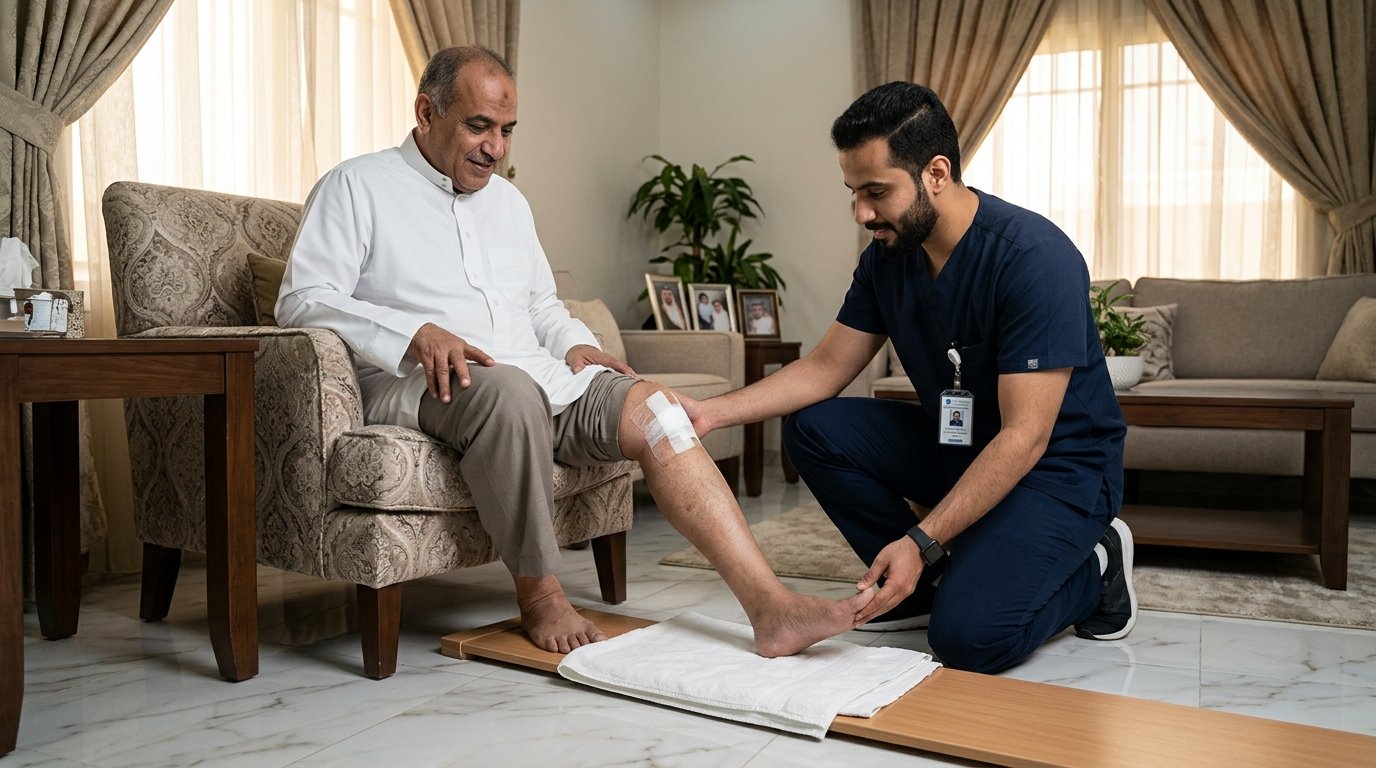
Intensive, surgeon-aligned home physiotherapy starting immediately upon hospital discharge across Dammam. Restore full extension, prevent arthrofibrosis, and regain independent mobility.
Comprehensive In-Home Clinical Evaluation (60-75 Mins)
Detailed functional & neuro examination, home safety audit, and custom protocol with portable equipment — no upfront package commitments.
Flexible appointments 7 days a week (8 AM - 10 PM) • Payment upon visit completion
1,500+ Successful Home Recoveries
Certified Clinical Physiotherapists
Assessment-First Protocol
Thorough physical evaluation before any treatment plan starts
Specialized Male Therapists
Professional licensed therapists visiting your residence
100% In-Home Rehabilitation
No clinic travel friction or waiting room discomfort
Targeted Functional Goals
Focused on daily stairs, walking endurance, and independence
Emergency Medical Red-Flags & Home Care Boundaries
Post-surgical home care is designed for stable patients. If you notice a sudden spike in body temperature above 38.5°C, foul-smelling incision drainage, or acute calf pain with severe swelling, contact your orthopedic surgeon immediately or visit the nearest emergency hospital.
Total Knee Arthroplasty (TKA) is recognized worldwide as one of the most successful orthopedic surgical interventions for eradicating end-stage osteoarthritis and restoring anatomical lower extremity alignment. However, surgical excellence accounts for only half of the functional equation; the decisive determinant of long-term walking ability, stair navigation, and functional independence is structured, immediate post-operative rehabilitation. Discharged patients returning home from major healthcare institutions in Dammam (such as King Fahd Specialist Hospital, Dammam Medical Complex, Mouwasat, or Saudi German Hospital) encounter immediate domestic hurdles: navigating low beds, accessing bathrooms, and facing steep polished marble staircases leading to upper-floor bedrooms.
Bidaya In-Home Physiotherapy provides an intensive post-surgical clinical protocol deployed directly to the patient's residence in Dammam from post-op day one. We completely eliminate the extreme pain, joint stiffness, and swelling flare-ups caused by car transfers, traffic delays, and clinic waiting rooms during the acute healing phase. Our certified male physical therapists arrive equipped with precision goniometers, mobile modalities, and sterile techniques to closely monitor surgical incision healing while systematically preventing arthrofibrosis (scar tissue contracture).
Our early domestic protocol prioritizes achieving complete anatomical extension (zero degrees) to prevent permanent antalgic limping, progressive flexion mobilization targeting over 110 degrees, active quadriceps reactivation, and safe progression from a front-wheeled walker to a single cane and independent stair climbing within the patient's familiar home environment.
The Critical Early Post-Surgical Window in Dammam Homes
Capitalizing on the Golden Period to Prevent Arthrofibrosis and DVT
The initial six weeks following total knee replacement represent the critical clinical window: 1. Preventing Arthrofibrosis Contractures: Inadequate early mobilization allows aggressive fibrous adhesions to form within the joint capsule, permanently restricting flexion and extension; our therapists perform gentle patellar mobilization and passive range-of-motion drills to preserve capsular compliance. 2. Deep Vein Thrombosis (DVT) Prophylaxis: Active ankle pumps and elevation protocols stimulate venous return, complementing pharmacological anticoagulants prescribed by the orthopedic surgical team. 3. Overcoming Domestic Architecture Barriers: In-home coaching eliminates movement anxiety, instructing the patient and family caregivers in safe bed, chair, and toilet transfers.
Structured Post-TKR Domestic Recovery Phases
Objective Clinical Milestones from Acute Swelling Control to Independent Gait
Our Dammam clinical program advances through three rigorous phases: Phase 1 (Weeks 1 - 2): Acute swelling modulation, achieving full zero-degree extension, restoring active flexion beyond 90 degrees, and mastering safe walker ambulation on home tile and marble surfaces. Phase 2 (Weeks 3 - 6): Expanding active flexion to 110-120 degrees, transitioning from walker to a single cane, initiating reciprocal stair climbing training, and progressing closed-chain quadriceps loading. Phase 3 (Weeks 7 - 12): Restoring symmetrical non-antalgic gait, discontinuing assistive walking devices, enhancing muscular endurance for community outings, and safely resuming driving and social obligations.
Surgical Safety Boundaries & Red-Flag Surveillance
Vigilant Infection and Vascular Monitoring in Coordination with Surgeons
Bidaya's clinicians maintain strict clinical vigilance throughout domestic rehabilitation: - Incision Site Inspection: Monitoring the surgical scar for persistent erythema, localized heat, wound dehiscence, or purulent drainage. - Calf Vascular Assessment: Checking for unilateral calf pain, induration, or pitting edema indicative of deep vein thrombosis. - Knee Positioning Rules: Strictly enforcing extension positioning during supine rest by placing supportive rolls under the ankle rather than under the knee joint.
Family and Caregiver Handling Training in Dammam Residences
Empowering Household Members to Facilitate Safe Daily Activity Transitions
During home visits across Dammam, our therapist coaches family members in: - Correct physical support mechanics during bed-to-chair transfers without pulling on arms or twisting the operated joint. - Eliminating domestic trip hazards, removing unsecured area rugs, and ensuring illuminated paths to bathrooms. - Supporting adherence to the independent daily home exercise schedule and scheduled post-exercise ice application.
Clinical Biomechanical Assessment & Objective Diagnostic Tests for (Post-Knee Replacement Rehab Dammam) at Home
Precision Goniometry, Manual Muscle Grading, and Neurodynamic Evaluation in Residential Care
Bidaya In-Home Physiotherapy adheres to an exhaustive clinical examination protocol during the initial evaluation visit in Dammam. Our visiting specialist examines not merely the localized zone of discomfort, but the entire kinetic chain to pinpoint the foundational biomechanical dysfunctions driving tissue overload.
Our standardized in-home clinical diagnostic suite comprises four rigorous evaluations: 1. Active and Passive Joint Goniometry: Precision measurement of joint displacement in degrees, establishing objective baseline parameters to track micro-gains across treatment sessions. 2. Standardized Manual Muscle Testing (MMT): Graded from 0 to 5 on the Medical Research Council scale, isolating inhibited prime movers and compensatory recruitment patterns. 3. Orthopedic Provocation Tests: Targeted stress testing to differentiate ligamentous laxity, tendinopathic degradation, capsular adhesions, and intra-articular derangements. 4. Neurodynamic Nerve Mobility Profiling: Conducting tension and gliding tests (such as Straight Leg Raise or Upper Limb Tension Tests) to evaluate neural mechano-sensitivity and radicular involvement.
Objective Clinical Standard
Establishing baseline quantitative goniometric and dynamometric metrics allows our clinicians to objectively demonstrate functional progress every 4 weeks.
| Clinical Metric | Diagnostic Purpose | Reference Standard | Portable Instrumentation |
|---|---|---|---|
| Joint Range of Motion | Detect capsular restrictions & end-feel | Comparison with contralateral limb | Digital medical goniometer |
| Muscle Strength | Identify neural inhibition & atrophy | MRC 0-5 scale grading | Manual resistive dynamometry |
| Postural Balance | Quantify fall risk & stability | Berg Balance & Timed Up & Go (TUG) | High-density proprioceptive pads |
| Neurodynamics | Assess peripheral nerve excursion | Validated neural tension tests | Reflex hammer & sensory filaments |
Domestic Ergonomic Adaptations & Home Environment Optimization in Dammam
Transforming Residential Corridors, Living Spaces, and Domestic Stairs into Supportive Recovery Zones
Achieving optimal recovery and long-term joint function requires seamless integration between clinical exercise protocols and the patient's domestic living space across Eastern Province communities in Dammam, Khobar, Dhahran, and Qatif. During initial home sessions, Bidaya's licensed male physiotherapist conducts a thorough environmental ergonomics inspection, analyzing seat heights, bed firmness, and surface traction to eliminate fall hazards and facilitate safe, independent therapeutic exercise between supervised visits.
Patients and family caregivers are systematically trained to leverage standard home architectural elements as rehabilitation supports: utilizing stable interior door jambs for pectoral and scapular stretching, employing sturdy armchairs for sit-to-stand reconditioning, and identifying reliable handrail contact points alongside marble interior staircases prevalent in local villas. This contextual coaching directly mitigates kinesiophobia (fear of movement), instilling functional confidence and promoting rapid functional autonomy in the patient's familiar domestic domain without constant caregiver reliance.
Clinical Domestic Recommendation
Eliminating loose rugs, optimizing corridor illumination, and securing stair handrails reduces domestic slip-and-fall incidence by over 40% during orthopedic rehabilitation.
- Verify seating ergonomics and avoid excessively low, deep, or non-supportive cushioned sofas
- Ensure primary walking pathways and nighttime bathroom routes remain clear of cords and obstacles
- Perform prescribed independent home exercises 2 to 3 times daily within comfortable pain tolerance
- Notify the clinical coordinator immediately if unexplained acute swelling or atypical pain occurs
Clinical Progression Milestones & Long-Term Recurrence Prevention for (Post-Knee Replacement Rehab Dammam) at Home
Objective Criteria for Phase Transition and Sustainable Patient Self-Management
Our clinical responsibility at Bidaya extends far beyond short-term symptomatic pain relief. We build comprehensive mechanical resilience to protect patients against injury relapse and secondary functional decline after formal therapy conclusion. We establish transparent, objective discharge criteria: - Pain Modulation Benchmark: Reduction of Visual Analog Scale (VAS) pain scores from severe baseline levels (7-10) to minimal functional levels (0-2) during active weight-bearing tasks. - Muscular Endurance Benchmark: Ability to maintain functional closed-chain motor recruitment for 2 continuous minutes without muscular tremor or compensatory biomechanical substitutions. - Functional Autonomy Benchmark: Independent execution of prayer postures, bed transfers, vehicular entry/exit, and reciprocal stair climbing without physical caregiver assistance.
Upon program completion, each patient receives an individualized digital maintenance protocol detailing specific twice-weekly exercises designed to sustain strength, mobility, and functional independence indefinitely.
- Maintain 10 minutes of daily morning and evening therapeutic flexibility exercises
- Break up sedentary desk or television periods every 45 minutes with active standing breaks
- Maintain adequate systemic hydration to preserve fascia and tendon viscoelasticity
- Schedule an optional preventative clinical checkup every 6 months to audit kinetic chain health
Frequently Asked Questions about In-Home Physiotherapy
Ideally within 24 to 48 hours of arriving home from the hospital, taking advantage of the early recovery window to prevent capsular tightness.
Related Clinical & Regional Pathways
In-Home Back Pain & Disc Herniation Physiotherapy in Dammam→
Evidence-based clinical rehabilitation delivered directly to your doorstep across Al Shatea
Knee Physiotherapy in Dammam→
Evidence-based clinical protocols designed to relieve knee joint stiffness
In-Home Post-Spine Surgery Rehabilitation in Dammam→
Evidence-based clinical rehabilitation delivered directly to your doorstep across Al Jamiyyin
In-Home Service Locations Coverage Therapy→
A responsive clinical mobile network connecting residences across the Eastern Province with licensed physical ...
In-Home Low Back Pain & Sciatica Rehabilitation Therapy→
Evidence-based clinical rehabilitation engineered to resolve lumbar disc herniations
In-Home Knee Pain & Osteoarthritis Rehabilitation Therapy→
Evidence-based clinical rehabilitation engineered to arrest articular cartilage degeneration
In-Home Stroke Rehabilitation & Neurological Physiotherapy Therapy→
Evidence-based neurological rehabilitation engineered to stimulate corticomotor neuroplasticity
In-Home Post-Operative Physiotherapy Therapy→
Evidence-based surgical rehabilitation protocols engineered to restore joint range of motion