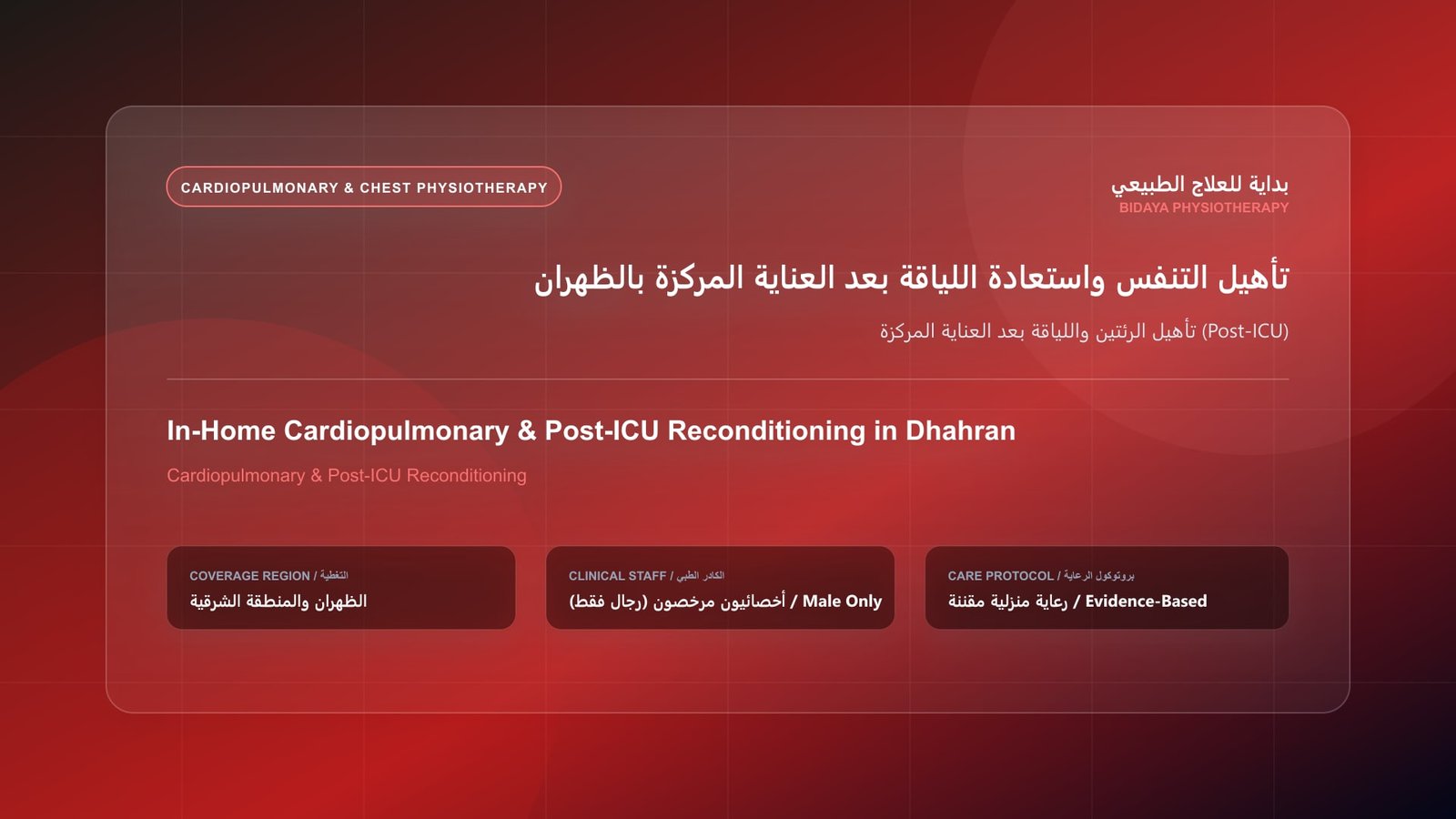
In-Home Cardiopulmonary & Post-ICU Reconditioning in Dhahran
Advanced in-home rehabilitation across Dhahran led by licensed male clinicians, restoring mobility and daily functional independence.
Comprehensive In-Home Clinical Evaluation (60-75 Mins)
Detailed functional & neuro examination, home safety audit, and custom protocol with portable equipment — no upfront package commitments.
Flexible appointments 7 days a week (8 AM - 10 PM) • Payment upon visit completion
1,500+ Successful Home Recoveries
Certified Clinical Physiotherapists
Assessment-First Protocol
Thorough physical evaluation before any treatment plan starts
Specialized Male Therapists
Professional licensed therapists visiting your residence
100% In-Home Rehabilitation
No clinic travel friction or waiting room discomfort
Targeted Functional Goals
Focused on daily stairs, walking endurance, and independence
Emergency Medical Red-Flags & Home Care Boundaries
Emergency Medical Boundary: Bidaya provides scheduled in-home therapeutic rehabilitation and is not an emergency medical dispatch service. For acute neurological deficits, unreduced fractures, severe respiratory distress, or sudden chest pain, contact the Saudi Red Crescent immediately at 997 or 911.
Specialized in-home physiotherapy for Cardiopulmonary & Post-ICU Reconditioning across Dhahran provides the gold standard for restoring movement while sparing patients the physical strain of clinic transit. Bidaya's visiting male clinicians execute meticulous diagnostic assessments including continuous pulse oximetry SpO2 telemetry, resting/exertional hemodynamic blood pressure tracking, and Borg Rating of Perceived Exertion (RPE), structuring targeted functional drills.
Managing Post-Intensive Care Syndrome (PICS) in Dhahran
ICU-Acquired Weakness (ICUAW), Diaphragmatic Sarcopenia & Oxygen Saturation Bounds
Prolonged mechanical ventilation and critical care hospitalization across regional Dhahran medical centers precipitate Post-Intensive Care Syndrome (PICS) and ICU-Acquired Weakness (ICUAW), causing profound muscle wasting and exertional dyspnea.
Bidaya's visiting physical therapists establish hemodynamic baseline surveillance (pulse oximetry, blood pressure, respiratory rate), screen diaphragmatic excursion, and grade global Medical Research Council (MRC) sum scores.
ICUAW Muscle Wasting Metric
Critical care patients lose up to 2%-3% of skeletal muscle mass daily while mechanically ventilated, demanding submaximal progressive reconditioning respecting cardiorespiratory limits.
- Monitor resting and exertional SpO2, heart rate, and blood pressure continuously
- Quantify respiratory muscle force through sustained inspiratory capacity screening
- Assess MRC muscle strength sum score across 12 peripheral muscle groups
- Verify healed tracheostomy and central line puncture sites for inflammation
Cardiopulmonary Reconditioning & Progressive Upright Mobility in Home Care
Incentive Spirometry, Seated Resistance Bands & Corridor Ambulation Pacing
Therapy administers lung volume expansion calisthenics using incentive spirometry and diaphragmatic breathing to resolve post-extubation atelectasis and clear retained bronchial secretions.
Clinicians progress vertical tolerance: advancing from supported edge-of-bed sitting to standing transfers and titrated walker ambulation along climate-controlled residential hallways across Dhahran.
Post-ICU Progressive Mobilization Rule
Graduating from edge-of-bed dangling to upright standing and brief corridor steps daily rebuilds autonomic baroreceptor reflexes safely.
- Execute 10 sustained incentive spirometry inhalations every two waking hours
- Perform seated active-assisted limb movements and light band resistance calisthenics
- Advance hallway ambulation using wheeled walkers under pulse oximetry monitoring
- Structure restorative midday rest buffers and coordinate high-protein nutritional intake
Empowering Family Caregivers in Daily Rehabilitation for Cardiopulmonary & Post-ICU Reconditioning in Dhahran
Coaching Safe Biomechanics to Protect Caregiver Spine and Ensure Patient Stability
Sustained functional recovery within Dhahran households heavily depends on seamless synergy between the visiting physical therapist, family members, and domestic caregivers. Relying solely on clinical sessions without structured between-visit movement pacing significantly retards recovery velocity.
Bidaya's clinicians dedicate targeted intervals during each home visit to coach caregivers in: 1. Biomechanical transfer mechanics: Guiding patient transfers using gait belts and pelvic cues rather than traction on vulnerable joints, safeguarding the caregiver's spine. 2. Protective positioning: Systematic repositioning regimens to alleviate focal tissue pressure and thwart joint contractures, implementing diaphragmatic excursion training, pursed-lip breathing against resistance, thoracic expansion drills, and interval paced corridor ambulation. 3. Vital monitoring and exertion limits: Recognizing physiological red flags and pacing daily active-assisted drills.
This hands-on education transforms caregivers into competent, confident therapeutic partners across Dhahran.
Caregiver Mechanics Rule in Dhahran
Never hoist a patient by the axillae or affected arm; utilize a secure transfer belt, keeping the load close to your center of gravity with flexed knees.
- Fasten a specialized transfer belt snugly around patient waist during transfers
- Engage dual wheel locks on wheelchairs and hospital beds prior to shifting weight
- Prompt maximal active patient effort to prevent learned dependency
- Pace activity cycles with controlled diaphragmatic breathing breaks
Comprehensive Biomechanical & Kinematic Evaluation for Cardiopulmonary & Post-ICU Reconditioning
Objective Arthrokinematic Goniometry & Selective Tissue Tension Testing across Dhahran
Every dedicated in-home physical therapy visit for Cardiopulmonary & Post-ICU Reconditioning in Dhahran begins with an in-depth kinematic assessment conducted by a licensed male physical therapist. The clinical objective is to differentiate contractile tissue lesions from inert capsular dysfunctions.
Key diagnostic components include: 1. Objective Diagnostic Protocol: Implementing continuous pulse oximetry SpO2 telemetry, resting/exertional hemodynamic blood pressure tracking, and Borg Rating of Perceived Exertion (RPE) to compare bilateral physiological and accessory motion arcs. 2. Cyriax Selective Tissue Tension Testing: Applying resisted isometric maneuvers to isolate tendinopathic strain from passive ligamentous insufficiency. 3. Manual Muscle Testing (MMT): Calibrating prime mover and stabilizer force production on a standardized 0-to-5 scale to reveal neuromuscular inhibition. 4. Focused Neurological Screening: Auditing deep tendon reflexes and dermatomal boundaries to verify neural integrity.
Baseline measurements are systematically documented, providing clear numerical metrics to benchmark progress using modified Medical Research Council (mMRC) Dyspnea Scale and 6-Minute Walk Test distance.
Diagnostic Specificity in Dhahran
Isolating the precise mechanical pain generator allows targeted reconditioning, preventing wasted recovery time on non-specific exercise.
- Quantify active and passive joint arcs comparing bilateral symmetry
- Audit kinetic chain alignment across adjacent stabilizing articulations
- Rule out acute systemic inflammatory flags prior to mechanical loading
- Establish measurable functional milestones aligned with domestic goals
Progressive Neuromuscular Conditioning & Adaptive Kinetic Loading
Recalibrating Proprioceptive Reflexes & Dynamic Joint Stability for Cardiopulmonary & Post-ICU Reconditioning
This advanced protocol elevates mechanical tissue capacity for patients managing Cardiopulmonary & Post-ICU Reconditioning, arresting chronic recurrent flare-ups.
Adaptive conditioning pillars: 1. Initial Neuromuscular Priming: Implementing diaphragmatic excursion training, pursed-lip breathing against resistance, thoracic expansion drills, and interval paced corridor ambulation emphasizing pain-free active movement. 2. Balance Perturbation Challenges: Practicing dynamic stance over variable compliant surfaces to retrain mechanoreceptors. 3. Velocity Normalization: Optimizing walking cadence and stride length to achieve maintaining SpO2 >= 92% throughout domestic ambulation, stabilizing exertion at Borg 11-13, and climbing one flight without acute desaturation.
This progression reintegrates entire kinetic chain segments into seamless daily functional tasks.
Neuromuscular Reprogramming
Proprioceptive retraining stimulates central motor pathways, restoring automatic muscular stabilizing reflexes during sudden perturbations.
- Execute balance drills adjacent to a sturdy wall or countertop for safety
- Gradually advance difficulty by incorporating reduced visual feedback under guidance
- Maintain upright cervical and spinal posture during ambulation retraining
- Observe scheduled rest intervals upon experiencing central neuromuscular fatigue
Domestic Environmental Hazard Auditing & Pathway Clearance for Cardiopulmonary & Post-ICU Reconditioning
Securing Ambulation Corridors, Bathroom Retrofits & Fall Prevention across Dhahran
Bidaya's licensed male physical therapists transform the patient's residence in Dhahran into an engineered recovery environment supporting autonomy for Cardiopulmonary & Post-ICU Reconditioning.
Core environmental hazard adaptations: 1. Washroom and shower retrofitting: Securing structural wall grab bars adjacent to toilets and showers, deploying rubberized suction mats to abort slips. 2. Living room and bedroom reconfiguration: Replacing deep, low sofas with ergonomic firm chairs, avoiding strict post-sternotomy precautions (no unilateral lifting > 4kg, no bilateral shoulder hyperextension), and maintaining room temperature at 21-23°C. 3. Daily conditioning integration: Implementing calibrated diaphragmatic excursion training, pursed-lip breathing against resistance, thoracic expansion drills, and interval paced corridor ambulation at structured daily times while tracking exertion. 4. Stable equilibrium support: Ensuring a sturdy support anchor remains within arm's reach during standing balance drills.
These adjustments establish a supportive living space promoting durable recovery. Contact intake: (+20 109 707 9170).
Safe Home Space in Dhahran
Illuminating transit corridors and securing wall anchors reduces domestic slip-and-trip incidents by over 75% on polished surfaces.
- Mount wall-anchored safety grab bars at high-risk transfer locations
- Refrain from performing unassisted standing drills over low-friction tiling
- Exercise under direct caregiver contact-guarding if balance is compromised
- Contact Bidaya directly to modify home exercise intensity as symptoms evolve
Clinical Safety Thresholds & Emergency Healthcare Interfacing across Dhahran
Decisive Red Flag Management & Coordination with Emergency Services at Johns Hopkins Aramco Healthcare (JHAH) and accredited medical centers
Bidaya's visiting physical therapists enforce uncompromising clinical safety parameters to ensure home care never compromises patient vitality.
Clinical indicators mandating acute emergency hospital referral: 1. Condition Red Flags for Cardiopulmonary & Post-ICU Reconditioning: Documented emergence of oxygen desaturation dropping beneath 88% refractory to rest, substernal chest pressure, perioral cyanosis, or acute resting tachyarrhythmia. 2. Severe Non-Mechanical Pain: Relentless nocturnal burning or deep thoracic pain unalleviated by positional changes, accompanied by diaphoresis. 3. Sudden Vertigo with Cranial Neuropathy: Acute severe spinning sensation coupled with diplopia, dysarthria, or dysphagia. 4. Acute Systemic Infection Signs: Spiking pyrexia accompanied by rigors and localized incision drainage.
Emergency Referral Workflow: Direct instruction is issued to activate the Saudi Red Crescent via 997 or emergency dispatch at 911 for transport to Johns Hopkins Aramco Healthcare (JHAH) and accredited medical centers. Bidaya provides scheduled rehabilitative therapy, not acute medical emergency services. Inquiries: (+20 109 707 9170).
Accredited Clinical Safety in Dhahran
Advanced training of our male clinical personnel guarantees swift, professional execution of emergency referral pathways.
- Keep Saudi Red Crescent dispatch (997) programmed into primary mobile devices
- Inform attending medical specialist or orthopedic surgeon of critical changes
- Refrain from administering oral analgesics or fluids if surgical triage is possible
- Utilize unified emergency numbers (997 and 911) as primary acute care conduits
Long-Term Preventive Maintenance & Joint Preservation for Cardiopulmonary & Post-ICU Reconditioning in Dhahran
Autonomous Conditioning Blueprint, Longitudinal Milestone Auditing & Home Wellness
Bidaya's clinical mission across Dhahran extends beyond acute symptom relief for Cardiopulmonary & Post-ICU Reconditioning, equipping patients and caregivers with a preventive framework that sustains functional gains and shields against recurrent injury.
Pillars of long-term functional maintenance: 1. Personalized Self-Directed Portfolio: Designing a streamlined 15-minute daily home routine focusing on diaphragmatic excursion training, pursed-lip breathing against resistance, thoracic expansion drills, and interval paced corridor ambulation. 2. Habitual Ergonomic Optimization: Refining daily postural habits during sitting, rising, and stair navigation to distribute mechanical forces symmetrically. 3. Periodic Clinical Check-Ins: Scheduling optional surveillance evaluations every 3 to 6 months to re-quantify joint arcs, audit muscle force, and calibrate exercise difficulty. 4. Open Direct Communication: Providing ongoing access to clinical case coordinators via WhatsApp (+20 109 707 9170) to address emerging mobility inquiries.
This proactive maintenance strategy protects hard-won clinical gains across Dhahran.
Long-Term Wellness Metric in Dhahran
Consistently executing gentle home mobility calisthenics sustains cartilage lubrication, arresting age-related muscle deconditioning.
- Maintain self-directed home mobility calisthenics at least 3 times weekly
- Self-screen joint range of motion reporting any emerging stiffness early
- Participate in regular low-impact walking along community corridors such as shaded residential walking loops and Dhahran Hills pedestrian corridors
- Contact Bidaya directly via phone (+20 109 707 9170) for periodic functional check-ups
Environmental Adaptation & Extended Social Integration for Cardiopulmonary & Post-ICU Reconditioning
Participating in Family Gatherings & Transit Between Dhahran Neighborhoods
Bidaya believes true clinical recovery from Cardiopulmonary & Post-ICU Reconditioning is achieved when patients re-engage with their families and social networks across Dhahran.
Dimensions of social and familial adaptation: 1. Attending Family Socials: Training ergonomic sitting and safe unassisted rising within spacious majlis quarters across Al-Dana, North Al-Dawhah, South Al-Dawhah, and KFUPM residential campus. 2. Restorative Outdoor Strolling: Capitalizing on shaded, cushioned pedestrian paths along shaded residential walking loops and Dhahran Hills pedestrian corridors to boost cardiopulmonary endurance. 3. Automotive Transit Independence: Developing smooth vehicular transfer skills without provoking torsion across healing articulations. 4. Autonomous Daily Errand Engagement: Accompanying family members on daily outings with comfort and pride.
We remain your dedicated partners throughout full social recovery across Dhahran. Telephone coordination: (+20 109 707 9170).
Social Connection in Dhahran
Active engagement in social and familial gatherings elevates morale, stimulating natural endorphin-mediated pain modulation.
- Schedule social visits outside periods of peak cumulative fatigue
- Select firm, elevated armchairs when seated in guest reception majlis areas
- Incorporate brief standing pauses during extended automotive journeys
- Share community mobility milestones with your Bidaya clinical team (+20 109 707 9170)
Clinical Quality Oversight & Professional Governance across Dhahran
Credentialed Male Clinician Standards, Outcome Tracking & Regional Hospital Alignment
Bidaya enforces comprehensive medical governance across Dhahran, ensuring patients managing Cardiopulmonary & Post-ICU Reconditioning receive premier rehabilitation care.
Pillars of clinical quality oversight: 1. Strict Professional Credentialing: Restricting clinical delivery exclusively to licensed male physical therapists (male clinicians only) with verified regulatory credentials. 2. Continuous Functional Quantification: Administering modified Medical Research Council (mMRC) Dyspnea Scale and 6-Minute Walk Test distance to benchmark tissue recovery trajectories against clinical gold standards. 3. Standardized Preventive Infection Control: Implementing rigorous sanitization protocols for mobile therapy equipment before entering domestic residences. 4. Healthcare System Integration: Aligning clinical milestones directly with physician and surgical orders from Johns Hopkins Aramco Healthcare (JHAH) and accredited medical centers.
We deliver complete clinical transparency and professional reliability across Dhahran. Inquiries: (+20 109 707 9170).
Professional Rigor in Dhahran
Deploying licensed male physical therapists exclusively guarantees clinical excellence while honoring family domestic privacy.
- Verify professional registration credentials for all visiting clinicians
- Audit recovery milestone progression against objective clinical curves
- Enforce hospital-grade sanitization of portable evaluation equipment
- Transmit progress summaries to attending physicians via clinical desk (+20 109 707 9170)
Frequently Asked Questions about In-Home Physiotherapy
Bidaya's licensed male clinicians deliver focused care combining kinematic evaluation, manual joint mobilization, and targeted neuromuscular strengthening in your home in Dhahran.
Related Clinical & Regional Pathways
In-Home Physiotherapy in Dhahran→
Comprehensive in-home physical therapy across Dhahran delivered by licensed male clinicians for geriatric
Stroke Motor Recovery & Hemiplegia→
Advanced in-home rehabilitation across Dhahran led by licensed male clinicians
Neck Pain & Desk Ergonomics Rehab→
Advanced in-home rehabilitation across Dhahran led by licensed male clinicians
In-Home Physiotherapy in Al Khobar→
Evidence-based clinical rehabilitation delivered directly to your villa
In-Home Low Back Pain & Sciatica Rehabilitation Therapy→
Evidence-based clinical rehabilitation engineered to resolve lumbar disc herniations
In-Home Knee Pain & Osteoarthritis Rehabilitation Therapy→
Evidence-based clinical rehabilitation engineered to arrest articular cartilage degeneration
In-Home Stroke Rehabilitation & Neurological Physiotherapy Therapy→
Evidence-based neurological rehabilitation engineered to stimulate corticomotor neuroplasticity
In-Home Post-Operative Physiotherapy Therapy→
Evidence-based surgical rehabilitation protocols engineered to restore joint range of motion