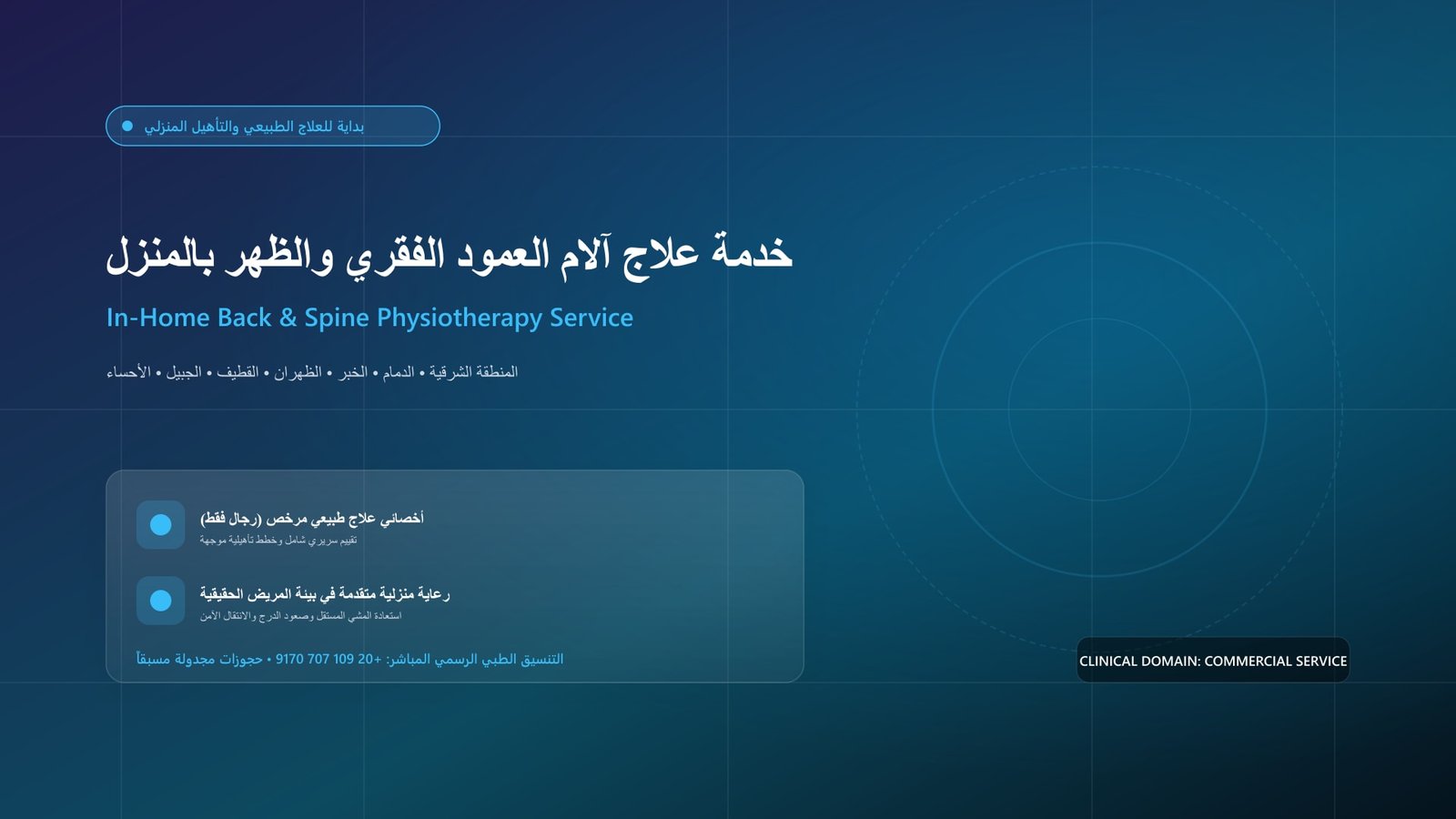
Specialized In-Home Back Pain & Spinal Disc Rehabilitation Service
Evidence-based clinical rehabilitation delivered directly to your residence across Dammam, Khobar, Dhahran, and Eastern Province cities with maximum privacy and comfort.
Comprehensive In-Home Clinical Evaluation (60-75 Mins)
Detailed functional & neuro examination, home safety audit, and custom protocol with portable equipment — no upfront package commitments.
Flexible appointments 7 days a week (8 AM - 10 PM) • Payment upon visit completion
1,500+ Successful Home Recoveries
Certified Clinical Physiotherapists
Assessment-First Protocol
Thorough physical evaluation before any treatment plan starts
Specialized Male Therapists
Professional licensed therapists visiting your residence
100% In-Home Rehabilitation
No clinic travel friction or waiting room discomfort
Targeted Functional Goals
Focused on daily stairs, walking endurance, and independence
Emergency Medical Red-Flags & Home Care Boundaries
In-home physiotherapy is intended strictly for medically stable recovery. In the presence of acute emergency symptoms, immediately call 997 or proceed to hospital emergency.
Spinal discomfort, lumbar disc prolapse, and sciatica are among the primary causes of functional restriction across Eastern Province communities. Undertaking highway travel or sitting in outpatient waiting areas during acute back spasms directly exacerbates intradiscal pressures and radicular symptoms. Bidaya In-Home Physiotherapy brings specialized spinal rehabilitation directly to your residence, led by licensed male clinicians trained in mechanical diagnosis and evidence-based spinal stabilization.
We utilize the McKenzie Method of Mechanical Diagnosis and Therapy (MDT) to isolate the patient's directional preference, promoting rapid centralization of radiating sciatic pain and decompressing affected nerve roots. Furthermore, we train deep lumbo-pelvic stabilizing musculature and optimize domestic prayer, sleeping, and seating postures to guarantee lasting spinal resilience.
Clinical Biomechanics & Advanced Tissue Pathology for (In-Home Back and Spine Physiotherapy)
Pathomechanical Analysis, Tissue Failure Mechanisms, and Kinetic Chain Compromise
Addressing In-Home Back and Spine Physiotherapy forms a core clinical specialty within Bidaya's advanced residential rehabilitation programs across Eastern Province. Pathophysiologically, the primary disorder involves lumbar vertebrae, intervertebral discs, exiting nerve roots, and deep spinal multifidi, expressing clinically as disc herniation, nerve root impingement, and facet joint arthropathy with radicular radiation.
This tissue compromise alters kinetic force transmission through adjacent articulations, directly disrupting gluteal amnesia, transverse abdominis inhibition, and compensatory erector spinae hyperactivity. In response, neighboring muscular sleeves enter sustained protective contraction to shield irritable structures, precipitating restricted range of motion, muscle ache, and difficulty lifting or manipulating domestic objects within the household environment.
Residential ergonomics across Eastern Province homes—such as low majlis floor seating and extended vehicle commutes in high ambient temperatures—magnify these mechanical stresses. Neglecting timely therapeutic intervention permits fibrotic periarticular adhesions and microcirculatory compromise to consolidate. Bidaya deploys targeted in-home mobilization and progressive stabilizer recruitment to dismantle these restrictions, restoring functional performance safely.
Our clinical methodology emphasizes evaluating patient tissue tolerance under authentic functional loading conditions. By examining patients within their actual living environment, clinicians identify and remediate domestic mechanical triggers with rigorous scientific precision, securing permanent functional recovery.
Our specialized pathway targets the cycle of mechanical irritation and muscle splinting, re-establishing closed-chain equilibrium to shield neighboring joints from compensatory mechanical overload. This comprehensive biomechanical realignment distributes ground reaction vectors symmetrically, eliminating chronic muscular fatigue across everyday domestic tasks. Furthermore, supervised home clinical intervention establishes early neuromuscular control, systematically attenuating nociceptive input and optimizing functional mobility across all domestic environments.
Comprehensive Residential Clinical Evaluation & Diagnostic Battery for (In-Home Back and Spine Physiotherapy)
Standardized Goniometry, Manual Muscle Testing, and Specialized Provocation Maneuvers
Our clinical team in Eastern Province provides a focused 60-minute in-home evaluation delivered by a licensed male specialist: 1. Postural alignment and bilateral symmetry screening identifying uneven weight distribution during upright stance. 2. Pain sensitivity mapping defining safe operational thresholds for manual therapy and active exercise. 3. Validated orthopedic special testing isolating structural pathology with high diagnostic accuracy. 4. Dynamic stair-climbing and chair transfer evaluation to ensure safe unassisted mobility in the residence.
These quantitative findings inform a progressive rehabilitation plan that promotes tissue repair without symptom exacerbation. Clinicians review the patient's functional history and daily physical demands, offering immediate posture modifications from session one. Serial metric evaluations track objective functional recovery toward full physical independence.
Our clinical staff utilizes standardized evidence-based diagnostic tests to isolate primary pain generators and select the most effective hands-on therapeutic modalities. Pinpointing exact tissue dysfunction ensures treatment sessions focus exclusively on resolving mechanical root causes. Recording granular clinical metrics during each home visit provides an objective benchmark for therapeutic progression, verifying steady functional recovery and patient physical resilience.
Precision Objective Documentation
Establishing quantified baseline metrics during the initial home visit enables precise outcome measurement, allowing clinicians to modulate load parameters in direct alignment with biological tissue healing rates.
| Clinical Assessment / Provocation Test | Diagnostic Target | Positive Clinical Indicator | Portable Clinical Instrumentation |
|---|---|---|---|
| Straight Leg Raise (SLR) Neurodynamic Test | Detect lumbosacral nerve root tension and radiculopathy | Reproduction of lancinating leg pain between 35 and 70 degrees | Digital inclinometer |
| McKenzie Directional Preference Assessment | Identify movement vectors centralizing radiating sciatic pain | Abolition of distal pain with repeated lumbar extension movements | Standardized MDT protocol |
| Biering-Sorensen Extensor Endurance Test | Quantify fatigue resistance in deep lumbar stabilizers | Inability to maintain horizontal posture beyond 60 seconds | Digital clinical timer |
Evidence-Based Rehabilitation Protocol & Progressive Loading Phases for (In-Home Back and Spine Physiotherapy)
Multi-Tiered Care Plan Combining Manual Therapy, Neuromuscular Stabilization, and Kinetic Chain Reconditioning
Our home rehabilitation methodology for (In-Home Back and Spine Physiotherapy) corrects mechanical alignment through four sequential clinical tiers: - Tier 1: Alleviating mechanical stress on lumbar vertebrae, intervertebral discs, exiting nerve roots, and deep spinal multifidi and achieving resting comfort in seated and lying postures. - Tier 2: Releasing tissue adhesions and promoting tendon-bone gliding through safe therapeutic stretches. - Tier 3: Dynamic stabilizer recruitment building muscular stamina against repetitive daily physical stresses. - Tier 4: Demanding transfer retraining and prolonged outdoor walking with total postural stability.
Advancement criteria demand zero exercise-induced soreness and restored manual muscle testing scores.
These structured tiers build robust self-efficacy, allowing patients to navigate everyday routines with ease and comfort.
Advancement benchmarks require complete absence of exercise-induced soreness and verified recovery of manual muscle strength across targeted muscle groups. Fulfilling these criteria confirms underlying kinetic links possess the endurance needed for independent function. Adherence to evidence-based mechanotransductive staging shields vulnerable articulations while steadily building functional physical endurance across everyday residential tasks.
Safe Therapeutic Loading Rules
Therapeutic exercise discomfort must remain at or below 3/10 during execution and must completely subside to baseline within 60 minutes post-session.
- Directed McKenzie extension drills offloading posterior disc protrusion
- Transverse abdominis and pelvic floor co-contraction stabilizing lumbar segments
- Iliopsoas and hamstring lengthening restoring neutral pelvic inclination
- Spinal-sparing hip-hinge mechanics for safe household lifting
Step-by-Step Prescribed Residential Exercise Protocol for (In-Home Back and Spine Physiotherapy)
Detailed Guidance on Movement Execution, Biomechanical Form, Respiratory Timing, and Safe Progression Criteria
To ensure flawless home exercise execution and prevent biomechanical faults that impede recovery, patients are thoroughly coached in the following prescribed drills:
1. Foundational Activation & Decompression Drill: Prone lumbar press-up (McKenzie extension): pushing chest upward with arms while maintaining complete pelvis and gluteal relaxation, 10 smooth reps holding 2 seconds.
2. Tissue Extensibility & Mobility Restoration Stretch: Dead bug lumbo-pelvic stabilization: maintaining neutral spine brace while slowly extending opposite arm and leg, 10 controlled reps per side.
3. Dynamic Functional Stability & Proprioceptive Exercise: Gluteal bridge activation: raising pelvis driven purely by gluteal contraction without lumbar arching, holding 5 seconds for 12 reps.
Our therapist provides step-by-step postural cues, regulates respiratory cadence, and prevents compensatory faulty patterns, formulating an exact schedule for independent practice between visits.
Progression across resistance band tensions is regulated by strict clinical criteria: resistance is increased only after completing two consecutive sets of 15 repetitions with zero next-day inflammatory reaction, providing ample structural adaptation time for healing fibers.
Patients receive a customized illustrated logbook to record repetition volume and resting comfort, enabling clinicians to make precise micro-adjustments during subsequent visits to maintain steady therapeutic momentum.
Our clinician coaches optimal joint angles, regulates rhythmic diaphragmatic respiration, and eliminates ballistic compensations that strain vulnerable ligaments. Meticulous postural cueing ensures each repetition strengthens target stabilizers while safeguarding neighboring structures. Disciplined independent execution under periodic clinical review reinforces positive biomechanical adaptations, permanently eliminating compensatory strain from daily physical routines.
- Avoid hazardous mechanical vectors, particularly: rapid loaded spinal flexion with twisting and lifting heavy items with straight knees
- Execute all prescribed drills on a firm, supportive mat rather than excessively plush beds or sofas
- Maintain steady diaphragmatic respiration, strictly avoiding Valsalva breath-holding during exertion
- Log exercise tolerance and any transient symptoms for review during subsequent visits
Domestic Environmental Ergonomics & Joint Protection Strategies across Eastern Province
Actionable Adjustments for Prayer Postures, Majlis Seating, and Extended Eastern Province Commuting
Practical domestic guidelines provided by Bidaya optimize residential environments to expedite healing for (In-Home Back and Spine Physiotherapy): - Worship Posture Adaptation: Guiding safe prayer angles to minimize internal joint stress while systematically progressing back toward ground Sujud. - Household Seating Design: Deploying supportive cushions beneath hips to prevent sinking into plush majlis couches that exacerbate ligament strain. - Extended Driving Ergonomics: Structuring 5-minute movement breaks during long commutes across Eastern Province highways, adjusting backrest incline. - Restorative Sleep Architecture: Establishing neutral sleeping postures that eliminate spinal twisting and joint compression, ensuring mornings free from stiffness.
Systematic domestic adaptation transforms the patient's home into a proactive healing sanctuary, decreasing reinjury vulnerability by over 80% when combined with prescribed maintenance exercises.
Creating an ergonomically sound home setting eliminates persistent micro-trauma from daily movement cycles. Therapists offer clear guidelines on safe lifting techniques for household items and posture adjustments during social gatherings, providing continuous 24-hour joint protection.
Customized domestic environmental adaptation reduces recurrent injury vulnerability by over 80% when combined with prescribed home maintenance exercises. Addressing physical environmental bottlenecks ensures your living space actively reinforces clinical gains. Cultivating joint-sparing habits during daily domestic tasks protects healing periarticular tissues, ensuring functional improvements achieved during therapy remain durable across years.
- Position a contoured lumbar support cushion while driving across Eastern Province highways
- Utilize an ergonomic prayer stool during acute flare-ups to preserve spinal neutrality
- Avoid plush sinking sofas in living majlis, opting for firm upright seating
- Engage in 10-minute gentle walking sessions twice daily to nourish intervertebral discs
Quantitative Clinical Discharge Criteria & Long-Term Joint Longevity for (In-Home Back and Spine Physiotherapy)
Evidence-Based Benchmarks Confirming Restored Functional Independence and Lasting Musculoskeletal Health
Clinical discharge from Bidaya's home rehabilitation program is governed by objective physical benchmarks: 1. Physiological Range of Motion: Restoring symmetrical active excursion within 90-95% of the contralateral unaffected limb. 2. Dynamic Neuromuscular Endurance: Sustaining functional stabilization drills for two minutes without fatigue or substitution. 3. Unrestricted Community Living: Confident participation in family gatherings, religious worship, and daily errands free from pain.
Each patient receives a comprehensive long-term joint health protocol to safeguard functional gains throughout future years.
Bidaya's dedicated coordination line (+20 109 707 9170) remains available for ongoing guidance, ensuring peace of mind for you and your family.
Our clinical commitment extends well beyond formal session completion. Through scheduled telephone follow-up reviews and accessible clinical advice, we ensure your transition back to unrestricted physical activity remains completely safe, stable, and fulfilling.
Our visiting clinician conducts a final educational review consolidating all joint protection strategies, ensuring lasting physical wellness and mobility. Graduating with complete movement self-efficacy ensures you pursue your life's aspirations without fear of pain. Achieving these standardized clinical discharge metrics validates that dynamic stabilization mechanisms operate effectively during all vocational, recreational, and spiritual activities.
Frequently Asked Questions about In-Home Physiotherapy
Yes, early conservative decompression and mechanical directional therapy resolve symptoms without surgical intervention in over 90% of cases.
Related Clinical & Regional Pathways
In-Home Knee Rehabilitation Service→
Evidence-based clinical rehabilitation delivered directly to your residence across Dammam
In-Home Orthopedic Physiotherapy→
Evidence-based clinical rehabilitation delivered directly to your residence across Dammam
In-Home Shoulder Rehabilitation Service→
Evidence-based clinical rehabilitation delivered directly to your residence across Dammam
In-Home Physiotherapy Services→
An integrated clinical care system delivering evidence-based physical therapy disciplines directly to your res...
In-Home Sports Rehabilitation & Athletic Physical Therapy in Khobar→
Advanced in-home physiotherapy delivered to your door across Khobar neighborhoods (Al Hizam Al Thahabi
In-Home Elderly Physiotherapy & Frailty Care in Khobar→
Advanced in-home physiotherapy delivered to your door across Khobar neighborhoods (Al Rawabi
In-Home Fall Prevention & Balance Confidence Rehabilitation in Khobar→
Advanced in-home physiotherapy delivered to your door across Khobar neighborhoods (Al Hizam Al Akhdar
In-Home Post-Hospital Deconditioning Rehabilitation in Khobar→
Advanced in-home physiotherapy delivered to your door across Khobar neighborhoods (Al Olaya