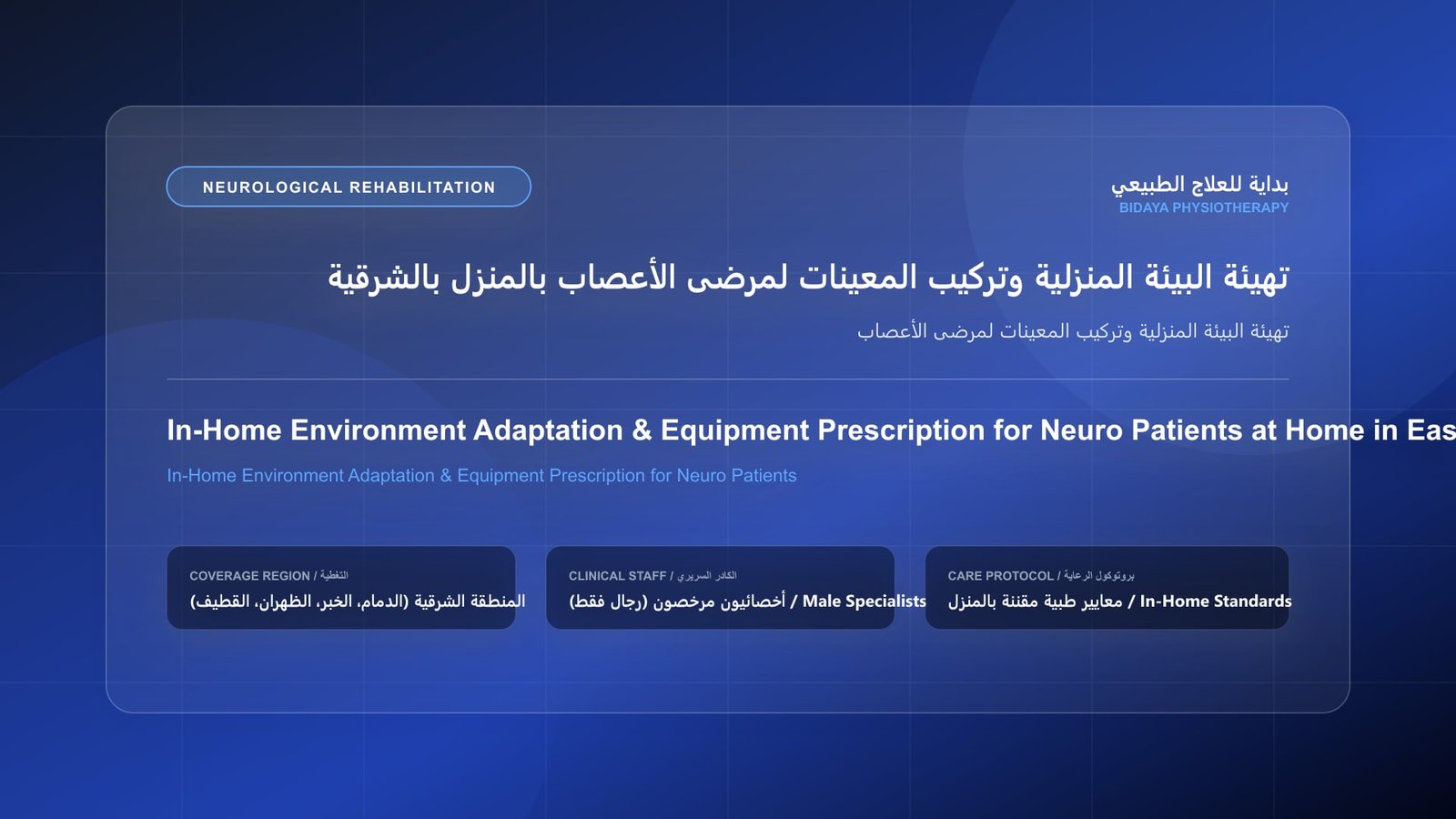
In-Home Environment Adaptation & Equipment Prescription for Neuro Patients
Advanced in-home neuro-rehabilitation harnessing neuroplasticity and functional independence by licensed male therapists.
Comprehensive In-Home Clinical Evaluation (60-75 Mins)
Detailed functional & neuro examination, home safety audit, and custom protocol with portable equipment — no upfront package commitments.
Flexible appointments 7 days a week (8 AM - 10 PM) • Payment upon visit completion
1,500+ Successful Home Recoveries
Certified Clinical Physiotherapists
Assessment-First Protocol
Thorough physical evaluation before any treatment plan starts
Specialized Male Therapists
Professional licensed therapists visiting your residence
100% In-Home Rehabilitation
No clinic travel friction or waiting room discomfort
Targeted Functional Goals
Focused on daily stairs, walking endurance, and independence
Emergency Medical Red-Flags & Home Care Boundaries
If sudden emergent neurological deficits occur—facial drooping, acute arm weakness, slurred speech (FAST), or severe sudden headache—seek emergency medical evaluation immediately or call ambulance (997).
In-Home Environment Adaptation & Equipment Prescription for Neuro Patients presents a significant neurological motor challenge demanding rigorous in-home physical therapy across Eastern Province. Bidaya provides an evidence-based clinical rehabilitation model designed to harness neuroplastic recovery and restore functional autonomy guided by licensed male clinicians.
Clinical Pathophysiology & Tissue Biomechanics for (In-Home Environment Adaptation & Equipment Prescription for Neuro Patients) in Eastern Province
Biomechanical Dysfunction, Tissue Overload, and Kinetic Chain Compensations
Addressing the complex functional impacts of In-Home Environment Adaptation & Equipment Prescription for Neuro Patients represents a key specialty of Bidaya's in-home clinical practice in Eastern Province. The underlying lesion impacts sensory-motor visual-spatial navigation architecture and residential domestic traversal pathways, characterized pathologically by domestic architectural barriers, threshold steps, and slick tile flooring precipitating mobility arrest and fall hazards.
This impairment alters kinematic load distribution across related kinetic linkages, notably neuromotor deficit, spatial environmental collisions, progressive mobility avoidance, and bedroom confinement. Left untreated, compensatory muscle hypertonicity and joint stiffness escalate, interfering with comfortable driving, stair navigation, and prolonged sitting.
Residential habits in the Eastern Province, including plush majlis seating and extended vehicle travel in hot climates, frequently exacerbate these symptoms. Our certified male physical therapists deploy customized home treatment plans integrating gentle joint glides, stabilizing drills, and postural re-education to restore unrestricted motion.
By prioritizing patient comfort and rigorous clinical science, Bidaya ensures rapid symptom relief and lasting musculoskeletal resilience without clinic travel burdens.
Comprehensive In-Home Diagnostic Assessment & Special Tests for (In-Home Environment Adaptation & Equipment Prescription for Neuro Patients)
Standardized Evaluation Battery: Precision Goniometry, MMT, and Provocation Tests
Our clinical diagnostic methodology at Bidaya deploys an exploratory 60-minute assessment conducted directly inside your residence in Eastern Province: 1. Kinetic chain load-transfer evaluation screening adjacent segments for latent mechanical compensations. 2. Objective dual-inclinometer tracking measuring active and passive joint excursion with medical accuracy. 3. Segmental neuromuscular provocation drills isolating irritated pain generators with maximum specificity. 4. Multi-planar movement trials assessing sit-to-stand, rotational stepping, and stair transitions under authentic domestic loading.
Conducting evaluation on-site captures real-world movement mechanics, enabling our male therapist to calibrate an individualized program resolving domestic movement friction.
Each therapist carries an advanced mobile clinical diagnostic kit, recording baseline benchmarks into an encrypted portal ensuring transparent physician collaboration.
Detailed biomechanical data gathered during this primary session allow our team to design highly focused interventions tailored to your specific musculoskeletal demands. This clinical clarity provides patients and their families absolute reassurance regarding the safety, rigor, and clinical validity of specialized in-home care.
Precision Baseline Documentation
Standardized objective metric recording during the initial home visit enables precise weekly progress quantification shared with your physician.
| Clinical Assessment Metric | Diagnostic Scope | Positive Diagnostic Finding | In-Home Clinical Gear |
|---|---|---|---|
| Trunk Impairment Scale (TIS Protocol) | Evaluating static and dynamic sitting balance alongside selective trunk coordination | Inability to maintain unsupported sitting balance without bilateral hand support | Standardized neurological TIS examination protocol |
| Fugl-Meyer Motor Assessment Battery | Quantifying selective motor recovery stages and decoupling from primitive mass synergies | Subscale score confirming moderate-to-severe voluntary movement dissociation | Complete neurological reflex hammer and goniometer kit |
| Timed Up and Go (TUG Neurological Protocol) | Measuring sit-to-stand, 3-meter walking, turning mechanics, and return to seated posture | Execution time >15 seconds accompanied by truncal deviation indicating high fall risk | Digital stopwatch and laser distance measure |
Evidence-Based Exercise Prescription & Staged Loading Protocol for (In-Home Environment Adaptation & Equipment Prescription for Neuro Patients)
Integrated Clinical Pathway Combining Manual Mobilization, Core Stabilization, and Kinetic Reconditioning
Bidaya designs an individualized residential rehabilitation trajectory for (In-Home Environment Adaptation & Equipment Prescription for Neuro Patients) restoring functional symmetry across four milestones: - Milestone 1: Protective unloading and soft tissue decompression around sensory-motor visual-spatial navigation architecture and residential domestic traversal pathways using soothing physical modalities. - Milestone 2: Range-of-motion normalization and circulatory enhancement facilitating biological tissue repair. - Milestone 3: Functional resistance training re-establishing force coupling across ascending and descending kinetic links. - Milestone 4: Advanced domestic training coaching prayer Sujud, long-distance driving, and independent community navigation.
Visiting male physical therapists monitor kinematic form continuously, modulating exercise dosage to match daily improvements.
This tailored approach restores full physical autonomy while preventing fatigue-induced mechanical compensations.
Safe Loading Threshold Rule
Therapeutic exercise discomfort must not exceed 3/10 on the Visual Analog Scale and must completely subside within one hour post-session.
- Edge-of-bed dynamic sitting posture stabilization recruiting deep core transversus abdominis
- Axial weight-bearing loading on paretic segments stimulating somatosensory afferents
- Visual biofeedback mirror training to restore bilateral sensorimotor alignment
- Domestic transitional transfer retraining between bed recumbency, sitting, and upright stance
Step-by-Step In-Home Exercise Execution Guide for (In-Home Environment Adaptation & Equipment Prescription for Neuro Patients)
Detailed Movement Mechanics, Postural Cues, and Repetition Guidelines for Independent Care
To ensure flawless home exercise execution and prevent biomechanical faults that impede recovery, patients are thoroughly coached in the following prescribed drills:
1. Foundational Activation & Decompression Drill: Unsupported seated trunk control: sit at edge of bed with grounded feet, extend arms forward, execute metered lateral weight shifts to right and left maintaining balance, 10 reps, 3 sets.
2. Tissue Extensibility & Mobility Restoration Stretch: Neurological pelvic bridging: supine with knees flexed, elevate pelvis directing deliberate drive through the weaker heel with therapist guidance, hold 4s, 10 reps, 2 sets.
3. Dynamic Functional Stability & Proprioceptive Exercise: Symmetrical sit-to-stand: seated on firm chair, symmetrical foot placement, lean trunk anteriorly (nose over toes), drive bilaterally into upright standing, 8 reps, 3 sets.
Our therapist provides step-by-step postural cues, regulates respiratory cadence, and prevents compensatory faulty patterns, formulating an exact schedule for independent practice between visits.
Progression across resistance band tensions is regulated by strict clinical criteria: resistance is increased only after completing two consecutive sets of 15 repetitions with zero next-day inflammatory reaction, providing ample structural adaptation time for healing fibers.
Patients receive a customized illustrated logbook to record repetition volume and resting comfort, enabling clinicians to make precise micro-adjustments during subsequent visits to maintain steady therapeutic momentum.
- Strictly avoid provocative faulty movement patterns, particularly: anchoring safety grab rails into hollow drywall instead of solid concrete masonry capable of supporting dynamic shock loads
- Perform all exercises on a dedicated firm plinth or exercise mat rather than soft cushioning
- Maintain uninterrupted diaphragmatic respiration, avoiding breath-holding (Valsalva) throughout exertion
- Document functional tolerance notes in your patient log for review during the next home visit
Domestic Environmental Adaptations & Daily Ergonomics in Eastern Province
Practical Biomechanical Strategies for Prayer, Soft Majlis Seating, and Highway Commuting
Home physical therapy integrates pragmatic ergonomic adjustments tailored specifically to residential lifestyles across Eastern Province: - Worship Movement Adaptation: Retraining joint-sparing mechanics during Ruku and floor Sujud, deploying supportive seating options where clinically appropriate. - Residential Seating Dynamics: Raising seat heights on deep majlis couches to support pelvis and lower back alignment, preventing ligamentous shear. - Eastern Province Commuting: Adjusting driver seat lumbar bolsters and headrests to absorb vibration along regional highways connecting Dammam, Khobar, and Jubail. - Nocturnal Spine Alignment: Positioning supportive pillows to maintain neutral musculoskeletal posture through uninterrupted nighttime sleep.
Clinicians survey actual home passageways and furnishings during visits, delivering immediate ergonomic refinements that eliminate chronic domestic strain.
Customized domestic modifications ensure that every daily movement supports joint recovery rather than perpetuating strain. Patients are coached on optimal posture when utilizing home technology and relaxing in living areas, translating therapeutic progress into effortless daily living.
- Install sturdy grab rails adjacent to bed and shower stall for secure transitional transfers
- Eliminate loose scatter rugs and conceal electrical cords from walking corridors
- Ensure ambient lighting in hallways is bright and free of deceptive shadows
- Adhere strictly to individualized home exercise routines guided by Bidaya male physical therapists
Clinical Recovery Milestones & Long-Term Recurrence Prevention for (In-Home Environment Adaptation & Equipment Prescription for Neuro Patients)
Transparent Objective Benchmarks Securing Permanent Movement Independence
Bidaya establishes definitive clinical discharge benchmarks ensuring permanent musculoskeletal health and structural resilience: 1. Lifelong Movement Independence: Effortless execution of worship, family responsibilities, and outdoor walking without support. 2. Dynamic Muscular Shield: Strong, coordinated muscle groups forming an internal protective brace shielding joints against strain. 3. Round-the-Clock Comfort: Zero pain, tightness, or morning gel during sleep, professional work, or recreational exercise.
Patients graduate with a comprehensive self-care portfolio including home exercises to perform twice weekly for lifelong health.
Our coordination line (+20 109 707 9170) and official WhatsApp remain permanently open to provide continuous support and peace of mind.
Principles of Neuroplasticity & Cortical Remapping in Home Neurological Rehab
Facilitating Synaptogenesis & High-Repetition Task-Specific Training in Domestic Setting
Bidaya's advanced neurological rehabilitation framework in Dammam and Khobar leverages the central nervous system's capacity to reorganize axonal circuitry and establish compensatory neural pathways around focal lesions—a biological mechanism known as neuroplasticity. Contemporary neuro-rehabilitation science demonstrates that motor recovery is not driven by passive, non-specific movement, but by intensive, goal-directed functional repetition embedded within the patient's lived environment.
Our licensed male physical therapist engineers a stimulating domestic sensory-motor milieu, deconstructing complex functional motor sequences—such as targeted reaching, grasp-and-release, sit-to-stand transitions, and reciprocal stepping—into graded biomechanical components with real-time tactile and auditory error-correction.
Executing neuro-rehabilitation within the patient's home provides an unparalleled advantage: practicing on the exact bed dimensions, living room seating, and floor thresholds transfers neuroplastic adaptations directly into daily autonomy.
Neuroplasticity Benchmark
Inducing durable cortical motor map remodeling requires over 300 to 400 task-specific, highly attentive repetitions weekly coupled with structured sensorimotor feedback.
- Prioritize meaningful functional goals over isolated, non-contextual muscle movements
- Integrate mirror feedback and visual guidance to restore bilateral sensorimotor symmetry
- Avoid excessive physical assistance; challenge the patient to recruit maximal active drive
- Structure sessions into high-intensity bouts interspersed with cognitive rest to prevent neural fatigue
Advanced Clinical Care Protocol & Domestic Adaptation for In-Home Environment Adaptation & Equipment Prescription for Neuro Patients
Evidence-Based Guidance for Sustained Functional Recovery and Secondary Prevention at Home
Bidaya licensed physical therapists emphasize embedding prescribed functional exercises seamlessly into daily residential routines. Clinical rehabilitation trials demonstrate that distributed practice—performing short, structured 10-minute bouts two to three times daily—induces significantly greater neuroplastic motor consolidation and tissue remodeling than exhaustive, infrequent training sessions.
Furthermore, our visiting clinical team conducts systematic domestic environmental evaluations across Eastern Province residences. We verify clear unobstructed circulation pathways, optimal lighting, and appropriate seating elevations. This comprehensive in-home approach empowers patients and their families with lasting movement autonomy, dignified privacy, and sustained functional recovery guided by certified male clinicians.
Domestic Recovery Guideline
Consistent daily execution of graded therapeutic movements yields superior functional outcomes compared to irregular high-effort workouts.
- Establish dedicated daily time slots for home exercise routines ensuring long-term habit consolidation
- Maintain optimal systemic hydration preserving myofascial pliability and cellular recovery
- Document transitional movement tolerances and subjective exertion levels for clinical review
- Contact Bidaya clinical care coordinators directly for ongoing guidance and exercise recalibration
Frequently Asked Questions about In-Home Physiotherapy
It comprises a comprehensive 60-minute clinical evaluation of voluntary motor strength, spastic tone, deep tendon reflexes, dynamic equilibrium, and domestic hazard analysis to tailor a personalized recovery plan.
Related Clinical & Regional Pathways
Neurological Fall Prevention Protocols & Floor-Recovery Training→
Advanced in-home neuro-rehabilitation harnessing neuroplasticity and functional independence by licensed male therapists
Caregiver Guide for Safe Handling & Transfers of Neurological Patients→
Advanced in-home neuro-rehabilitation harnessing neuroplasticity and functional independence by licensed male therapists
Comprehensive In-Home Neurological Physical Therapy Assessment→
Advanced in-home neuro-rehabilitation harnessing neuroplasticity and functional independence by licensed male therapists
Neurological Physiotherapy→
Evidence-based neurological physical therapy harnessing neuroplasticity