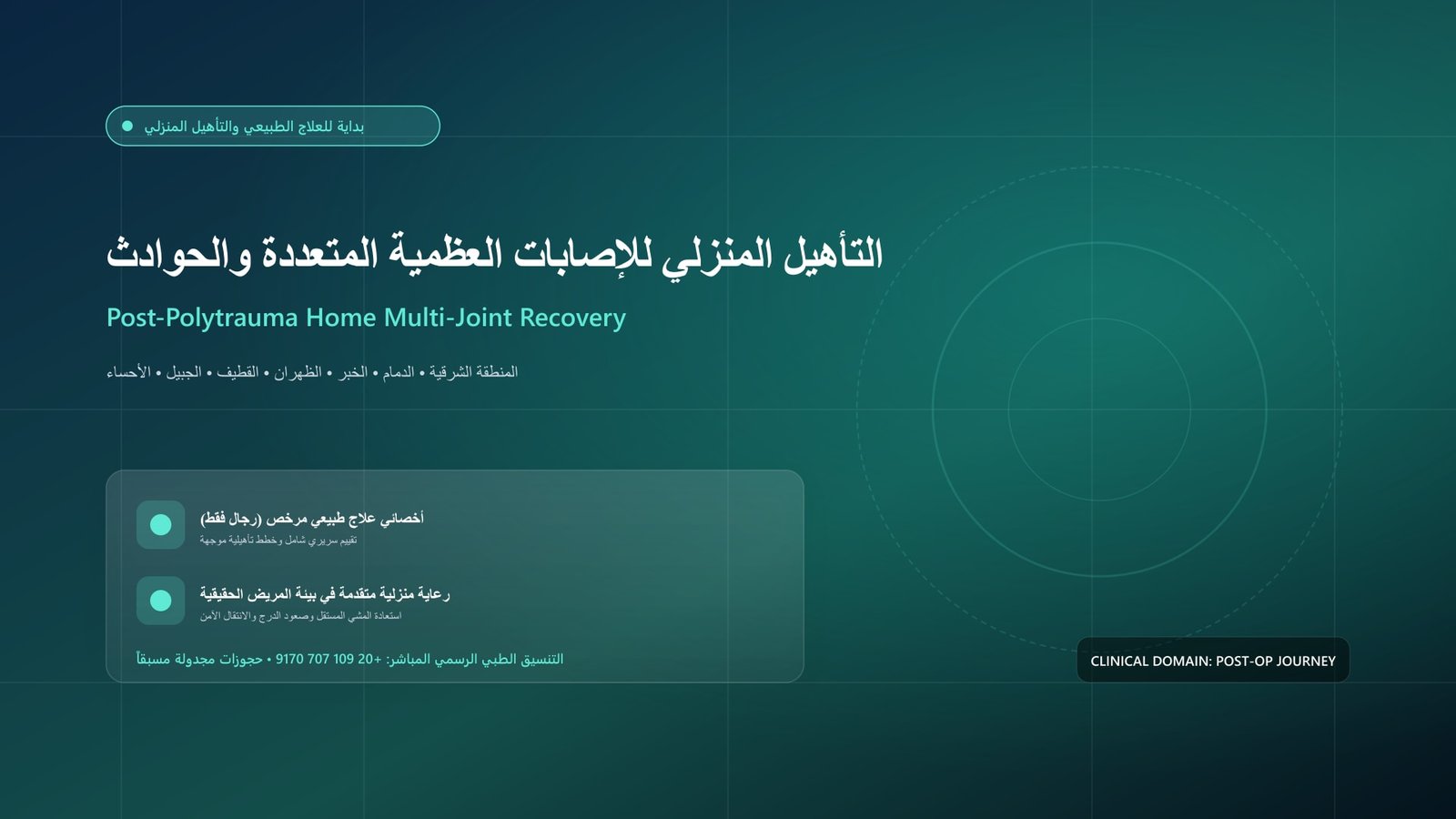
Advanced In-Home Physiotherapy for Polytrauma & Complex Multi-Joint Injuries
Evidence-based post-operative rehabilitation delivered directly to your doorstep in Dammam, Khobar, and Eastern Province cities with maximum privacy and clinical rigor.
Comprehensive In-Home Clinical Evaluation (60-75 Mins)
Detailed functional & neuro examination, home safety audit, and custom protocol with portable equipment — no upfront package commitments.
Flexible appointments 7 days a week (8 AM - 10 PM) • Payment upon visit completion
1,500+ Successful Home Recoveries
Certified Clinical Physiotherapists
Assessment-First Protocol
Thorough physical evaluation before any treatment plan starts
Specialized Male Therapists
Professional licensed therapists visiting your residence
100% In-Home Rehabilitation
No clinic travel friction or waiting room discomfort
Targeted Functional Goals
Focused on daily stairs, walking endurance, and independence
Emergency Medical Red-Flags & Home Care Boundaries
In-home post-operative therapy is strictly intended for stable conditions. If acute chest pain, sudden dyspnea, or active hemorrhage occurs, contact emergency medical services immediately.
Survivors of high-velocity vehicular collisions and industrial trauma across the Eastern Province frequently sustain complex polytrauma—multiple concurrent fractures involving the pelvis, spine, and upper/lower extremities. When conventional weight-bearing and standard crutch walking are restricted across multiple limbs, home rehabilitation demands advanced clinical problem-solving. Bidaya delivers coordinated, multi-limb in-home rehabilitation via certified male physical therapists.
Clinical Biomechanics & Advanced Tissue Pathology for (Post-Polytrauma & Multi-Fracture Home Recovery)
Pathomechanical Analysis, Tissue Failure Mechanisms, and Kinetic Chain Compromise
Residential rehabilitation for Post-Polytrauma & Multi-Fracture Home Recovery delivered by Bidaya across Eastern Province targets the delicate biomechanical balance governing multi-segmental fractured skeletal anatomy, bilateral upper/lower extremities, pelvic ring, and cardiopulmonary system. This pathology manifests primarily through high-energy polytrauma, discordant multi-limb weight-bearing restrictions, critical illness myopathy, and prolonged immobilization.
When structural integrity degrades, force attenuation capacity diminishes, transmitting unmanaged kinetic stress into inability to utilize standard axillary/forearm crutches, compromised vital capacity, and severe total caregiver dependence. Over time, defensive neuromuscular splinting restricts functional movement excursion, provoking daily fatigue, joint stiffness, and compensatory gait alterations throughout domestic routines.
Demanding lifestyle realities in the Eastern Province—such as prolonged vehicular commutes across Dammam-Khobar expressways and long hours at desktop workstations—aggravate these mechanical deficiencies. Bidaya's specialized in-home physiotherapy protocols decompress irritated articulations, re-educate dynamic stabilizers, and restore functional mobility within the comfort and privacy of the patient's residence.
Early clinical mobilization and structured in-home therapeutic exercise protocols prevent maladaptive compensations, restoring physiological movement confidence and supporting long-term musculoskeletal longevity.
Rehabilitation research confirms that restoring synchronized muscular force-couples serves as the primary defense against recurrent strain during extended highway driving and sustained desk work. Our evidence-based protocols systematically reactivate dormant stabilizer sleeves, building enduring musculoskeletal resilience. Furthermore, supervised home clinical intervention establishes early neuromuscular control, systematically attenuating nociceptive input and optimizing functional mobility across all domestic environments.
Comprehensive Residential Clinical Evaluation & Diagnostic Battery for (Post-Polytrauma & Multi-Fracture Home Recovery)
Standardized Goniometry, Manual Muscle Testing, and Specialized Provocation Maneuvers
Bidaya deploys an evidence-based clinical evaluation framework in Eastern Province administered by a licensed male physical therapist: 1. Arthrokinematic glide and capsular flexibility assessment isolating mechanical restrictions and joint crepitus. 2. Functional angular measurement during sitting, standing, and transitional maneuvers compared against normative standards. 3. Provocation maneuver battery establishing precise tissue irritability thresholds to guide initial exercise dosage. 4. Muscular endurance testing evaluating the patient's ability to sustain daily domestic tasks without fatigue.
In-home evaluation provides authentic clinical insight into movement bottlenecks that clinical rooms cannot replicate. Therapists bring modern diagnostic inclinometers, dynamometers, and testing tools to ensure thorough clinical screening at your bedside. Patients receive a definitive diagnostic summary outlining targeted milestones and expected recovery timelines.
This thorough evaluation provides patients and families with a clear, reassuring trajectory outlining anticipated recovery milestones and therapeutic timeframes. Transparent clinical guidance alleviates anxiety, establishing an empowering atmosphere conducive to rapid physical reconditioning. Recording granular clinical metrics during each home visit provides an objective benchmark for therapeutic progression, verifying steady functional recovery and patient physical resilience.
Precision Objective Documentation
Establishing quantified baseline metrics during the initial home visit enables precise outcome measurement, allowing clinicians to modulate load parameters in direct alignment with biological tissue healing rates.
| Clinical Assessment / Provocation Test | Diagnostic Target | Positive Clinical Indicator | Portable Clinical Instrumentation |
|---|---|---|---|
| Multi-Limb Weight-Bearing Priority Matrix Audit | Review surgical directives across all injured limbs to reconcile discordant weight-bearing tiers | Constructing a coherent movement blueprint respecting bone healing across all trauma sites | Comprehensive clinical audit |
| Forearm Platform Walker Adaptation Screen | Assess ability to bear axial loads through forearms when concurrent wrist/hand fractures exist | Stable, upright stance without transmitting compressive forces across fractured carpal/radial zones | Assistive device evaluation |
| Orthostatic Hemodynamic Tolerance Screen | Monitor blood pressure, heart rate, and oxygen saturation before, during, and post-verticalization | Hemodynamic equilibrium maintained without symptomatic orthostatic hypotension during standing | Continuous physiological screen |
Evidence-Based Rehabilitation Protocol & Progressive Loading Phases for (Post-Polytrauma & Multi-Fracture Home Recovery)
Multi-Tiered Care Plan Combining Manual Therapy, Neuromuscular Stabilization, and Kinetic Chain Reconditioning
Our home rehabilitation methodology for (Post-Polytrauma & Multi-Fracture Home Recovery) corrects mechanical alignment through four sequential clinical tiers: - Tier 1: Alleviating mechanical stress on multi-segmental fractured skeletal anatomy, bilateral upper/lower extremities, pelvic ring, and cardiopulmonary system and achieving resting comfort in seated and lying postures. - Tier 2: Releasing tissue adhesions and promoting tendon-bone gliding through safe therapeutic stretches. - Tier 3: Dynamic stabilizer recruitment building muscular stamina against repetitive daily physical stresses. - Tier 4: Demanding transfer retraining and prolonged outdoor walking with total postural stability.
Advancement criteria demand zero exercise-induced soreness and restored manual muscle testing scores.
These structured tiers build robust self-efficacy, allowing patients to navigate everyday routines with ease and comfort.
Advancement benchmarks require complete absence of exercise-induced soreness and verified recovery of manual muscle strength across targeted muscle groups. Fulfilling these criteria confirms underlying kinetic links possess the endurance needed for independent function. Adherence to evidence-based mechanotransductive staging shields vulnerable articulations while steadily building functional physical endurance across everyday residential tasks.
Safe Therapeutic Loading Rules
Therapeutic exercise discomfort must remain at or below 3/10 during execution and must completely subside to baseline within 60 minutes post-session.
- Constructing a multi-fracture clinical matrix coordinating distinct weight-bearing tiers across each extremity
- Deploying forearm platform walkers enabling vertical ambulation without loading fractured wrist/hand bones
- Phased whole-body reconditioning, thoracic expansion breathing, and multi-assistant domestic transfers
- Coordinated caregiver training instructing family assistants on synchronized ergonomic support mechanics
Step-by-Step Prescribed Residential Exercise Protocol for (Post-Polytrauma & Multi-Fracture Home Recovery)
Detailed Guidance on Movement Execution, Biomechanical Form, Respiratory Timing, and Safe Progression Criteria
To optimize functional gains while safeguarding healing structures in (Post-Polytrauma & Multi-Fracture Home Recovery), our visiting clinician directly supervises the following home exercise protocol:
1. Restorative Tissue Decompression & Activation: Forearm platform walker standing: rest forearms on padded platform gutters, push through torso and cleared lower limb to rise upright, sustaining standing 30 seconds with deep breathing, 3 reps.
2. Capsular Extensibility & Muscle Lengthening: Recumbent thoracic expansion sequence: semi-recumbent, taking deep diaphragmatic inspiration while activating free extremities, exhaling slowly with abdominal contraction, 10 reps every 2 hours.
3. Progressive Dynamic Stabilization & Neuromuscular Coordination: Non-injured extremity conditioning: gentle active-resistive movements targeting uninjured limbs to promote systemic circulation, cross-education neuroplasticity, and metabolic vitality, 10 reps, 2 sets.
Clinicians fine-tune body alignment, cue diaphragmatic breathing, and structure individualized rest intervals ensuring exercises stimulate remodeling without overload.
Movement precision and movement quality supersede repetition volume; patients are advised to stop immediately and alert their therapist should sharp atypical discomfort occur.
Therapeutic movements are systematically integrated into your domestic rhythm, ensuring each exercise directly facilitates easier bed transfers, smoother prayer transitions, and effortless household mobility.
Our visiting specialist regulates movement tempo to activate deep postural stabilizers, avoiding rapid rebounding motions that fatigue healing tissues. Controlled deceleration trains eccentric muscular capacity, providing vital joint protection during daily tasks. Disciplined independent execution under periodic clinical review reinforces positive biomechanical adaptations, permanently eliminating compensatory strain from daily physical routines.
- Avoid hazardous mechanical vectors, particularly: unauthorized loading across restricted limbs, single-unassisted transfers, and neglecting hemodynamic monitoring
- Execute all prescribed drills on a firm, supportive mat rather than excessively plush beds or sofas
- Maintain steady diaphragmatic respiration, strictly avoiding Valsalva breath-holding during exertion
- Log exercise tolerance and any transient symptoms for review during subsequent visits
Domestic Environmental Ergonomics & Joint Protection Strategies across Eastern Province
Actionable Adjustments for Prayer Postures, Majlis Seating, and Extended Eastern Province Commuting
In-home physical therapy integrates practical environmental modifications tailored to Eastern Province residences in Eastern Province: - Prayer Biomechanics: Coaching joint-sparing transitional postures during Ruku and Sujud, introducing supportive stools when clinically warranted. - Majlis Seating: Elevating seat bases with firm cushions to prevent lumbar and hip hyperflexion that overloads periarticular tissues. - Expressway Commuting: Adjusting car seat lumbar bolsters and steering distance to absorb road vibration along Eastern Province highways. - Nocturnal Support: Recommending ergonomic mattresses and pillow arrangements to ensure neutral spinal alignment throughout the night.
Visiting clinicians inspect your living space to offer immediate adjustments for hallways, stairs, and bathrooms, establishing a safe healing environment.
Integrating these ergonomic refinements into your residential routine provides round-the-clock musculoskeletal protection. By eliminating subconscious postural strains during leisure, dining, and prayer, healing tissues repair rapidly, establishing a robust defense against long-term symptom recurrence.
Our therapist delivers these practical recommendations with professional care, respecting Eastern Province domestic traditions to ensure seamless long-term adherence. Tailoring modifications to cultural lifestyle realities guarantees sustained compliance and practical domestic comfort. Cultivating joint-sparing habits during daily domestic tasks protects healing periarticular tissues, ensuring functional improvements achieved during therapy remain durable across years.
- Arrange an expansive ground-floor bedroom near bathroom facilities accommodating wide platform walker widths
- Provide an adjustable electric hospital bed permitting head elevation and variable height transfer mechanics
- Structure a paced daily schedule alternating short mobility bouts with restorative seated and recumbent rest
- Display emergency contact numbers and Bidaya clinical team lines prominently for rapid coordination
Quantitative Clinical Discharge Criteria & Long-Term Joint Longevity for (Post-Polytrauma & Multi-Fracture Home Recovery)
Evidence-Based Benchmarks Confirming Restored Functional Independence and Lasting Musculoskeletal Health
Bidaya enforces rigorous, quantitative clinical discharge criteria ensuring patients conclude therapy with verified structural robustness: 1. Pain Modulation Benchmark: Consistently scoring below 2/10 on the Visual Analog Scale throughout the most strenuous daily routines. 2. Bilateral Strength Symmetry: Demonstrating isolated muscular strength reaching 90-95% of the healthy contralateral limb. 3. Complete Functional Independence: Executing unassisted prayer, stair climbing, vehicle transfers, and sustained walking without hesitation.
Upon graduating, each patient receives an individualized home exercise maintenance pamphlet to preserve long-term muscular balance.
Direct communication channels via our official coordination line (+20 109 707 9170) remain open for ongoing guidance, safeguarding lasting health.
Our definitive discharge benchmarks guarantee that patients transition to independent living with restored structural resilience. Ongoing communication support through Bidaya's dedicated coordination line ensures expert physical therapy guidance is always accessible whenever new functional questions arise.
Graduating patients receive a comprehensive digital discharge summary detailing percentage improvements from baseline, validating restored health and physical autonomy. This objective documentation confirms that your body has achieved genuine structural and functional recovery. Achieving these standardized clinical discharge metrics validates that dynamic stabilization mechanisms operate effectively during all vocational, recreational, and spiritual activities.
Frequently Asked Questions about In-Home Physiotherapy
We deploy platform gutter walkers that allow axial weight to be borne safely through the forearm and elbow, completely bypassing fractured wrist and hand bones.
Related Clinical & Regional Pathways
Post-Surgical Scar Tissue Mobilization & Desensitization→
Evidence-based post-operative rehabilitation delivered directly to your doorstep in Dammam
Post-External Fixator Removal Mobilization & Pin-Site Care→
Evidence-based post-operative rehabilitation delivered directly to your doorstep in Dammam
Post-Operative Red-Flag Protocols & Emergency Safety→
Evidence-based post-operative rehabilitation delivered directly to your doorstep in Dammam
Post-Operative Physiotherapy→
Evidence-based surgical rehabilitation protocols engineered to restore joint range of motion