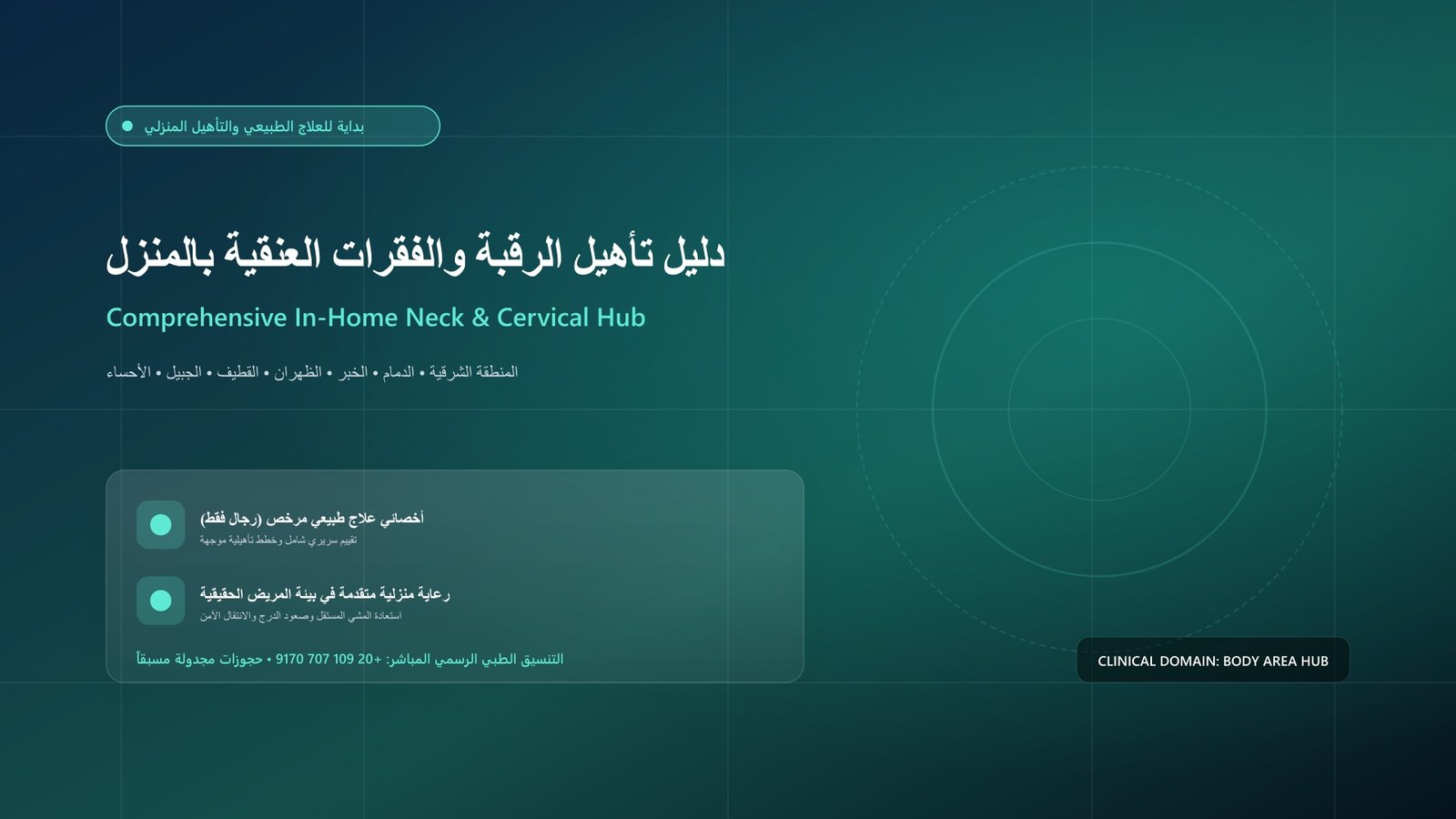
Comprehensive In-Home Neck & Cervical Spine Rehabilitation Hub
Evidence-based clinical rehabilitation delivered directly to your doorstep in Dammam, Al Khobar, Dhahran, and Eastern Province cities with maximum privacy.
Comprehensive In-Home Clinical Evaluation (60-75 Mins)
Detailed functional & neuro examination, home safety audit, and custom protocol with portable equipment — no upfront package commitments.
Flexible appointments 7 days a week (8 AM - 10 PM) • Payment upon visit completion
1,500+ Successful Home Recoveries
Certified Clinical Physiotherapists
Assessment-First Protocol
Thorough physical evaluation before any treatment plan starts
Specialized Male Therapists
Professional licensed therapists visiting your residence
100% In-Home Rehabilitation
No clinic travel friction or waiting room discomfort
Targeted Functional Goals
Focused on daily stairs, walking endurance, and independence
Emergency Medical Red-Flags & Home Care Boundaries
In-home physiotherapy is strictly indicated for medically stable rehabilitation. In the event of acute medical emergencies, contact 997 or visit the nearest emergency facility.
The cervical spine features extraordinary physiological mobility paired with delicate anatomical architecture, supporting the cranial mass across wide visual planes while shielding crucial neurovascular conduits supplying the brain and upper extremities. In today's digital and corporate environment, Eastern Province residents increasingly suffer from postural text-neck strain, cervicogenic headaches, cervical spondylosis, and radicular arm pain stemming from sustained forward head postures during desktop and mobile device use. This Cervical Spine Hub serves as an authoritative clinical directory for in-home neck rehabilitation.
In-home physical therapy offers cervical patients a serene, low-stress recovery setting. By eliminating jarring automobile vibration and stressful highway driving that exacerbate acute neck muscle guarding, Bidaya's certified male physical therapists evaluate cervical excursion, assess deep cervical flexor endurance, and inspect domestic sleeping and desk ergonomics directly inside the patient's home.
Our clinical protocols combine gentle cervical joint mobilization, myofascial trigger point deactivation across the upper trapezius and levator scapulae, and targeted motor control retraining, equipping patients with sustainable movement strategies that prevent recurrent cervical stiffness and restore pain-free head rotation.
Clinical Biomechanics & Advanced Tissue Pathology for (Comprehensive Neck and Cervical Spine Rehabilitation Hub)
Pathomechanical Analysis, Tissue Failure Mechanisms, and Kinetic Chain Compromise
Numerous residents across Eastern Province experience complex functional limitations resulting from Comprehensive Neck and Cervical Spine Rehabilitation Hub. Centered anatomically upon cervical vertebrae, intervertebral discs, brachial plexus nerve roots, and deep cervical flexors, the condition is driven by cervical radiculopathy, disc herniation, upper trapezius spasm, and cervicogenic headaches, impairing the delicate equilibrium between tissue compliance and load attenuation capacity.
This mechanical insufficiency exerts unrelenting stress on sensorimotor mechanoreceptors, interacting unfavorably with upper crossed syndrome, forward head posture, and deep cervical flexor inhibition and manifesting as recurrent episodes of movement apprehension and difficulty executing basic transitions such as rising from bed, deep floor transfers, or bending forward to lift household objects.
Patient functional tolerance is particularly taxed during daily religious observances, where full prayer cycles involving Ruku and Sujud demand peak mechanical integrity from affected structures. Bidaya's licensed male physical therapists deliver home care focusing on movement retraining, manual therapy, and progressive loading that restore load-bearing resilience without provoking pain or kinesiophobic avoidance.
We place dedicated emphasis on patient biomechanical education. Contemporary clinical trials consistently demonstrate that when patients understand the anatomical basis of their dysfunction, adherence to therapeutic exercises improves substantially, driving functional recovery at accelerated rates.
Empirical evidence demonstrates that early clinical mobilization during initial symptomatic stages reorganizes collagen fibril architecture, preventing acute discomfort from consolidating into chronic syndromes. Delivering precise passive and active-assisted movement drills restores capsular pliability without aggravating sensitive mechanoreceptors. Furthermore, supervised home clinical intervention establishes early neuromuscular control, systematically attenuating nociceptive input and optimizing functional mobility across all domestic environments.
Comprehensive Residential Clinical Evaluation & Diagnostic Battery for (Comprehensive Neck and Cervical Spine Rehabilitation Hub)
Standardized Goniometry, Manual Muscle Testing, and Specialized Provocation Maneuvers
Bidaya enforces a detailed home evaluation protocol in Eastern Province assessing motor coordination and muscular endurance: 1. Dynamic load-bearing joint assessment detecting instability or postural deviation under progressive physical stress. 2. Digital inclinometric measurement of active and passive joint angles establishing exact bilateral symmetry. 3. Clinical provocation testing establishing tissue irritability thresholds and guiding precise exercise dosage. 4. Kinematic coordination analysis during chair transfers, stair climbing, and hallway walking.
This domestic clinical examination targets root mechanical causes rather than merely addressing superficial symptoms.
Advanced portable testing gear carried by our clinician ensures diagnostic accuracy matching top-tier rehabilitation facilities.
The session concludes with immediate postural advice optimizing resting positions to foster healing from the very first visit.
Patients receive a clear diagnostic summary outlining treatment milestones and anticipated functional outcomes across upcoming weeks, prioritizing meaningful domestic goals. This individualized roadmap demystifies the rehabilitation pathway, establishing clear expectations for patient and caregiver alike. Recording granular clinical metrics during each home visit provides an objective benchmark for therapeutic progression, verifying steady functional recovery and patient physical resilience.
Precision Objective Documentation
Establishing quantified baseline metrics during the initial home visit enables precise outcome measurement, allowing clinicians to modulate load parameters in direct alignment with biological tissue healing rates.
| Clinical Assessment / Provocation Test | Diagnostic Target | Positive Clinical Indicator | Portable Clinical Instrumentation |
|---|---|---|---|
| Spurling's Cervical Radiculopathy Provocation Test | Detect mechanical cervical nerve root entrapment | Reproduction of sharp radiating arm pain or paresthesia with lateral tilt and axial load | Manual orthopedic test |
| Craniocervical Flexion Endurance Test (CCFT) | Quantify motor control in deep longus colli and longus capitis muscles | Inability to hold target pressures (26-30 mmHg) without superficial muscle substitution | Pressure biofeedback unit |
| Cervical Manual Distraction Decompression Test | Verify symptom relief through neural foramen enlargement | Immediate abolition or reduction of radiating arm symptoms upon gentle axial traction | Standardized manual distraction |
Evidence-Based Rehabilitation Protocol & Progressive Loading Phases for (Comprehensive Neck and Cervical Spine Rehabilitation Hub)
Multi-Tiered Care Plan Combining Manual Therapy, Neuromuscular Stabilization, and Kinetic Chain Reconditioning
Engineered to deliver permanent recovery, Bidaya's residential clinical pathway for (Comprehensive Neck and Cervical Spine Rehabilitation Hub) advances through four systematic biological loading tiers: - Tier 1: Acute tissue preservation and spasm downregulation around cervical vertebrae, intervertebral discs, brachial plexus nerve roots, and deep cervical flexors via gentle manual distraction and positional unloading. - Tier 2: Neuromuscular re-education activating inhibited stabilizer groups and restoring symmetrical force coupling. - Tier 3: Functional capacity expansion subjecting tissues to progressive mechanical load matching authentic daily demands. - Tier 4: Unrestricted domestic reintegration achieving effortless prayer transitions, Sujud, and extended vehicle driving.
Transitioning across tiers demands fulfilling rigorous clinical criteria, confirming genuine structural adaptation and objective strength recovery.
Therapists provide dedicated clinical exercise gear for home use, personally coaching biomechanical form to guarantee hospital-grade rehabilitation in residential comfort.
Each therapeutic tier is engineered to restore optimal load distribution across affected joints and adjacent kinetic segments. This comprehensive conditioning protocol permanently eliminates compensatory movement habits, shielding healing tissues from repetitive mechanical strain.
Our visiting therapist closely monitors exercise tolerance to ensure progressive loading accurately reflects individual healing rates and functional adaptability. Calibrating resistance to match tissue remodeling ensures steady functional improvement without setbacks. Adherence to evidence-based mechanotransductive staging shields vulnerable articulations while steadily building functional physical endurance across everyday residential tasks.
Safe Therapeutic Loading Rules
Therapeutic exercise discomfort must remain at or below 3/10 during execution and must completely subside to baseline within 60 minutes post-session.
- Cervical retraction (chin tuck) drills restoring anatomical alignment and neural decompression
- Targeted stretching for hypertonic upper trapezius and levator scapulae muscle sleeves
- Deep cervical flexor endurance reconditioning utilizing biofeedback guidance
- Scapular stabilization drills correcting forward head posture during digital work
Step-by-Step Prescribed Residential Exercise Protocol for (Comprehensive Neck and Cervical Spine Rehabilitation Hub)
Detailed Guidance on Movement Execution, Biomechanical Form, Respiratory Timing, and Safe Progression Criteria
To optimize functional gains while safeguarding healing structures in (Comprehensive Neck and Cervical Spine Rehabilitation Hub), our visiting clinician directly supervises the following home exercise protocol:
1. Restorative Tissue Decompression & Activation: Seated chin tuck retraction: sitting tall, gliding chin horizontally straight backward without nodding, holding 5 seconds for 12 reps.
2. Capsular Extensibility & Muscle Lengthening: Upper trapezius stretch: tilting ear toward opposite shoulder while anchoring involved shoulder downward, holding 20 seconds, 3 reps per side.
3. Progressive Dynamic Stabilization & Neuromuscular Coordination: Submaximal isometric cervical stabilization: pressing forehead gently against stationary hand palm without head motion, holding 8 seconds for 8 reps.
Clinicians fine-tune body alignment, cue diaphragmatic breathing, and structure individualized rest intervals ensuring exercises stimulate remodeling without overload.
Movement precision and movement quality supersede repetition volume; patients are advised to stop immediately and alert their therapist should sharp atypical discomfort occur.
Therapeutic movements are systematically integrated into your domestic rhythm, ensuring each exercise directly facilitates easier bed transfers, smoother prayer transitions, and effortless household mobility.
Our visiting specialist regulates movement tempo to activate deep postural stabilizers, avoiding rapid rebounding motions that fatigue healing tissues. Controlled deceleration trains eccentric muscular capacity, providing vital joint protection during daily tasks. Disciplined independent execution under periodic clinical review reinforces positive biomechanical adaptations, permanently eliminating compensatory strain from daily physical routines.
- Avoid hazardous mechanical vectors, particularly: aggressive neck circumduction with extension and cradling phone receivers between ear and shoulder
- Execute all prescribed drills on a firm, supportive mat rather than excessively plush beds or sofas
- Maintain steady diaphragmatic respiration, strictly avoiding Valsalva breath-holding during exertion
- Log exercise tolerance and any transient symptoms for review during subsequent visits
Domestic Environmental Ergonomics & Joint Protection Strategies across Eastern Province
Actionable Adjustments for Prayer Postures, Majlis Seating, and Extended Eastern Province Commuting
In-home physical therapy is integrated with practical environmental modifications tailored to residential architecture across Eastern Province: - Prayer Biomechanics: Training safe transitional mechanics during Ruku and Sujud, introducing temporary supportive seating when indicated while preserving joint engagement. - Transfers and Seating: Coaching hip-hinge sit-to-stand transitions powered by gluteal strength, avoiding soft low sofas that overload irritable tissues. - Highway Commuting: Adjusting vehicular lumbar and cervical angles to dissipate road vibration along Eastern Province expressways. - Sleep Ergonomics: Recommending orthopedic mattresses and supportive pillow placement to preserve neutral musculoskeletal alignment without focal pressure.
Visiting therapists inspect the immediate residential layout to provide immediate ergonomic recommendations concerning hallway pathways, bed mattress heights, and bathroom grab rails, safeguarding against repetitive movement fatigue.
Domestic environmental ergonomics are continuously refined during subsequent home visits as functional capacity improves. Our clinicians provide actionable strategies for navigating multi-story residential stairs, kitchen workstations, and leisure activities, ensuring your living space actively reinforces clinical gains.
Visiting therapists survey your actual domestic layout to offer immediate ergonomic recommendations for hallway navigation, bed heights, and supportive seating. Implementing these practical environmental adjustments transforms your residence into an active healing environment supporting recovery. Cultivating joint-sparing habits during daily domestic tasks protects healing periarticular tissues, ensuring functional improvements achieved during therapy remain durable across years.
- Elevate computer screens and smartphones directly to eye level to eliminate neck flexion
- Utilize a contoured orthopedic pillow preserving neutral cervical curvature during sleep
- Take structured 2-minute posture breaks every 30 minutes of sustained screen usage
- Adjust vehicle head restraints to contact the posterior cranium, dampening road vibration
Quantitative Clinical Discharge Criteria & Long-Term Joint Longevity for (Comprehensive Neck and Cervical Spine Rehabilitation Hub)
Evidence-Based Benchmarks Confirming Restored Functional Independence and Lasting Musculoskeletal Health
We define rigorous clinical discharge criteria confirming complete biological healing and restored functional movement capacity: 1. Complete Physiological Range: Demonstrating 100% active and passive joint excursion compared to the healthy contralateral side. 2. Enduring Mechanical Resilience: Lifting daily household items and traversing stairs with fluid confidence and zero fatigue. 3. Lasting Pain Resolution: Consistently scoring zero on visual analog pain scales during both rest and daily exertion.
Patients receive a customized self-management plan tailored to their vocational and household routine to prevent recurrent strain.
Our clinical staff remains available through official channels to offer continuous advice, safeguarding your active lifestyle.
Our clinical staff delivers a customized long-term care plan tailored to your vocational and domestic routine, preventing strain and supporting active living. Sustainable movement habits protect joints from repetitive strain during both work and recreational pursuits. Achieving these standardized clinical discharge metrics validates that dynamic stabilization mechanisms operate effectively during all vocational, recreational, and spiritual activities.
Frequently Asked Questions about In-Home Physiotherapy
Deactivating suboccipital myofascial trigger points and restoring upper cervical arthrokinematics (C1-C2) definitively resolves headache symptoms.
Related Clinical & Regional Pathways
Specialized Shoulder Rehabilitation→
Evidence-based clinical rehabilitation delivered directly to your doorstep in Dammam
Specialized Back & Spine Rehabilitation→
Evidence-based clinical rehabilitation delivered directly to your doorstep in Dammam
Specialized Elbow Rehabilitation→
Evidence-based clinical rehabilitation delivered directly to your doorstep in Dammam
Specialized Cervical Neck Pain & Stiffness→
Evidence-based cervical spine rehabilitation delivered directly to your doorstep in Dammam
Specialized Cervical Radiculopathy→
Evidence-based cervical spine rehabilitation delivered directly to your doorstep in Dammam
Specialized Text Neck Syndrome & Postural Strain→
Evidence-based cervical spine rehabilitation delivered directly to your doorstep in Dammam
Specialized Cervicogenic Headache Rehabilitation→
Evidence-based cervical spine rehabilitation delivered directly to your doorstep in Dammam
Specialized Neck Rotation Limitation & Acute Wry Neck→
Evidence-based cervical spine rehabilitation delivered directly to your doorstep in Dammam